Tag: Industry News

  • Walk-Behind Snow Equipment Dealer Starter Packages: What to Stock First

    Walk-Behind Snow Equipment Dealer Starter Packages: What to Stock First

    KINGO ANDA dealer stocking notesRequest a dealer starter package

    Industry Products / Dealer Stocking

    Walk-Behind Snow Equipment Dealer Starter Packages: What to Stock First

    A dealer stocking guide for walk-behind snow equipment starter packages, covering power units, attachments, wear parts, documents and demo support.
    Published Aug. 7, 2026Dealer InventorySnow Equipment Packages
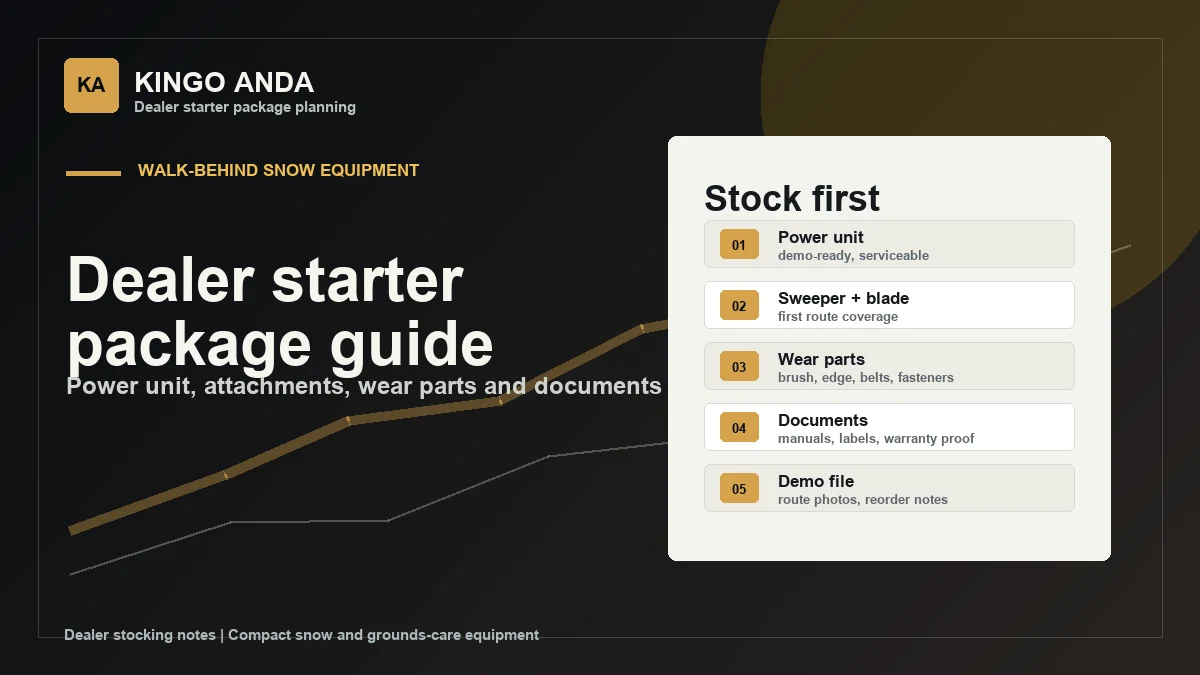
    Dealer starter package board for walk-behind snow equipment with power unit attachments parts and documents

    Dealers do not need a warehouse full of winter equipment to look prepared. In 2026, the better question is whether the first starter package can be demonstrated, supported and reordered without confusion. A compact snow equipment line should help a dealer answer real route questions, not simply add another group of machines to the floor.

    That distinction matters because equipment dealers are still managing inventory carefully. The 2026 dealer outlook coverage from Farm Equipment and Upstream points to a market where many dealers are more disciplined about new and used stock than they were during the previous supply swing. Snow and grounds-care buyers are also researching earlier in the year. Snow Plow News’ 2026-2027 media planning notes show that contractor, fleet and municipal decision-makers keep looking for equipment information outside the first snowfall window.

    For KINGO ANDA dealers, the practical response is a tighter starter package: one clear walk-behind power unit platform, the right first attachments, a starter wear-parts set, documents and a demo file that sales and service can both use.

    Start with a small, supportable package

    The first order should be narrow enough for a dealer to explain in five minutes and support in one service call. A good starter package normally begins with the power unit, one snow sweeper, one blade, a small set of wear parts, operator documents and a quote sheet that lists the package as a system. More attachments can come later, after the dealer knows which route problems are common in the market.

    This is where a compact two-wheel platform earns its place. The dealer can show one engine and handle system, then move the conversation toward winter or grounds-care attachments. But that flexibility should not turn into a confusing first quote. If every attachment is presented at once, the buyer sees a catalog. If the first package solves the first winter route, the buyer sees a program.

    Stock around the first winter route problem

    Most compact snow equipment buyers ask practical questions before they ask technical ones. Will it clear a sidewalk after light snow? Will it move slush near a storefront? Can it work around bollards, entrances, campus paths, apartment walks or municipal corners? Those questions decide which attachments belong in the first dealer package.

    A snow sweeper is often the clean first demonstration for light snow, slush, dusting and sensitive paved areas. A snow blade gives the dealer a simple visual answer for straight-line pushing and quick clearing. A compact thrower can be introduced where snow needs to be cast away from doorways, curbs or fence lines. The point is not to claim that one attachment fits every condition. The point is to make the dealer’s first package match the buyer’s first route.

    Put wear parts and documents in the same order

    The common stocking mistake is selling the machine and delaying the support file. That creates trouble when the first brush wafer wears down, a scraper edge is damaged, a belt needs replacing, or the buyer asks for a manual before approval. A starter package should include the machine, the attachment and the paperwork that keeps the dealer from chasing basic information during winter.

    Package itemWhat to stock firstWhy it matters
    Power unitOne demo unit plus one sale-ready unit where budget allows.Keeps the showroom unit from being pulled into customer inventory.
    Snow sweeperBrush wear items, belt or drive notes, fasteners and setup photos.Supports the most visible light-snow and slush demo.
    Snow bladeScraper edge, skid shoes, mount hardware and route-use notes.Makes simple sidewalk and entrance clearing easier to quote.
    DocumentsManuals, parts list, warranty path, serial label and carton notes.Reduces buyer friction for dealer, OEM and municipal review.

    For parts planning, connect the starter package to the parts and service workflow at the quote stage. A buyer does not need a large parts counter on day one, but they do need to know what wears, what is in stock, what is special-order and who receives a service photo when something fails.

    Keep demo units separate from sale inventory

    Equip Exposition’s 2026 programming places dealer operations, education and business discipline beside the product show floor. That is the right framing for compact equipment. A demo unit is not just a machine. It is a controlled sales asset with photos, route notes, operator feedback and a service record.

    Dealers should mark one package as the demo set and protect it from being casually sold out of stock. That demo set should have clean photos, a short walk-around video, attachment-change notes, a spare-parts list and a simple route story. The sale inventory can then remain clean, packed and ready. When a contractor or municipal buyer asks for proof, the dealer can show the demo record without opening a new carton.

    A starter package should make the dealer easier to trust: clear product, clear route use, clear parts support and clear documents.

    Build the RFQ file before the buyer asks

    A dealer-ready RFQ file should contain the power unit, attachment set, target route, package quantity, spare parts, labels, manuals, warranty notes and expected delivery window. If the buyer is an OEM or private-label customer, add model naming, serial label rules and carton artwork requirements before price approval. If the buyer is a municipal or property-maintenance team, add route width, snow type, pavement condition and operator needs.

    KINGO ANDA can support dealers by turning the product range into starter packages that are easier to quote. The next step is not to stock everything. It is to build a first package that sales can demonstrate, service can support and buyers can approve without guessing.

    Plan a dealer starter package.

    Send market, buyer type, target attachment set, expected volume and support-document needs. KINGO ANDA can prepare the catalog and quote path.

    Request Quote Path

    Editorial references: Upstream 2026 dealer outlook analysis, Farm Equipment 2026 dealer outlook preview, Snow Plow News 2026-2027 media guide note and Equip Exposition 2026. Image source: locally generated KINGO ANDA editorial graphic, owned site asset.
  • Compact Snow Equipment Maintenance Checklist for Municipal Sidewalk Routes

    Compact Snow Equipment Maintenance Checklist for Municipal Sidewalk Routes

    KINGO ANDA municipal route notesRequest a compact snow package

    Industry News / Municipal Routes

    Compact Snow Equipment Maintenance Checklist for Municipal Sidewalk Routes

    A municipal buyer checklist for compact snow equipment maintenance, attachment inspection, route proof and dealer support before winter routes begin.

    Published Aug. 6, 2026Sidewalk RoutesPreseason Maintenance
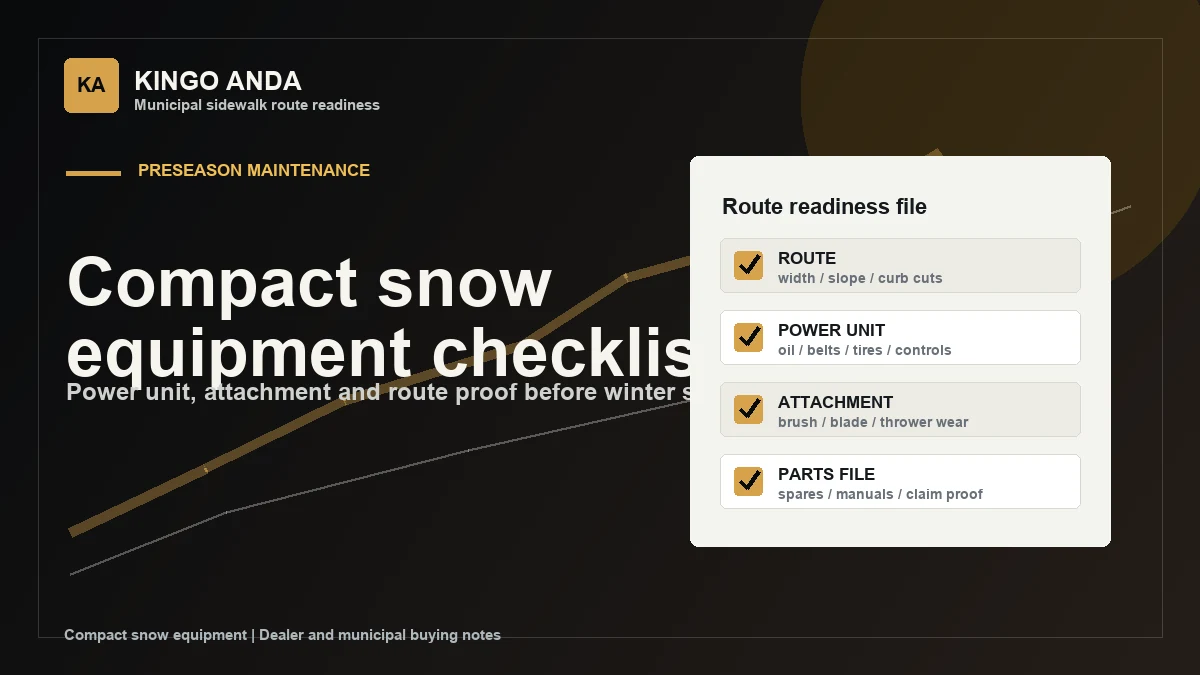
    Municipal sidewalk snow equipment maintenance checklist for compact walk-behind routes

    By early August, winter equipment buying is no longer theoretical. Municipal councils are already approving plow trucks, public works departments are opening vendor registration, and school districts are asking snow contractors to list the equipment they can put on site. That timing matters for compact sidewalk equipment. The small machine that clears a library entrance, a campus path or a downtown curb ramp usually fails a route before it fails mechanically.

    The maintenance checklist for compact snow equipment therefore has to begin with the route. A dealer or municipal buyer should not only ask whether a walk-behind power unit starts and whether a sweeper turns. They should ask whether the package has enough width, traction, wear parts, lighting, service notes and documentation to survive the first week of winter calls.

    KINGO ANDA’s compact line is built around that buying logic: one walk-behind power unit can support snow and grounds-care attachments, but each winter route still needs a disciplined preseason inspection file.

    Start with the route, not the machine

    Public works snow operations show why route discipline matters. Cedar Rapids describes a snow program that moves across more than 1,400 lane miles with a mixed fleet, material staging and route priorities. Virginia Beach’s FY26 winter plan breaks its operation into 30 routes and puts equipment checks inside the operator rules. Those documents are for larger fleets, but the lesson travels well to compact sidewalk work: the machine is only useful when it matches a known route.

    For sidewalk equipment, that means measuring clear width, curb cuts, ramps, tree wells, bollards, bus stops, bridge decks, protected bike-lane segments and storage turns before locking a package. A sweeper may be the right first pass on light snow and slush. A blade may be quicker on a straight paved path. A compact thrower may earn its place where snow needs to be moved away from doorways or curb lines. Dealers should turn those route notes into an RFQ attachment, not leave them buried in email.

    Inspect the power unit before the first cold start

    The power unit check should be boring and repeatable. Confirm engine oil, fuel condition, air filter, belts, cables, throttle response, tire condition, wheel fasteners, handle controls and emergency stop behavior before a machine is offered for a municipal demo or contractor route. If the unit has been used for warm-season attachments, clean the coupling area and check that the attachment interface has not been damaged by tilling, mowing or transport.

    Cold-start confidence is not only about the engine. The buyer should know where the unit will be stored, whether the operator can load it safely, which spare belt or control cable belongs in the first kit, and who receives the service photo when something feels wrong. A compact power unit is often sold as a simple platform; in winter it becomes a schedule-critical tool.

    Check attachment wear before ordering spares

    Attachments deserve their own inspection list. On a snow sweeper, inspect brush wear, shaft alignment, belt or drive condition, shield fasteners and any height adjustment points. On a snow blade, check the scraper edge, skid shoes, trip or angle mechanism, mount points and curb-contact wear. On a compact thrower, review skid shoes, chute movement, belts and shear or wear items where the design uses them.

    The dealer should turn that inspection into a stocking note. A good quote does not simply say “one sweeper package.” It lists the attachment, working width, power unit match, expected wear items, starter spare parts, operator notes and replacement lead time. That makes the winter support conversation much cleaner when a city, campus or property manager is comparing suppliers.

    Checklist areaWhat to confirmWhy it belongs in the quote file
    Route proofClear width, ramps, curb cuts, slopes, tight turns and storage points.Prevents a package from being oversized or under-equipped.
    Power unitCold start, controls, tires, belts, cables and coupling area.Separates machine readiness from attachment choice.
    AttachmentBrush, blade, thrower, mount and wear-item condition.Shows what the buyer must maintain during the season.
    Support fileManuals, parts list, service contact, photos and warranty evidence.Keeps winter support from becoming a chain of unclear messages.

    Make the quote easy for public works buyers to approve

    Current public procurement signals point in the same direction: buyers want proof, not brochure language. Edwardsville’s August council agenda ties winter use to a specific equipment purchase. Prince George’s County opened 2026-2027 snow-season vendor opportunities in July. School and municipal bid packages commonly ask contractors to list equipment and personnel. Even when KINGO ANDA is supplying dealers rather than bidding directly, the dealer still needs a file that a public buyer can read quickly.

    A useful quote page should therefore include product model, route use case, attachment set, working width, spare-parts starter kit, service documents, carton or label notes, warranty path and expected delivery timing. If private-label or OEM supply is involved, add serial labels, manual language and package artwork to the same file. A buyer should not have to chase basic evidence after price is discussed.

    The maintenance checklist is not paperwork. It is the buyer’s proof that a compact machine, attachment and support path are ready for a route.

    Where KINGO ANDA fits in a preseason package

    KINGO ANDA dealers can use the product range to build a compact route package around the power unit, sweeper, blade and other attachments. The buying conversation should then move to dealer support, parts and service, and the evidence needed for municipal, campus or property-maintenance approval.

    For a serious preseason inquiry, send the route width, snow type, pavement condition, buyer type, expected annual volume, target attachment set and required documents. KINGO ANDA can prepare the right catalog path, spare-parts note and quote structure for the dealer or OEM buyer.

    Build a sidewalk route package.

    Send route notes, buyer type, attachment set and support-document requirements. KINGO ANDA can prepare a compact snow equipment quote path.

    Request Quote Path

    Editorial references: Edwardsville equipment agenda, Prince George’s County snow-season vendor notice, Cedar Rapids snow and ice control notes and Virginia Beach FY26 winter maintenance plan. Image source: locally generated KINGO ANDA editorial graphic, owned site asset.
  • Serial Labels, Carton Photos and Warranty Evidence for OEM Snow Equipment Orders

    Serial Labels, Carton Photos and Warranty Evidence for OEM Snow Equipment Orders

    KINGO ANDA OEM evidence notesRequest an order evidence pack

    Industry News / OEM Support

    Serial Labels, Carton Photos and Warranty Evidence for OEM Snow Equipment Orders

    An OEM buyer guide to serial labels, carton photos, QC proof and warranty evidence for compact snow equipment orders before winter shipment.

    Published July 30, 2026OEM OrdersWarranty Evidence
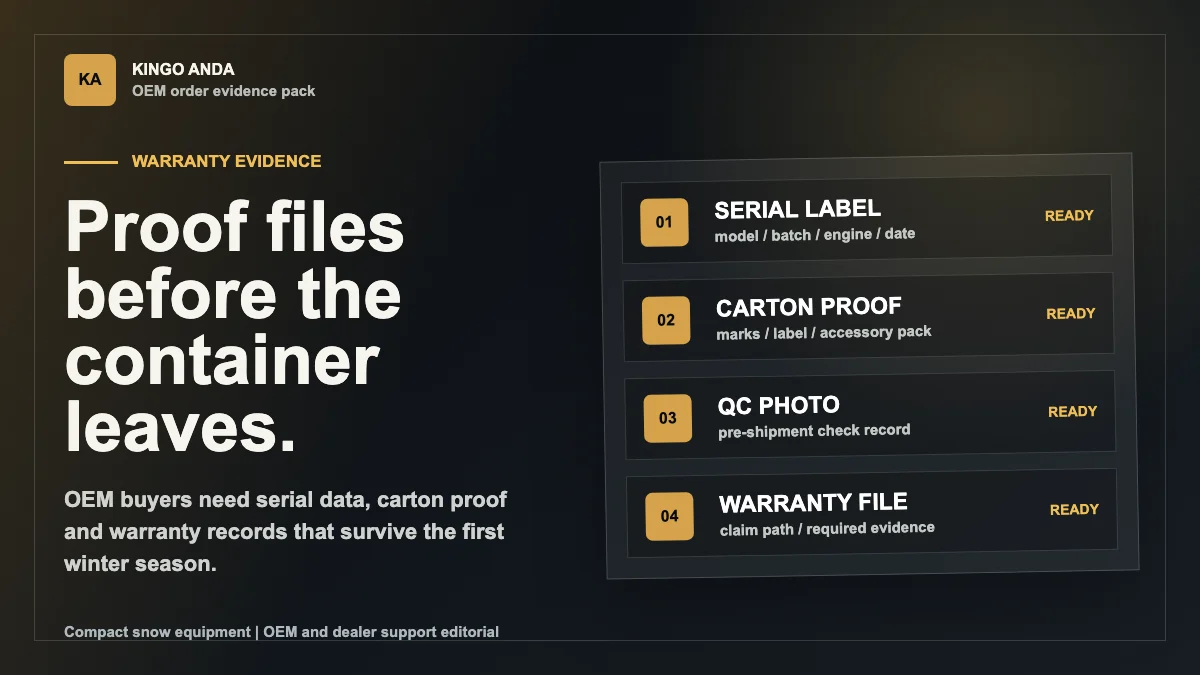
    OEM snow equipment order evidence board with serial labels carton photos and warranty files

    In a compact snow equipment order, warranty trouble usually starts long before a failed part arrives at the dealer counter. It starts when nobody can prove which carton held the machine, which serial label was applied, which accessory pack shipped with it, or whether the customer photo shows a warrantable issue or a wear item that should have been stocked separately.

    That is why OEM and dealer buyers should treat serial labels, carton photos and warranty evidence as part of the buying file, not as clerical work after production. A clean evidence pack gives the importer, dealer and end user the same reference point when winter service questions arrive.

    For KINGO ANDA’s compact snow line, the issue is practical. A buyer comparing a multifunction power unit, snow sweeper, snow blade or compact thrower should also ask how the order will be identified, photographed and supported after delivery. The machine may be simple; the support trail cannot be vague.

    Why traceability is moving into ordinary equipment orders

    The language around traceability is no longer limited to food, batteries or regulated consumer goods. In 2026, the broader manufacturing conversation is shifting from visibility to verifiability. PSQR’s 2026 traceability review describes a market where companies are expected to prove product information, not only know where goods moved. QT9 explains the operational side in plain terms: each product or component receives a unique machine-readable identification, then events are logged against that identifier through the process.

    A compact snow equipment dealer does not need a complex global compliance system to learn from that direction. The first step is more basic: every machine and major attachment should be easy to identify by model, batch, order, carton and dealer shipment. When that information is visible on labels and matched to photos, warranty handling becomes less dependent on memory.

    Equipment brands already make this expectation visible in support rules. Buyers Products’ SnowDogg warranty procedure asks for proof of purchase, maintenance records and dealer involvement, and its spreader warranty process calls for information such as model, serial number, date installed and distributor. Briggs & Stratton tells owners to use documentation or manuals to determine warranty coverage and notes that authorized dealers handle repairs. The signal is clear: the dealer needs documentation that connects the product to the claim.

    What belongs on the serial label

    A serial label is not just a sticker for the factory. It is the first field-service index. At minimum, an OEM order should define the model code, serial number format, batch or production date, engine reference where applicable, electrical or attachment reference when needed, and the buyer’s private-label requirements. If QR codes are used, the buyer should know what they point to before the first shipment is approved.

    For a walk-behind power unit, the label should help the dealer confirm the platform and the shipment batch. For a sweeper, blade or thrower, the label should separate attachment identity from the base unit identity. If both labels use unclear codes, the dealer may quote the wrong part or misread whether the claim belongs to the power unit, the attachment or a third-party engine component.

    The label should answer a service question, not only satisfy a carton checklist. If a dealer cannot read it in a winter service bay, it is not finished.

    Carton photos prevent preventable disputes

    Carton photos are not glamorous, but they are one of the cheapest ways to reduce avoidable confusion. For compact snow equipment orders, the buyer should request photos of the outer carton, carton mark, model label, accessory pack, manual pack, spare-parts starter kit and any private-label artwork before shipment release.

    This matters most for OEM and dealer programs where the same platform may ship with different attachments or brand treatments. A carton marked for a sweeper package should not look identical to a carton marked for a blade package. The photo set gives the buyer a record before the container leaves, and it gives the receiving warehouse a simple way to confirm whether the right goods arrived.

    For KINGO ANDA packages, that photo set should connect to the commercial quote path. The same order file can hold the product list, quote-page specification table, carton proof, serial-label format and spare-parts plan. That makes the handoff from sales to warehouse to service much cleaner.

    Warranty evidence should be defined before the first claim

    Dealers should not wait until the first broken scraper edge, brush assembly or belt question to define warranty evidence. The supplier and buyer should agree up front what a claim requires: model and serial photo, purchase or shipment proof, installation date where relevant, hour or use estimate, photos of the failed area, maintenance evidence and a short failure description.

    The distinction between defect and wear item must also be written down. Snow blades have scraper edges and fasteners that wear. Sweepers have brushes and drive parts that need inspection. Compact throwers may have belts, chute components or shear/wear items depending on design. A dealer-facing parts and service page should make these items easy to identify before winter.

    Evidence itemWhy it mattersWho uses it
    Serial-label photoLinks the claim to a model, batch and shipment record.Dealer service / supplier support
    Carton mark photoConfirms package type, accessory pack and private-label routing.Warehouse / OEM buyer
    Part close-upSeparates production defect, installation issue and normal wear.Service manager
    Maintenance noteShows whether the product was used and maintained within the expected range.Warranty reviewer

    How OEM buyers can request a cleaner evidence pack

    An OEM buyer should include evidence requirements in the RFQ, not after the purchase order. Ask for label layout, carton-mark sample, manual language, carton photo set, spare-parts list, warranty claim path and the file naming rule for production photos. These are small details, but they decide how quickly a dealer can support the line in season.

    For dealer stocking, connect the evidence pack to starter parts. The right first-season kit may include scraper edges, skid shoes, fasteners, brush wear items, belts, labels, instruction sheets and a simple photo guide for claims. For private-label supply, add carton artwork approval, logo placement, manual cover approval and label durability checks.

    Buyers reviewing KINGO ANDA equipment can start with the product range, confirm the target attachment set, then use dealer support and parts-service resources to define the evidence pack. The goal is not paperwork for its own sake. The goal is to keep the first winter from turning into a chain of unclear emails.

    Request an OEM evidence pack.

    Send buyer type, target market, attachment set, annual volume, label requirements and warranty-document needs. KINGO ANDA can prepare the right order evidence path.

    Request Evidence Pack

    Editorial references: Farm Equipment 2026 dealer outlook, Buyers Products warranty policy, Briggs & Stratton warranty information, PSQR traceability review and QT9 supply chain traceability guide. Image source: locally generated KINGO ANDA editorial graphic, owned site asset.
  • Dealer Quote Page Specification Tables for Compact Snow Equipment Buyers

    Dealer Quote Page Specification Tables for Compact Snow Equipment Buyers

    KINGO ANDA dealer quote-page notesRequest a specification table

    Industry News / Dealer Support

    Dealer Quote Page Specification Tables for Compact Snow Equipment Buyers

    A dealer guide to the specification tables compact snow equipment buyers need before requesting quotes, samples and attachment packages.

    Published July 29, 2026Quote PagesDealer RFQ
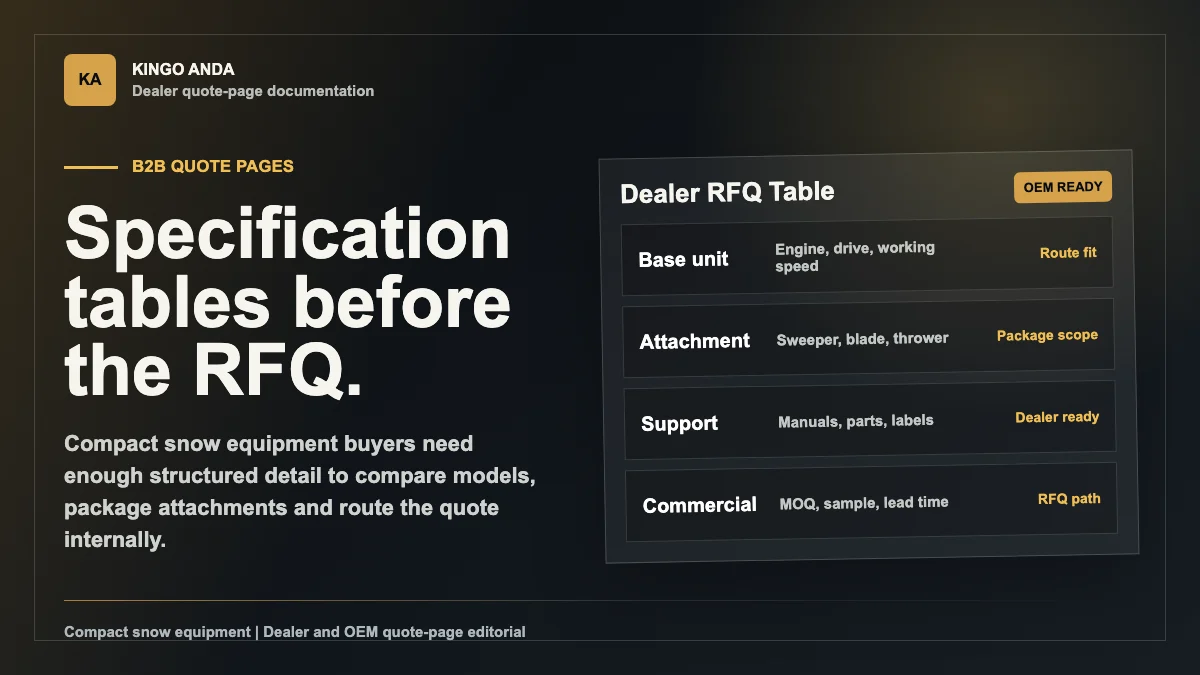
    Dealer quote page specification table for compact snow equipment buyers

    A good dealer quote page does not try to close a compact snow equipment order with a single hero photo. It gives the buyer enough structured information to decide whether the line fits the route, the service model, the warehouse plan and the next purchasing meeting.

    That sounds basic, but many equipment pages still make buyers work too hard. Model codes sit beside glossy images, while working width, attachment scope, sample order terms, parts support and document availability are scattered across a brochure, a chat thread or an old PDF. In a B2B sale, that friction is expensive. The first visitor is rarely the only decision maker.

    For walk-behind power units and compact snow attachments, the quote page has to behave like a short buying file. It should help a dealer, OEM buyer, municipal purchasing team or facility contractor compare the base power unit, shortlist attachments and send a usable RFQ without asking the same entry-level questions twice.

    Why quote-page tables now matter

    Industrial buyers are doing more research before they speak to sales. Sagefrog’s 2026 industrial buying analysis points out that stakeholders come to a supplier site with different needs: engineering wants specifications, operations wants reliability evidence, procurement wants commercial terms, and leadership wants risk reduction. If one of those needs is missing, the sales conversation slows down.

    Wholesale and B2B commerce research says the same thing in plainer terms. Modern buyers expect self-service product information, clear terms and fast search by SKU, category, product type, variant or use case. They are not browsing like a retail customer. They are collecting evidence for an internal decision.

    The larger snow-equipment brands have already trained the market in that direction. BOSS puts a Product Selector, Request a Quote path, Sidewalk Vehicle Builder, manuals, technical information and training videos into visible navigation. The lesson for a compact equipment supplier is straightforward: the buyer should not need to guess what information is available after the first sales call.

    Start with the buyer’s job, not the model code

    A dealer quote page should open with the job the equipment is meant to do. For compact snow equipment, that usually means sidewalks, campuses, storefront approaches, apartment routes, service yards, factory paths or narrow municipal walkways. The model code belongs in the table, but the table should answer route questions first.

    The buyer wants to know whether a snow sweeper is better for light snow on paved entrances, whether a snow blade makes sense for push routes, and whether a compact thrower is needed when windrows or deeper accumulation appear. A good quote table makes those choices visible without overpromising one attachment for every surface.

    The page should let a buyer build a short list before the RFQ. If the table only lists model names, the sales team will still have to rebuild the buying file by email.

    The first table: base unit and route-fit data

    The base-unit table should be practical, not decorative. For a walk-behind power platform, include engine type, drive mode, working speed range, wheel or tire information, operator control notes, approximate machine size, net weight and compatible attachment families. Keep the row labels plain enough for a dealer salesperson to understand and technical enough for a service manager to trust.

    Route-fit fields are just as important. Add recommended route types, surface limits, typical user groups and storage requirements. A campus buyer and a small contractor may both need compact snow equipment, but they do not evaluate it in the same way. One cares about staff training and repeatable sidewalk clearance. The other cares about trailer space, attachment changeover and whether the package can produce margin in a tight winter route.

    Table fieldWhy it belongs on the quote pageBuyer using it
    Working widthConfirms sidewalk, entrance and route coverage before attachment selection.Dealer sales / municipal buyer
    Compatible attachmentsPrevents mismatched base-unit and attachment quotes.Dealer sales / OEM buyer
    Route fitConnects the machine to light snow, push routes, deep snow or mixed surface use.Contractor / facility manager
    Parts packShows whether the dealer can support first-season wear items.Service manager

    The second table: attachment package and support scope

    Attachment pages need their own table because the buying logic changes. A snow sweeper table should show working width, brush type, replacement brush information, surface guidance and common wear parts. A blade table should show blade width, scraper edge material, skid shoe notes, fasteners and angle or push guidance. A thrower table should make clearing width, chute control, wear items and depth suitability clear.

    Dealers should also link these rows to support assets. A quote page is stronger when it sends buyers to parts and service support, manuals, service videos, warranty notes and training files. That support layer reduces the fear that a compact imported machine will be hard to maintain after the first shipment.

    KINGO ANDA has already built content around attachment compatibility and RFQ preparation. The next step is to use those articles as internal support points: link the quote page to the attachment compatibility table guide and the dealer RFQ checklist so a buyer can move from research to inquiry without losing context.

    Commercial fields that belong beside the specs

    Some commercial information should sit close to the table. Dealers and OEM buyers need to know whether sample orders are available, what packaging or private-label work can be discussed, what document files can be provided, and what information the supplier needs before preparing a quote path. Hiding all of that behind “contact us” makes the form feel generic.

    The table does not need to publish every price or contract detail. It does need to state the input fields required for a serious quote: buyer type, target market, annual volume, attachment set, document requirements, packaging needs, spare-parts plan and expected order timing. Those fields make the first inquiry useful for both sides.

    For private-label or OEM supply, add rows for color, logo, carton label, manual language and sample approval steps. For dealer stocking, add rows for starter parts, carton proof, spare brush or scraper items and preseason delivery timing. That is how a page moves from product catalog to B2B sales tool.

    How KINGO ANDA dealers can use the table before RFQ

    A compact snow equipment quote page should end with a clear path: choose the power unit, choose the attachment set, identify the route type, list the buyer type and submit the request. A dealer should not have to write a long email to explain what is missing.

    For buyers reviewing KINGO ANDA packages, start with the product range, compare the base unit and attachments, then use dealer support and parts-service pages to check what documentation can be prepared with the quote. If the order involves OEM branding, sample approval or municipal documents, include those requirements at the beginning instead of adding them after the price discussion.

    The better the quote table, the shorter the first sales cycle. It filters poor-fit inquiries, gives serious buyers something they can forward internally, and helps the supplier prepare the right catalog set instead of sending a loose PDF package.

    Build a cleaner quote path.

    Send buyer type, target route, attachment set, annual volume and document requirements. KINGO ANDA can prepare the right specification table and dealer quote package.

    Request Quote Path

    Editorial references: Sagefrog industrial B2B buying analysis, B2BWave 2026 wholesale website checklist, BOSS Product Selector and BOSS support navigation. Image source: locally generated KINGO ANDA editorial graphic, owned site asset.
  • Service Videos and Dealer Training Files for Walk-Behind Snow Equipment

    Service Videos and Dealer Training Files for Walk-Behind Snow Equipment

    KINGO ANDA service-readiness notesRequest a dealer file pack

    Industry News / Dealer Support

    Service Videos and Dealer Training Files for Walk-Behind Snow Equipment

    A dealer guide to the service videos, manuals, safety notes and parts files buyers expect before stocking walk-behind snow equipment.

    Published July 28, 2026Service VideosDealer Training
    Dealer training file stack for walk-behind snow equipment service support

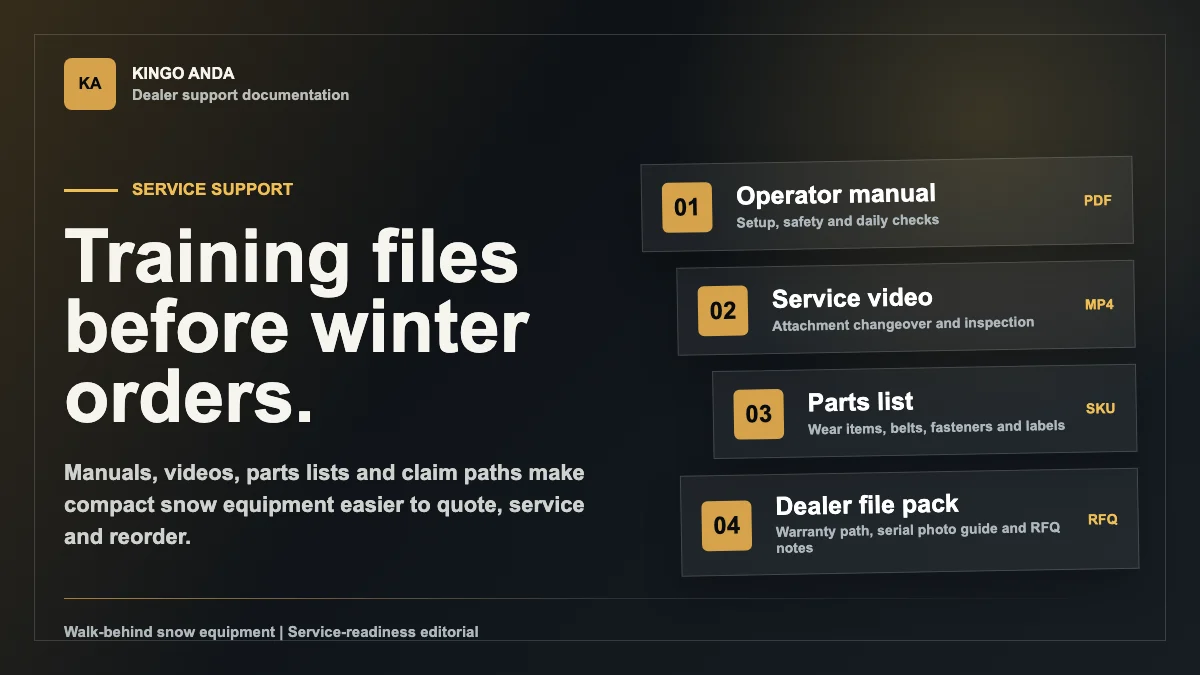
    By late summer, a dealer can usually tell which compact snow equipment line is going to be easy to support and which one will turn into a winter help-desk problem. The difference is not only steel, engine size or freight cost. It is the file set behind the machine.

    Walk-behind snow equipment is often sold into practical, time-sensitive work: sidewalks, campus paths, storefront routes, apartment entries and service yards. When the first storm arrives, a dealer does not have time to translate a confusing manual, chase an exploded parts diagram or explain an attachment changeover from memory. The support material has to be ready before the first stocking order ships.

    For KINGO ANDA’s compact walk-behind equipment line, that means treating service videos, manuals, parts lists and warranty notes as part of the product package. A buyer looking at a multifunction power unit, snow sweeper, snow blade or compact thrower should also see how the dealer will train operators and identify parts after delivery.

    Why training files now matter to dealer buying decisions

    The outdoor power equipment channel is paying closer attention to support quality. OPE+ reported in April 2026 that parts, inventory and service moved from a supporting role to a strategic issue for B2B outdoor power equipment, with uptime, speed and reliability shaping purchase decisions. That is exactly the environment where a clean training file pack helps a compact equipment supplier look serious.

    Established snow-equipment brands already make this visible. BOSS gives Parts & Service prominent navigation and points buyers to manuals, technical information and training videos. SnowEx puts a service publications library, document search, maintenance videos and maintenance checklist on its support path. Western gives buyers a document library and parts-finder route. Honda Power Equipment separates owner manuals, parts information, shop manuals, warranty information and how-to videos into its support structure.

    The pattern is not accidental. Dealers do not want a support answer buried in a private chat thread. They want a repeatable file path that sales, service, warehouse and warranty staff can all use.

    The minimum file set a dealer should request

    A serious walk-behind snow equipment quote should include more than a model list. At minimum, a dealer should ask for the operator manual, quick-start sheet, safety notes, attachment compatibility table, parts list, serial-label guide, warranty claim path and storage checklist. If the buyer is considering multiple attachments, each attachment needs its own fit notes and service points.

    For a snow sweeper, the file pack should explain brush inspection, brush replacement, belt or drive checks, skid or wheel adjustment and end-of-season cleaning. For a snow blade, it should cover scraper edge wear, skid shoes, fasteners, surface limits and safe operating angles. For a compact thrower, dealers need shear or wear items, chute checks, belt inspection and storage guidance.

    The parts list matters as much as the manual. Dealers should be able to identify common wear items by clear name, photo, part code and attachment model. If the parts sheet forces a service writer to guess, the dealer will either overstock the wrong item or avoid the line.

    Video topics that prevent avoidable support calls

    Not every service topic needs a long video. The most useful dealer training videos are short, specific and repeatable. A practical set starts with uncrating and pre-delivery inspection, then moves into attachment installation, daily operator checks, safe startup, first-hour inspection, seasonal storage and basic troubleshooting.

    Attachment changeover deserves special attention. One power unit with multiple work heads is commercially attractive only if the dealer can show the changeover clearly. A two-minute video that shows the coupling points, belt path, guard position and final inspection is often more valuable than a polished brand film.

    Dealers should also ask for service videos around wear parts. Brush modules, scraper edges, belts, skid shoes and chute components are normal consumables. Showing a technician how to inspect and replace them reduces avoidable calls during the first winter and gives the parts counter a better reason to stock a starter kit.

    Organize files around one power unit and multiple attachments

    Multi-attachment platforms need disciplined file names. A dealer should not receive a folder called “manuals” with ten unrelated PDFs inside. Use the base unit model first, then the attachment model, then the document type and revision date. That simple naming rule prevents confusion when the same dealer stocks a sweeper, blade, thrower and warm-season attachment.

    The structure can follow the sales path: power unit file, snow attachment file, parts file, service video file and warranty file. The parts and manuals download-page checklist published earlier goes deeper on how dealers can organize public support downloads. The same principle belongs inside the quote package before the order is placed.

    If private-label or OEM supply is involved, add artwork and label control to the file pack. The model code on the carton, serial label, manual cover and parts list should match. A mismatch looks minor before shipment. It becomes expensive when a distributor has to trace warranty claims by photo.

    What KINGO ANDA dealers should request with the first quote

    Before asking only for price, dealers should send buyer type, target route, primary attachment set, expected first-order volume and support requirements. That lets KINGO ANDA prepare the equipment recommendation and the support package together.

    A clean first request should name the intended power unit, the winter attachments being compared, the preferred spare-parts starter kit and the file formats needed by the dealer team. If the dealer will sell to municipalities, campuses or contractors, add any language, label or certificate requirements at the beginning rather than after samples arrive.

    This is the practical standard: the dealer should be able to receive a machine, identify its attachments, train an operator, find the likely wear parts and explain the warranty path without waiting for a factory reply in the middle of a storm week.

    A walk-behind snow equipment line is easier to stock when the file pack is as clear as the machine package.

    Request the dealer support file pack.

    Send buyer type, target attachment set, market region, annual volume and support requirements. KINGO ANDA can prepare a quote path with manuals, service files and spare-parts notes.

    Request Package Quote

    Industry references checked: OPE+ parts and service outlook for 2026, BOSS manuals and technical information, SnowEx parts and service library, WESTERN document library, Honda Power Equipment shop manuals and service support materials.

  • Commercial Snow Sweeper vs Snow Blade: Matching Surface Conditions and Snow Type

    Commercial Snow Sweeper vs Snow Blade: Matching Surface Conditions and Snow Type

    KINGO ANDA attachment selection notesBuild a winter equipment package

    Industry News / Products

    Commercial Snow Sweeper vs Snow Blade: Matching Surface Conditions and Snow Type

    A practical dealer guide to matching snow sweepers and snow blades by snow depth, pavement condition, surface sensitivity and route layout.

    Published July 24, 2026Sweeper vs BladeDealer Selection
    Dealer guide comparing commercial snow sweeper and snow blade use by surface condition and snow type

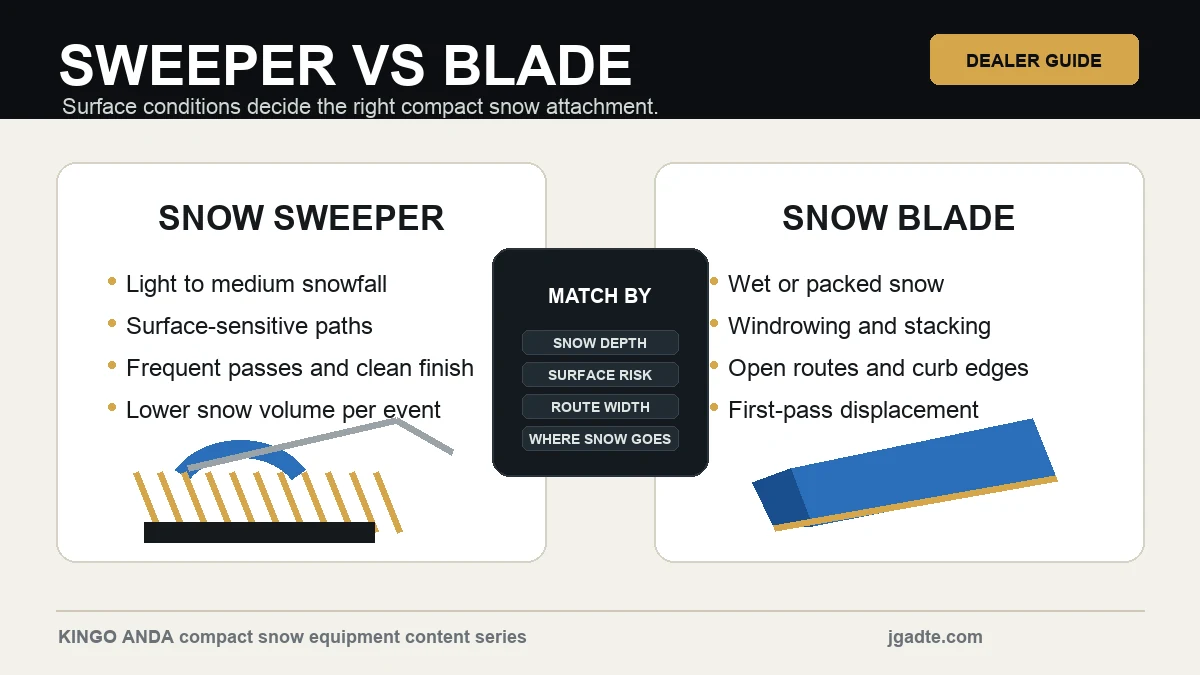
    A snow sweeper and a snow blade can both clear a sidewalk. That does not make them interchangeable. The right answer depends less on the attachment name and more on the surface, the snow type, the route width and what the operator is expected to leave behind after one pass.

    This is the comparison dealers should make before quoting a compact snow package. A buyer asking for a snow sweeper may really need clean pavement after light storms. A buyer asking for a snow blade may be thinking about wet snow, windrowing and stacking. If those questions are not asked early, the dealer can ship a machine that works mechanically but fits the route poorly.

    Why this comparison matters in the 2026 buying cycle

    Across the snow and ice market, the language has moved toward productivity per operator, compact equipment and mixed fleets. Sno-Way’s 2026 trend note points to rising demand for high-efficiency plows, compact equipment, precision ice management and flexible fleets. BOSS is also pushing 2026 product messaging around material control, municipal-sized output and dealer-ready support tools.

    For compact walk-behind equipment, the practical version of that trend is simple: one power unit has to carry the right winter attachment for the surface in front of it. The dealer who can explain sweeper versus blade selection clearly will look more useful than the seller who only sends a price list.

    Use a sweeper when finish quality matters

    A rotary broom is usually strongest when the route has light to medium snowfall, frequent service intervals and a surface that should be left clean. Ventrac describes its narrow broom as a light-to-medium snowfall solution that can clear down to concrete. SnowEx positions its SS-4000 rotary broom as a walk-behind sidewalk unit that combines sweeper and plow functions for hard-to-reach areas.

    That tells dealers where the sweeper conversation belongs. It is not only about moving snow. It is about reducing residue, working along curbs and walls, handling pavers or decorative concrete more carefully, and giving crews a clean finish on campus routes, storefront walks, residential communities and pedestrian approaches.

    A sweeper is not magic. If the snowfall is too deep, too wet or already packed by traffic, the broom may require too many passes. In those cases, it becomes a finish tool after a blade or thrower has handled volume.

    Use a blade when the route needs displacement

    A blade is the better first conversation when the buyer needs to push, windrow, stack or open a route after heavier accumulation. Buyers Products describes SnowDogg plows around clean scraping, heavy wet snow and applications ranging from small parking lots to large campuses. BOSS sidewalk vehicle pages also show why compact straight blades remain part of professional sidewalk fleets: they are simple, direct and productive when snow has somewhere to go.

    For dealers, blade selection should include the edge and surface discussion. Steel edges scrape aggressively but may be too harsh for certain finished surfaces. Poly or alternative edges can make sense where the buyer is worried about pavers, uneven sidewalks or surface marking. Skid shoes, scraper edges and fasteners also need to be treated as stocking items, not afterthoughts; that links directly to the earlier KINGO ANDA note on snow blade wear items.

    Ask the route questions before quoting the attachment

    The best dealer questions are operational. How wide is the sidewalk or path? How often is it cleared during a storm? Is the route concrete, asphalt, brick, paver, turf-edge or mixed? Does snow need to be pushed to one side, thrown away from the path, swept clean, or stacked at the end of a run? How much freeze-thaw happens between service windows?

    Those answers decide the package. A narrow sidewalk route with frequent light snow may point toward a sweeper. A campus route with wet snow and open shoulders may point toward a blade. A site with drifting snow or limited storage may need a thrower instead, which is why the older KINGO ANDA article on snow sweeper versus compact snow thrower route fit still belongs in the same sales conversation.

    Build the quote around the season, not one storm

    Dealers should avoid quoting only the main attachment. The better package includes the power unit, primary winter attachment, a second attachment when the route demands it, replacement wear items, document files and operator notes. For municipal, HOA, campus and property-maintenance buyers, this turns the quote from a machine price into a route plan.

    KINGO ANDA’s attachment range gives dealers room to build those packages. A sweeper can be sold for clean frequent passes. A blade can be sold for wet snow displacement and simple first-pass clearing. The right mix depends on surface condition, snow depth and where the buyer can safely put the snow.

    A sweeper is often a finish-quality tool. A blade is often a displacement tool. The dealer’s job is to match that job to the surface, not just match a buyer to a brochure name.

    Quote by route condition.

    Send route width, surface type, snow depth, buyer type and target attachments. KINGO ANDA can help prepare a practical sweeper, blade or mixed winter package.

    Build Attachment Package

    Industry references checked: Ventrac sidewalk snow management, SnowEx SS-4000 Rotary Broom, Sno-Way snow removal trends for 2026, BOSS 2026 new products, BOSS Snowrator builder, Buyers Products SnowDogg plows.

  • Sidewalk Route Widths and Turning Space: How Dealers Size Compact Snow Packages

    Sidewalk Route Widths and Turning Space: How Dealers Size Compact Snow Packages

    KINGO ANDA route sizing notesBuild a winter equipment package

    Industry News

    Sidewalk Route Widths and Turning Space: How Dealers Size Compact Snow Packages

    Dealers quoting compact sidewalk snow equipment should match attachment width, turning room, passing space and surface limits to each winter route.

    Published July 21, 2026Sidewalk RoutesDealer Sizing
    Sidewalk route width and turning space plan for compact snow equipment dealers

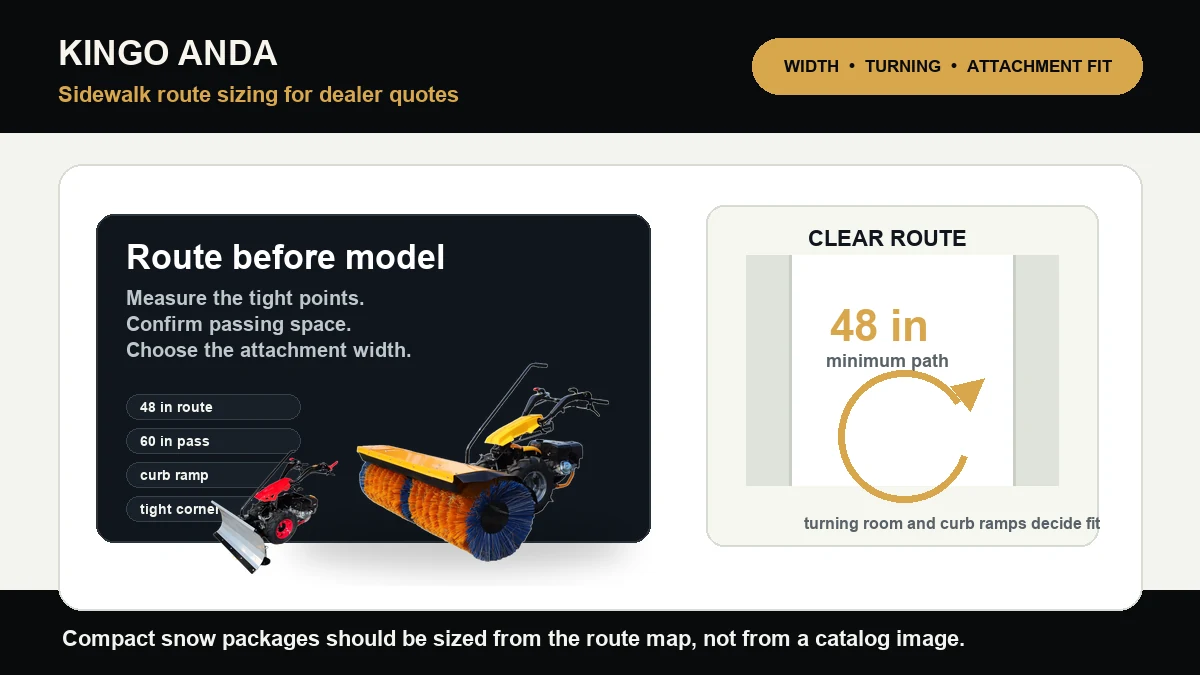
    A compact sidewalk snow package should be sized from the route, not from the machine photo. The difference matters. A buyer may ask for a sweeper, blade or compact snow thrower, but the route decides whether that attachment can actually move through the property, turn at entrances, clear curb ramps and leave enough usable path after the storm.

    Dealers that sell into campuses, municipal accounts, hospitals, shopping centers and property-maintenance channels should treat route width as an RFQ item. It belongs beside working width, snow type, surface limits, spare parts and delivery timing. If the route is not measured, the quote is still half blind.

    Start with the narrowest usable path

    The U.S. Access Board’s public right-of-way accessibility guidelines list a 48-inch minimum continuous clear width for pedestrian access routes in most cases, and a 60-inch requirement for certain medians, refuge islands and passing spaces. They also call for passing spaces at 200-foot maximum intervals when the clear route is under 60 inches. Dealers should not turn those figures into legal advice, but the numbers are useful planning anchors: a snow package that cannot respect the narrow points of a pedestrian route will create buyer-side objections quickly.

    The first quote question is therefore simple: what is the tightest section that must be cleared? Measure between walls, bollards, railings, planters, light poles, curb edges and parked-vehicle zones. A five-foot sidewalk can behave like a three-and-a-half-foot route after obstructions and snow storage are considered. That is where a compact package earns its place.

    Match attachment width to snow movement, not only path width

    A route that is 48 inches wide does not automatically call for a 48-inch attachment. The dealer has to consider snow windrow, brush throw, discharge direction, curb ramps and where the operator turns. A broom that clears close to the pavement may be right for light accumulation on hard surfaces. A blade may be simpler for pushing light snow if there is somewhere to put the windrow. A thrower becomes more useful when discharge distance matters or when repeated pushing would close the route again.

    Ventrac’s sidewalk snow pages present the same operating logic at a larger system level: brooms, blades, blowers and spreaders are separate choices because light snow, heavy snow and surface finish are different jobs. BCS publishes snow-removal attachments and a snow thrower with 24-inch and 28-inch width options, which shows why working width cannot be separated from the power unit and the route. KINGO ANDA dealers should apply the same discipline when presenting the attachment lineup.

    Turning space is where many quotes fail

    Straight sidewalk footage is the easy part. The difficult points are turns, door approaches, curb ramps, loading zones, bus stops, gates and transitions from sidewalk to storage areas. A compact machine may fit through the path but still be awkward if the operator has to reverse repeatedly or lift snow into a corner with no discharge room.

    Dealers should ask for a route map or a short phone video before quoting a larger dealer package. Mark the 90-degree turns, dead ends, stairs, ramps, bollards and places where pedestrians must pass. Then match each section to the attachment: sweeper for clean surface finish, blade for short pushes, thrower for discharge, and spare wear items for routes with curb contact. The earlier KINGO ANDA article on snow sweeper versus compact thrower route fit is still a good comparison point.

    Public and institutional buyers need support notes

    FHWA has long treated snow removal on federally funded pedestrian facilities as a maintenance issue, and its pedestrian-facility research summary notes that winter-maintenance guidance compares different equipment types for sidewalk snow removal. For a dealer, that means the quote should not read like a retail listing. It should show how the package supports a maintenance policy: route priority, snow trigger, surface protection, attachment changeover, spare parts and document availability.

    Institutional buyers also care about liability and repeatability. If a campus crew clears the same paths at 5 a.m. after every storm, the dealer should quote a package that is easy to train, easy to service and consistent across the route. This is where links to municipal RFQ documents, spare-parts starter kits and warranty files help the buyer see more than a machine.

    Turn the route review into a quote table

    The best dealer quote page should convert the route review into a table. Recommended columns are route segment, clear width, obstruction note, surface type, snow condition, attachment choice, support parts and quote status. If a field is unknown, mark it as “confirm before quote” instead of hiding it. This is cleaner than forcing every buyer into the same package.

    For KINGO ANDA, the table can sit beside the attachment compatibility table. One table answers what fits the power unit. The second table answers what fits the route. Together they reduce revisions, improve dealer confidence and make it easier for OEM or municipal buyers to approve the package.

    Dealers can send route width, tight turns, surface type, target snow depth, buyer type and attachment interest through Build Your Package. KINGO ANDA can then prepare the right compact snow package instead of quoting from a product name alone.

    A compact sidewalk package should pass three checks before quote: clear-route width, turning space and where the snow can actually go.

    Size the route before the package.

    Share sidewalk width, turning points, snow condition and target attachment set. KINGO ANDA can support the dealer quote path with the right compact package.

    Request Quote

    Industry references checked: U.S. Access Board PROWAG technical requirements, FHWA sidewalk snow-removal memorandum, FHWA pedestrian-facility maintenance research summary, Ventrac sidewalk snow management, Ventrac Sidewalk Snow Vehicle, BCS snow thrower attachment.

  • Municipal Sidewalk Snow Equipment RFQ Documents Dealers Should Prepare

    Municipal Sidewalk Snow Equipment RFQ Documents Dealers Should Prepare

    KINGO ANDA dealer planning notesBuild a winter equipment package

    Industry News

    Municipal Sidewalk Snow Equipment RFQ Documents Dealers Should Prepare

    Dealers quoting municipal sidewalk snow equipment should prepare specs, route notes, safety items, manuals, warranty files and parts support before RFQs.

    Published July 17, 2026Municipal RFQDealer Support
    Municipal sidewalk snow equipment RFQ document package for dealers

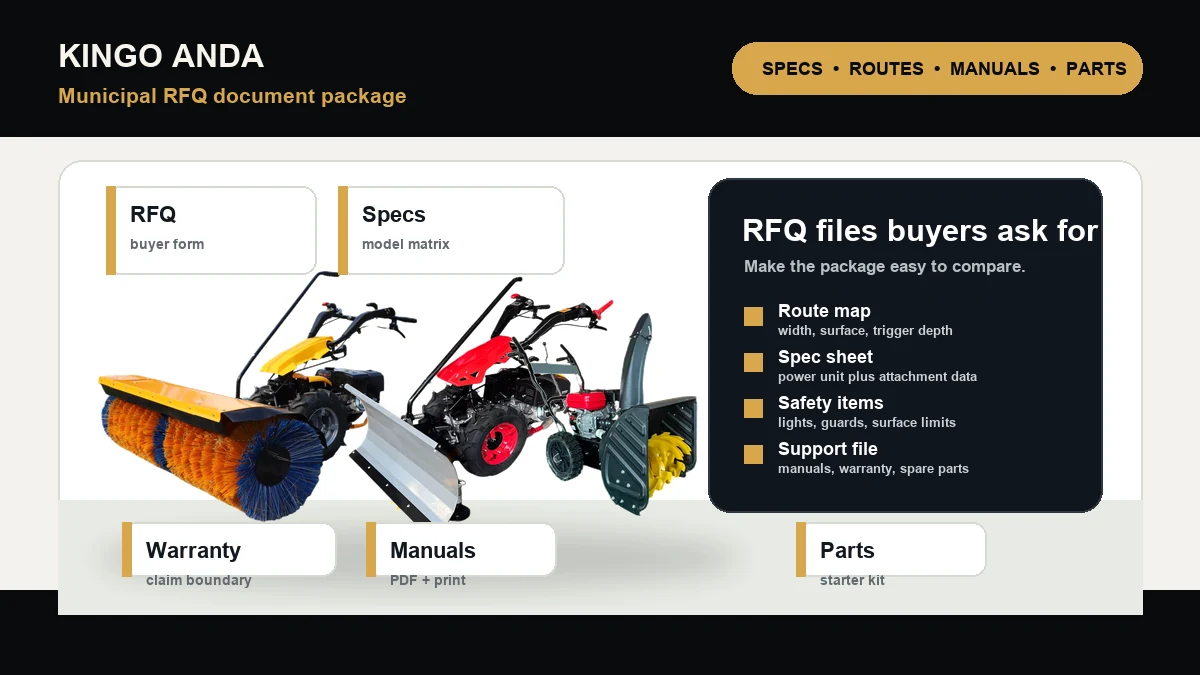
    Municipal sidewalk snow equipment is rarely bought from a product photo alone. Public buyers, facility authorities and dealer purchasing teams usually need a file that lets them compare equipment, route conditions, safety expectations, warranty coverage and service support. A clean RFQ response is therefore not just a price sheet. It is a document package.

    For dealers quoting compact walk-behind snow equipment, this is where preparation separates a serious package from a catalog reply. The buyer may not use the same vocabulary as the factory. They may ask for sidewalk equipment, a broom, a snow thrower, a plow, spare parts, manuals or proof that the machine will not damage surfaces. The dealer has to translate those requests into an equipment set that can be quoted, delivered and supported.

    Start with the route and surface file

    The first document should describe where the equipment will work. Sidewalk width, surface material, curb transitions, access points, storage area, snow-placement limits and response time all affect the correct attachment. A 2025 transit-facility RFQ from MAX, for example, required snow-throwing equipment on brick-paver sidewalks to use rubber blades to prevent surface damage, and it tied service to time-of-day and accumulation triggers. That is not a generic snow-equipment question. It is a route-specific equipment question.

    The same lesson appears in sidewalk snow specifications from the City of Mitchell, South Dakota. The document calls for equipment to be in working condition, fitted with flashing amber lights, sized for the job, and not harmful to the sidewalk. It also separates equipment classes and requires the correct class for general sidewalk clearing. A dealer who knows these details before quoting can avoid proposing a machine that looks good on paper but is hard to approve.

    For KINGO ANDA, the route file should connect directly to the attachment set: sweeper, blade, thrower, broom head, skid shoes, scraper edge and spare-parts needs. The route defines the package.

    Give the buyer a clear equipment specification

    A municipal RFQ package should include a compact spec sheet that explains the power unit, attachment, working width, engine or drive information, operating controls, transport dimensions where relevant, replacement wear items and packaging. The Manchester-Boston Regional Airport 2026 snow removal equipment bid package shows how formal equipment procurement can be: it separates multi-tasking equipment with plow and broom, carrier vehicles, spreaders and an extended warranty item, with technical specifications behind each line.

    Compact sidewalk equipment is smaller than airport SRE, but the buyer still needs comparable information. If one dealer sends only a product name and price, while another sends working width, attachment compatibility, support parts and document availability, the second dealer is easier to evaluate.

    This is why the existing KINGO ANDA dealer RFQ checklist should be treated as a working document, not just a blog post. Dealers can use it to standardize model names, attachment combinations and support notes before the buyer asks for revisions.

    Manuals, warranty and parts files reduce buyer risk

    Many RFQs ask for more than equipment. They ask whether the supplier can support the equipment after delivery. Manchester’s bid package references manufacturer maintenance and service manuals, printed manual sets and notifications for software or parts updates. For a dealer, this points to a basic rule: do not wait for award-stage questions to prepare support documents.

    A practical municipal file should include the operating manual, parts list, warranty boundary, wear-item list, recommended first-season spare kit and a contact path for dealer support. If the buyer is comparing several offers, these documents help show that the package can be maintained after the first storm.

    For KINGO ANDA posts already published, the relevant internal support links are the dealer spare-parts starter kit, warranty packet guide and snow blade wear-item checklist. These are the kinds of files municipal buyers expect a serious dealer to understand.

    Safety and visibility items belong in the quote

    Public facilities care about visibility, operator control and damage prevention. Mitchell’s sidewalk specification mentions flashing amber lights and equipment sizing. Trackless municipal tractor materials list safety-oriented features such as automated shutoffs, backup cameras, alarms, strobes, reflectors and lighting. Ventrac’s sidewalk snow page emphasizes maneuverability on sidewalks and attachment choices such as broom, blade, blower and spreader tools.

    A compact walk-behind package will not have the same feature set as a cabbed municipal tractor. Still, the RFQ reply should state the safety-relevant items it does offer: route suitability, attachment guards, operator controls, surface limits, maintenance checks, lighting or visibility accessories if used, and the buyer’s responsibility to choose the right package for the site.

    This is especially important when a buyer clears campuses, transit stops, public parking lots, schools or narrow commercial entrances. The question is not only whether the machine can move snow. It is whether the machine fits the route, protects surfaces and can be supported by the dealer.

    Make the RFQ easy to compare

    Public procurement often rewards clarity. MRSC’s procurement guidance points to examples of bid documents and notes that agencies should follow local policies and procedures; its sample references also show how specifications, supplier agreements, OEM or approved-equal language and standard terms appear in public purchasing files. Dealers do not need to write the buyer’s procurement policy. They do need to make their reply easy to evaluate inside that policy.

    A useful compact snow equipment RFQ package should include: one cover quote, one model matrix, one route/attachment match, one spec sheet per attachment, one spare-parts recommendation, one warranty note, one manual/document list and one delivery/packing note. The file should use the same model names everywhere. The buyer should not have to reconcile different names across the quote, catalog, manual and carton label.

    Dealers preparing a municipal or facility quote can also link the RFQ package to preseason order timing and sample-order testing. Those two steps help buyers approve the package before the winter window is already tight.

    A municipal RFQ package should show the route, equipment specification, support documents, wear items and warranty path in one consistent file.

    Dealers, OEM buyers and municipal suppliers can send route type, buyer requirements, target attachments and document expectations through Build Your Package. KINGO ANDA can prepare the right compact snow equipment file before the formal RFQ deadline.

    Prepare the RFQ file before the deadline.

    Share the route, surface, attachment set and document requirements. KINGO ANDA can support the dealer quote path with the right package file.

    Request Quote

    Industry references checked: Manchester-Boston Regional Airport 2026 snow removal equipment bid package, MAX snow removal RFQ, City of Mitchell sidewalk snow specifications, Ventrac sidewalk snow management page, MacQueen Trackless municipal tractor page, MRSC procurement guidance.

  • Snow Blade Attachment Wear Items: Scraper Edges, Skid Shoes and Fasteners

    Snow Blade Attachment Wear Items: Scraper Edges, Skid Shoes and Fasteners

    KINGO ANDA dealer planning notesBuild a winter equipment package

    Industry Products

    Snow Blade Attachment Wear Items: Scraper Edges, Skid Shoes and Fasteners

    Dealers quoting compact snow blade attachments should confirm scraper edges, skid shoes, curb guards, fasteners and route surfaces before winter orders.

    Published July 16, 2026Dealer StockingSnow Blade Attachments
    Snow blade attachment wear items checklist for compact equipment dealers

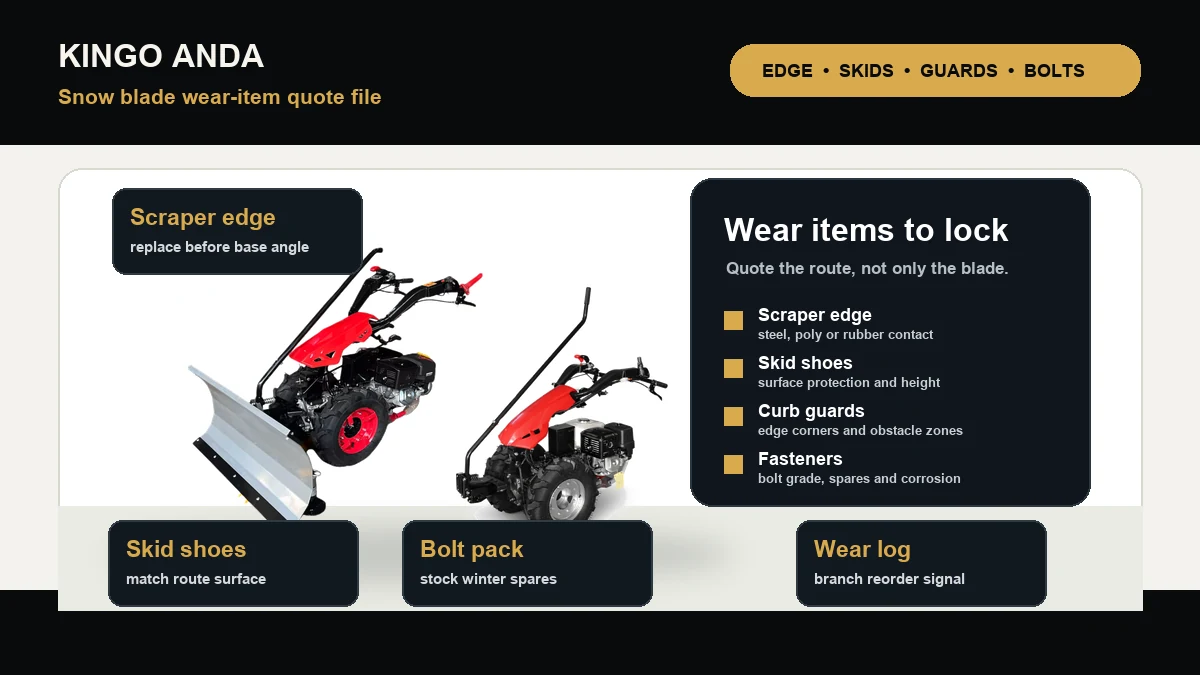
    A compact snow blade looks simple in a catalog. A moldboard, a mounting point and a working width are easy to compare. The order becomes more serious when a dealer has to support the blade through a full winter. The real quote is not only the attachment. It is the scraper edge, skid shoes, curb guards, fasteners and route surface that decide whether the blade can be sold and serviced cleanly.

    That is why snow blade wear items should be discussed before the preseason order is placed. A buyer who asks only for blade width and price will usually come back later for edge material, replacement hardware, shoe height and surface notes. Those late questions slow down the order, and they leave the dealer counter with weak information when the first storm arrives.

    Start with the surface the blade will scrape

    Western’s cutting-edge guide makes the practical point that wear is affected by contact pressure, climate, surface conditions, speed and edge material. That is a useful way to brief a compact-equipment dealer. The same snow blade can have very different wear behavior on smooth concrete, broken asphalt, pavers, gravel shoulders or municipal sidewalks with raised joints.

    For a KINGO ANDA snow blade attachment, the quote should therefore describe the expected route before the buyer chooses the wear pack. The dealer may need a harder steel edge for long paved runs, a softer edge for sensitive surfaces, or a clearer skid-shoe setup for mixed pavement. A small walk-behind package does not remove this decision. It just makes the support file more important because the buyer may be serving branch stores, contractors or municipal crews with different route conditions.

    KAGE also points to skid shoes as surface-protection parts and discusses blade features such as trip edges and floating moldboards that reduce strain when a blade hits uneven ground. For compact equipment, the dealer should know whether the route includes curb lips, frost-heaved slabs, driveway transitions or older sidewalk panels. That information belongs in the RFQ, not in a service call after delivery.

    Scraper edges should be treated as scheduled stock

    Hiniker’s maintenance guidance stresses that the cutting edge is in continuous contact with the ground, and that wear, cracking, corrosion and loose hardware should be checked through the season. This is the part of the blade most likely to turn into a branch-level reorder. Dealers should not wait until the first replacement request to learn the edge type and bolt pattern.

    A practical dealer kit should state the working width, edge material, thickness, hole spacing, bolt size and whether the edge can be reversed. If the blade is sold into a region that uses salt or brine, corrosion around hardware should be assumed. A small spare bolt pack is cheap compared with a machine that cannot go back out because one missing fastener holds up an edge change.

    This is the same logic behind the KINGO ANDA dealer spare-parts starter kit. Edge wear is not a surprise failure. It is a normal support item, and it should be stocked like one.

    Skid shoes and curb guards protect the sale after delivery

    Skid shoes are easy to overlook because they are not the largest or most visible part on the attachment. In use, they help set blade height, protect surfaces and reduce how aggressively the edge bites into uneven ground. If the buyer is clearing pavers, decorative concrete, parking-lot transitions or municipal sidewalk sections, the skid-shoe question should be handled before shipment.

    Curb guards deserve the same treatment. Blade corners often take the hit when operators work near curbs, loading areas and building entrances. A quote that includes the guard style and replacement path gives the dealer a cleaner answer when customers ask how the blade will hold up around hard edges.

    Trackless writes about municipal winter attachments in the context of sidewalks, uneven surfaces, frost heave and public safety. The equipment category is different, but the operating lesson carries over: winter attachments need to protect the operator, the machine and the public route. For a compact snow blade, that means the wear package should match the actual route environment.

    Fasteners are part of the blade, not an afterthought

    A snow blade order should include the fastener specification that holds the wear edge and guard parts. Dealers need to know the bolt grade, nut type, washer setup and whether any parts are treated for corrosion resistance. If the edge is reversible, the fastener pack should support that service event. If the attachment is going into a fleet account, the buyer may want enough hardware for the first replacement cycle.

    BOSS lists replacement cutting edges for compact vehicle blades and separates different materials for different use cases, including steel and polyurethane options. That kind of parts clarity is what dealers need from the supplier side as well. A blade sold without a clear parts line becomes harder to support even when the attachment itself is sound.

    The fastener discussion also belongs beside the snow sweeper wear-parts checklist and the compact snow thrower parts guide. Dealers do not buy one attachment in isolation. They buy a winter support system.

    Put the wear-item file into the RFQ

    The cleanest quote path is a short wear-item file attached to the RFQ. It should list the target route, blade width, edge material, edge dimensions, skid-shoe style, curb guard need, fastener pack, first-season spare quantity and any surface restrictions. That file gives purchasing, service and branch staff the same reference point.

    It also helps the supplier quote the right package. A buyer asking for a dealer program may need extra consumables, carton labeling, parts names and reorder references. A municipal buyer may care more about route durability and service records. An OEM buyer may need the wear-item file to match the private-label parts list.

    For preseason planning, connect this article with the dealer RFQ checklist and the sidewalk snow equipment preseason order calendar. The earlier the wear items are locked, the fewer support questions appear after the first storm.

    A snow blade quote is not complete until the wear edge, skid shoes, curb guards, fasteners and route surface are documented together.

    Dealers, OEM buyers and municipal suppliers preparing compact snow blade packages can send route type, blade width, expected annual volume and first-season spare requirements through Build Your Package. KINGO ANDA can align the attachment quote with a cleaner winter support path.

    Quote the blade with the wear pack.

    Share the target route, buyer type, attachment set and spare-parts expectation. KINGO ANDA can prepare a dealer-ready quote path.

    Request Quote

    Industry references checked: Hiniker snow plow maintenance guidance, KAGE snow blade selection guidance, BOSS compact vehicle blade accessories, Trackless municipal winter attachment safety article, Western cutting-edge selection guide.

  • Private-Label Compact Snow Equipment: What OEM Buyers Should Lock Before Artwork

    Private-Label Compact Snow Equipment: What OEM Buyers Should Lock Before Artwork

    KINGO ANDA dealer planning notesBuild a winter equipment package

    Industry Products

    Private-Label Compact Snow Equipment: What OEM Buyers Should Lock Before Artwork

    OEM buyers ordering private-label compact snow equipment should lock model codes, serial labels, manuals, carton marks and parts files before artwork starts.

    Published July 15, 2026OEM SupplyPrivate Label
    Private-label compact snow equipment artwork checklist for OEM buyers

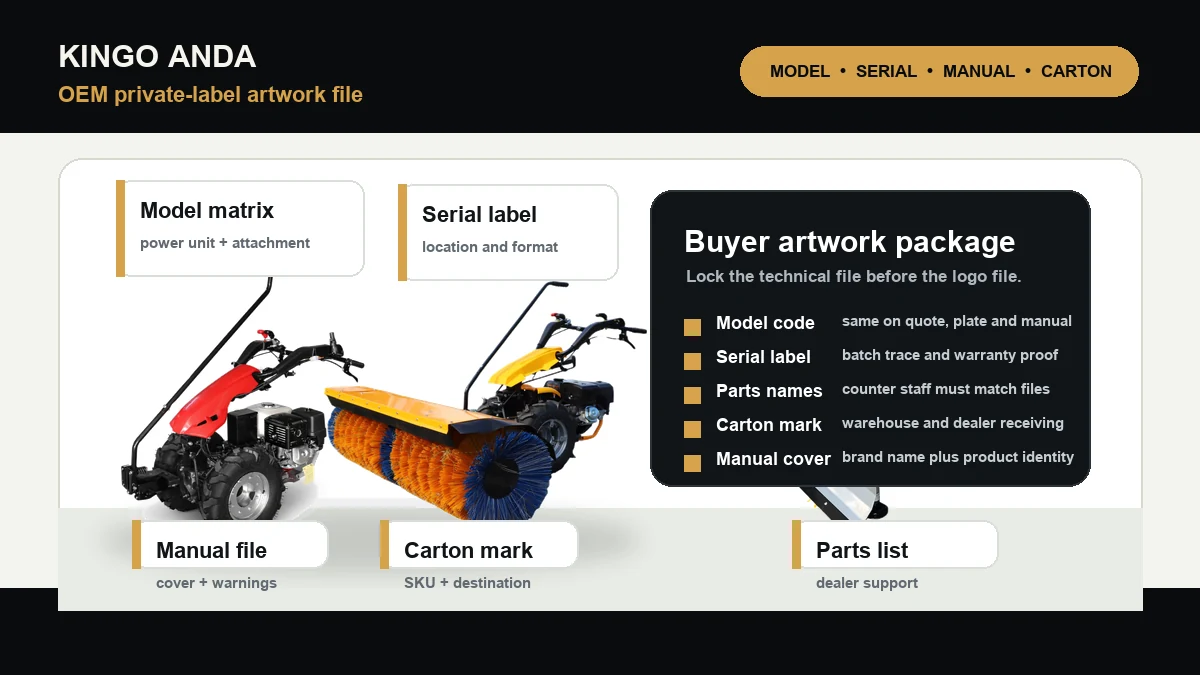
    Private-label equipment buyers often treat artwork as the point where a project starts to look real. The logo is on the cover. The carton mark is drafted. The dealer wants a name for the package. That is usually the wrong order. For compact snow equipment, artwork should come after the technical file is already locked.

    The reason is simple: a snow sweeper, snow blade, compact thrower or walk-behind power unit becomes a support product as soon as it reaches a dealer. If the model code, serial label, manual name, carton mark and spare-parts file do not match, the first winter service question becomes harder than it needs to be.

    Artwork starts with product identity, not the logo

    OEM and private-label buyers should first decide how the equipment will be named across the quote, rating plate, manual, carton and parts sheet. BOSS tells parts buyers to identify the product by model, serial number, product family and documentation before ordering replacement parts. That habit is not only useful after the sale. It should shape the buyer file before the first artwork proof is approved.

    For a KINGO ANDA compact snow package, the buyer file should separate the walk-behind power unit, the attachment, the working width, the connection kit and the first-season support parts. A private-label name can sit on top of that structure, but it should not replace it.

    This is where many early projects become messy. The sales quote says one model. The manual cover uses another. The carton label uses a buyer SKU that the factory cannot map back to the attachment. The product is still usable, but the support path is weak before the first unit ships.

    Serial labels are a service system

    Serial labels are not decoration. The CPSC recall notice for Amerisun PowerSmart snow blowers identifies model and serial number ranges and explains where those labels are located on the equipment. Briggs & Stratton’s recall and notification page also points owners toward recall notices, model-number lookup, manuals, parts lists and dealer support. The pattern is clear: when equipment needs service, identification data matters.

    Private-label buyers should therefore approve more than the look of the label. They should confirm the label location, serial format, batch meaning, durability, language set and whether the same code appears in the packing list, invoice, manual file and warranty record. If the buyer uses its own SKU, the cross-reference between buyer SKU and factory model must be kept in writing.

    This connects directly to the KINGO ANDA dealer warranty packet. A warranty packet without a clean serial record is a slow claim. A private-label order without a serial rule is a future support cost.

    Manual and parts names must match the dealer counter

    Private-label artwork often focuses on the front cover: brand mark, product name, image and color. The more important pages are usually inside the file. The parts list, maintenance section, safety references and service-contact page need names that match the actual stocked product.

    If a buyer wants a snow sweeper under a regional brand, the manual should still make the attachment identity clear enough for the dealer counter. Brush wafers, skid shoes, scraper edges, shear items, belts, chute parts and fasteners must be named in a way the dealer can reorder. A nice catalog cover cannot fix a parts sheet that uses vague names.

    That is why the earlier compact snow thrower parts guide matters for OEM buyers as well. The best private-label file ties the artwork, model matrix and spare-parts plan together before production begins.

    Carton marks should serve receiving, not just branding

    Carton artwork has a different job from the brochure. It should help the receiving warehouse, dealer branch and service team identify the shipment quickly. The carton mark should normally carry the buyer item code, factory model reference, attachment type, gross and net weight where applicable, carton count, destination mark and any handling notes the buyer requires.

    Cotech presents itself as a snow-removal and agricultural equipment manufacturer with OEM manufacturing agreements and a dealer network across North America. That kind of dealer-channel positioning depends on consistency. The brand promise is not only the finished product. It is also whether dealers can receive, identify, service and reorder the package without rebuilding the file from email threads.

    For KINGO ANDA, this is the same logic behind the compact snow equipment packaging guide. Private-label artwork should be reviewed beside carton labels and spare-parts packs, not as a separate design task.

    Approve one sample file before mass production

    Outdoor power equipment demand continues to grow, and buyers are asking suppliers to support more market-specific product packages. Fortune Business Insights estimates global outdoor power equipment at USD 39.33 billion in 2026, with North America remaining a major market. That scale does not make private-label projects simpler. It raises the cost of unclear files.

    Before mass production, the buyer should approve one complete sample file: quote model, product photos, plate or serial label, manual cover, manual PDF, carton mark, parts list, warranty boundary and service-contact path. The sample unit should be checked against that file, not only against the logo proof.

    Dealers and OEM buyers preparing compact equipment packages can use the dealer RFQ checklist to organize model, attachment and document requirements before the artwork round starts. If the private-label program includes multiple attachments, the same checklist should be repeated for each attachment family.

    A private-label order is ready for artwork only after the technical name, serial logic, manual file, carton mark and parts file all point to the same product.

    For a cleaner quote path, share the target market, buyer brand, model naming rule, attachment set, carton-label requirements and expected annual volume through Build Your Package. KINGO ANDA can align the private-label file before the artwork becomes expensive to change.

    Build the private-label file before artwork.

    Send the buyer market, attachment set, SKU rule and support expectations. KINGO ANDA can prepare the quote path around the right technical file.

    Request Quote

    Industry references checked: BOSS parts identification guidance, CPSC Amerisun snow blower recall notice, Briggs & Stratton recall and notification page, Cotech manufacturer and OEM positioning, Fortune Business Insights outdoor power equipment market overview.