Industry News / OEM Support
Serial Labels, Carton Photos and Warranty Evidence for OEM Snow Equipment Orders
An OEM buyer guide to serial labels, carton photos, QC proof and warranty evidence for compact snow equipment orders before winter shipment.
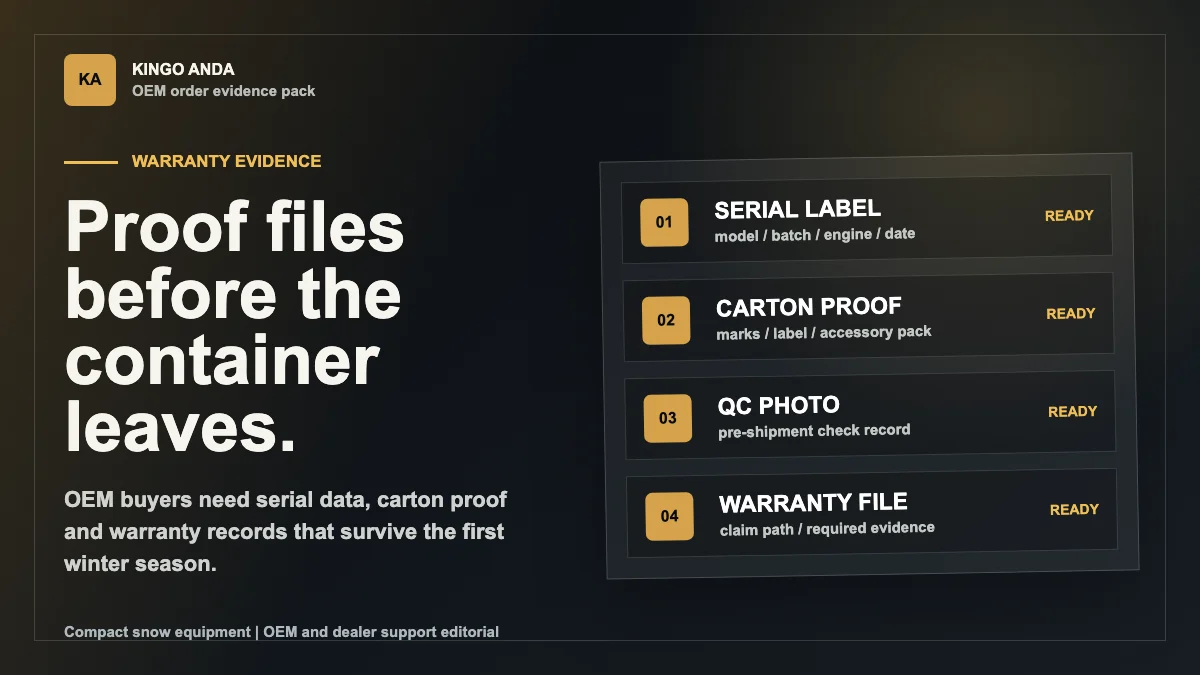
In a compact snow equipment order, warranty trouble usually starts long before a failed part arrives at the dealer counter. It starts when nobody can prove which carton held the machine, which serial label was applied, which accessory pack shipped with it, or whether the customer photo shows a warrantable issue or a wear item that should have been stocked separately.
That is why OEM and dealer buyers should treat serial labels, carton photos and warranty evidence as part of the buying file, not as clerical work after production. A clean evidence pack gives the importer, dealer and end user the same reference point when winter service questions arrive.
For KINGO ANDA’s compact snow line, the issue is practical. A buyer comparing a multifunction power unit, snow sweeper, snow blade or compact thrower should also ask how the order will be identified, photographed and supported after delivery. The machine may be simple; the support trail cannot be vague.
Why traceability is moving into ordinary equipment orders
The language around traceability is no longer limited to food, batteries or regulated consumer goods. In 2026, the broader manufacturing conversation is shifting from visibility to verifiability. PSQR’s 2026 traceability review describes a market where companies are expected to prove product information, not only know where goods moved. QT9 explains the operational side in plain terms: each product or component receives a unique machine-readable identification, then events are logged against that identifier through the process.
A compact snow equipment dealer does not need a complex global compliance system to learn from that direction. The first step is more basic: every machine and major attachment should be easy to identify by model, batch, order, carton and dealer shipment. When that information is visible on labels and matched to photos, warranty handling becomes less dependent on memory.
Equipment brands already make this expectation visible in support rules. Buyers Products’ SnowDogg warranty procedure asks for proof of purchase, maintenance records and dealer involvement, and its spreader warranty process calls for information such as model, serial number, date installed and distributor. Briggs & Stratton tells owners to use documentation or manuals to determine warranty coverage and notes that authorized dealers handle repairs. The signal is clear: the dealer needs documentation that connects the product to the claim.
What belongs on the serial label
A serial label is not just a sticker for the factory. It is the first field-service index. At minimum, an OEM order should define the model code, serial number format, batch or production date, engine reference where applicable, electrical or attachment reference when needed, and the buyer’s private-label requirements. If QR codes are used, the buyer should know what they point to before the first shipment is approved.
For a walk-behind power unit, the label should help the dealer confirm the platform and the shipment batch. For a sweeper, blade or thrower, the label should separate attachment identity from the base unit identity. If both labels use unclear codes, the dealer may quote the wrong part or misread whether the claim belongs to the power unit, the attachment or a third-party engine component.
Carton photos prevent preventable disputes
Carton photos are not glamorous, but they are one of the cheapest ways to reduce avoidable confusion. For compact snow equipment orders, the buyer should request photos of the outer carton, carton mark, model label, accessory pack, manual pack, spare-parts starter kit and any private-label artwork before shipment release.
This matters most for OEM and dealer programs where the same platform may ship with different attachments or brand treatments. A carton marked for a sweeper package should not look identical to a carton marked for a blade package. The photo set gives the buyer a record before the container leaves, and it gives the receiving warehouse a simple way to confirm whether the right goods arrived.
For KINGO ANDA packages, that photo set should connect to the commercial quote path. The same order file can hold the product list, quote-page specification table, carton proof, serial-label format and spare-parts plan. That makes the handoff from sales to warehouse to service much cleaner.
Warranty evidence should be defined before the first claim
Dealers should not wait until the first broken scraper edge, brush assembly or belt question to define warranty evidence. The supplier and buyer should agree up front what a claim requires: model and serial photo, purchase or shipment proof, installation date where relevant, hour or use estimate, photos of the failed area, maintenance evidence and a short failure description.
The distinction between defect and wear item must also be written down. Snow blades have scraper edges and fasteners that wear. Sweepers have brushes and drive parts that need inspection. Compact throwers may have belts, chute components or shear/wear items depending on design. A dealer-facing parts and service page should make these items easy to identify before winter.
| Evidence item | Why it matters | Who uses it |
|---|---|---|
| Serial-label photo | Links the claim to a model, batch and shipment record. | Dealer service / supplier support |
| Carton mark photo | Confirms package type, accessory pack and private-label routing. | Warehouse / OEM buyer |
| Part close-up | Separates production defect, installation issue and normal wear. | Service manager |
| Maintenance note | Shows whether the product was used and maintained within the expected range. | Warranty reviewer |
How OEM buyers can request a cleaner evidence pack
An OEM buyer should include evidence requirements in the RFQ, not after the purchase order. Ask for label layout, carton-mark sample, manual language, carton photo set, spare-parts list, warranty claim path and the file naming rule for production photos. These are small details, but they decide how quickly a dealer can support the line in season.
For dealer stocking, connect the evidence pack to starter parts. The right first-season kit may include scraper edges, skid shoes, fasteners, brush wear items, belts, labels, instruction sheets and a simple photo guide for claims. For private-label supply, add carton artwork approval, logo placement, manual cover approval and label durability checks.
Buyers reviewing KINGO ANDA equipment can start with the product range, confirm the target attachment set, then use dealer support and parts-service resources to define the evidence pack. The goal is not paperwork for its own sake. The goal is to keep the first winter from turning into a chain of unclear emails.
Request an OEM evidence pack.
Send buyer type, target market, attachment set, annual volume, label requirements and warranty-document needs. KINGO ANDA can prepare the right order evidence path.
Editorial references: Farm Equipment 2026 dealer outlook, Buyers Products warranty policy, Briggs & Stratton warranty information, PSQR traceability review and QT9 supply chain traceability guide. Image source: locally generated KINGO ANDA editorial graphic, owned site asset.