Industry News / Dealer Support
Dealer Quote Page Specification Tables for Compact Snow Equipment Buyers
A dealer guide to the specification tables compact snow equipment buyers need before requesting quotes, samples and attachment packages.
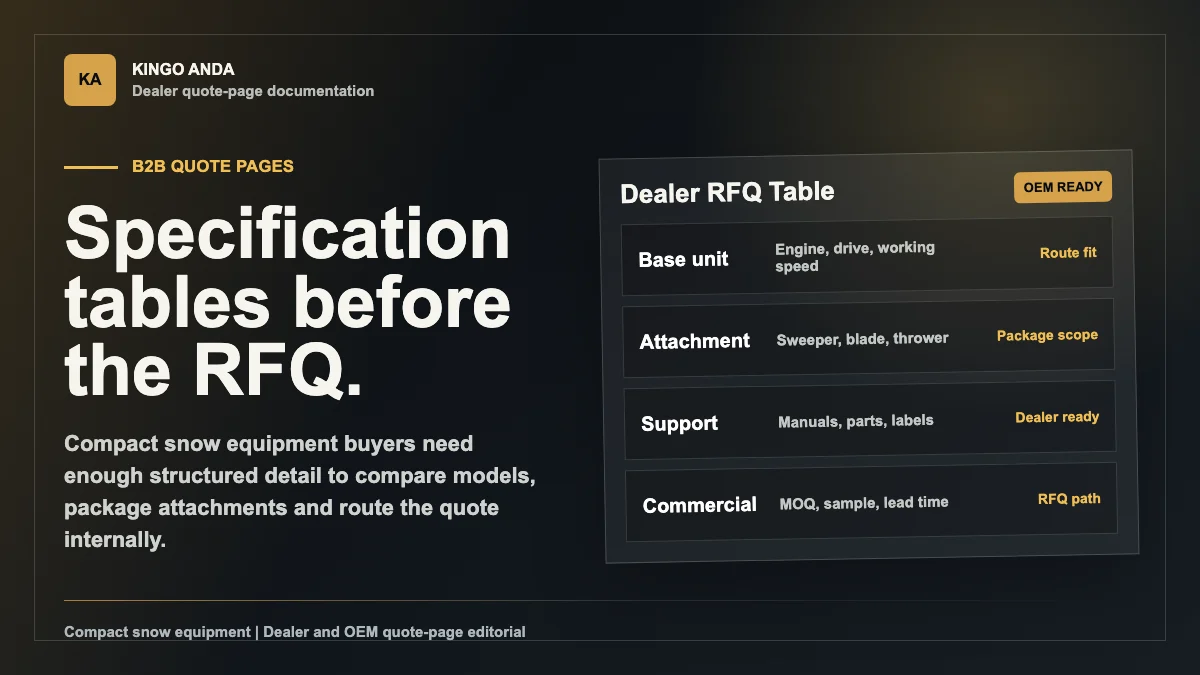
A good dealer quote page does not try to close a compact snow equipment order with a single hero photo. It gives the buyer enough structured information to decide whether the line fits the route, the service model, the warehouse plan and the next purchasing meeting.
That sounds basic, but many equipment pages still make buyers work too hard. Model codes sit beside glossy images, while working width, attachment scope, sample order terms, parts support and document availability are scattered across a brochure, a chat thread or an old PDF. In a B2B sale, that friction is expensive. The first visitor is rarely the only decision maker.
For walk-behind power units and compact snow attachments, the quote page has to behave like a short buying file. It should help a dealer, OEM buyer, municipal purchasing team or facility contractor compare the base power unit, shortlist attachments and send a usable RFQ without asking the same entry-level questions twice.
Why quote-page tables now matter
Industrial buyers are doing more research before they speak to sales. Sagefrog’s 2026 industrial buying analysis points out that stakeholders come to a supplier site with different needs: engineering wants specifications, operations wants reliability evidence, procurement wants commercial terms, and leadership wants risk reduction. If one of those needs is missing, the sales conversation slows down.
Wholesale and B2B commerce research says the same thing in plainer terms. Modern buyers expect self-service product information, clear terms and fast search by SKU, category, product type, variant or use case. They are not browsing like a retail customer. They are collecting evidence for an internal decision.
The larger snow-equipment brands have already trained the market in that direction. BOSS puts a Product Selector, Request a Quote path, Sidewalk Vehicle Builder, manuals, technical information and training videos into visible navigation. The lesson for a compact equipment supplier is straightforward: the buyer should not need to guess what information is available after the first sales call.
Start with the buyer’s job, not the model code
A dealer quote page should open with the job the equipment is meant to do. For compact snow equipment, that usually means sidewalks, campuses, storefront approaches, apartment routes, service yards, factory paths or narrow municipal walkways. The model code belongs in the table, but the table should answer route questions first.
The buyer wants to know whether a snow sweeper is better for light snow on paved entrances, whether a snow blade makes sense for push routes, and whether a compact thrower is needed when windrows or deeper accumulation appear. A good quote table makes those choices visible without overpromising one attachment for every surface.
The first table: base unit and route-fit data
The base-unit table should be practical, not decorative. For a walk-behind power platform, include engine type, drive mode, working speed range, wheel or tire information, operator control notes, approximate machine size, net weight and compatible attachment families. Keep the row labels plain enough for a dealer salesperson to understand and technical enough for a service manager to trust.
Route-fit fields are just as important. Add recommended route types, surface limits, typical user groups and storage requirements. A campus buyer and a small contractor may both need compact snow equipment, but they do not evaluate it in the same way. One cares about staff training and repeatable sidewalk clearance. The other cares about trailer space, attachment changeover and whether the package can produce margin in a tight winter route.
| Table field | Why it belongs on the quote page | Buyer using it |
|---|---|---|
| Working width | Confirms sidewalk, entrance and route coverage before attachment selection. | Dealer sales / municipal buyer |
| Compatible attachments | Prevents mismatched base-unit and attachment quotes. | Dealer sales / OEM buyer |
| Route fit | Connects the machine to light snow, push routes, deep snow or mixed surface use. | Contractor / facility manager |
| Parts pack | Shows whether the dealer can support first-season wear items. | Service manager |
The second table: attachment package and support scope
Attachment pages need their own table because the buying logic changes. A snow sweeper table should show working width, brush type, replacement brush information, surface guidance and common wear parts. A blade table should show blade width, scraper edge material, skid shoe notes, fasteners and angle or push guidance. A thrower table should make clearing width, chute control, wear items and depth suitability clear.
Dealers should also link these rows to support assets. A quote page is stronger when it sends buyers to parts and service support, manuals, service videos, warranty notes and training files. That support layer reduces the fear that a compact imported machine will be hard to maintain after the first shipment.
KINGO ANDA has already built content around attachment compatibility and RFQ preparation. The next step is to use those articles as internal support points: link the quote page to the attachment compatibility table guide and the dealer RFQ checklist so a buyer can move from research to inquiry without losing context.
Commercial fields that belong beside the specs
Some commercial information should sit close to the table. Dealers and OEM buyers need to know whether sample orders are available, what packaging or private-label work can be discussed, what document files can be provided, and what information the supplier needs before preparing a quote path. Hiding all of that behind “contact us” makes the form feel generic.
The table does not need to publish every price or contract detail. It does need to state the input fields required for a serious quote: buyer type, target market, annual volume, attachment set, document requirements, packaging needs, spare-parts plan and expected order timing. Those fields make the first inquiry useful for both sides.
For private-label or OEM supply, add rows for color, logo, carton label, manual language and sample approval steps. For dealer stocking, add rows for starter parts, carton proof, spare brush or scraper items and preseason delivery timing. That is how a page moves from product catalog to B2B sales tool.
How KINGO ANDA dealers can use the table before RFQ
A compact snow equipment quote page should end with a clear path: choose the power unit, choose the attachment set, identify the route type, list the buyer type and submit the request. A dealer should not have to write a long email to explain what is missing.
For buyers reviewing KINGO ANDA packages, start with the product range, compare the base unit and attachments, then use dealer support and parts-service pages to check what documentation can be prepared with the quote. If the order involves OEM branding, sample approval or municipal documents, include those requirements at the beginning instead of adding them after the price discussion.
The better the quote table, the shorter the first sales cycle. It filters poor-fit inquiries, gives serious buyers something they can forward internally, and helps the supplier prepare the right catalog set instead of sending a loose PDF package.
Build a cleaner quote path.
Send buyer type, target route, attachment set, annual volume and document requirements. KINGO ANDA can prepare the right specification table and dealer quote package.
Editorial references: Sagefrog industrial B2B buying analysis, B2BWave 2026 wholesale website checklist, BOSS Product Selector and BOSS support navigation. Image source: locally generated KINGO ANDA editorial graphic, owned site asset.