Product Introduction
Dealer RFQ Checklist for Walk-Behind Power Unit Attachment Packages
Dealers quoting walk-behind power units should confirm buyer type, attachment set, samples, spare parts and packaging before pricing.
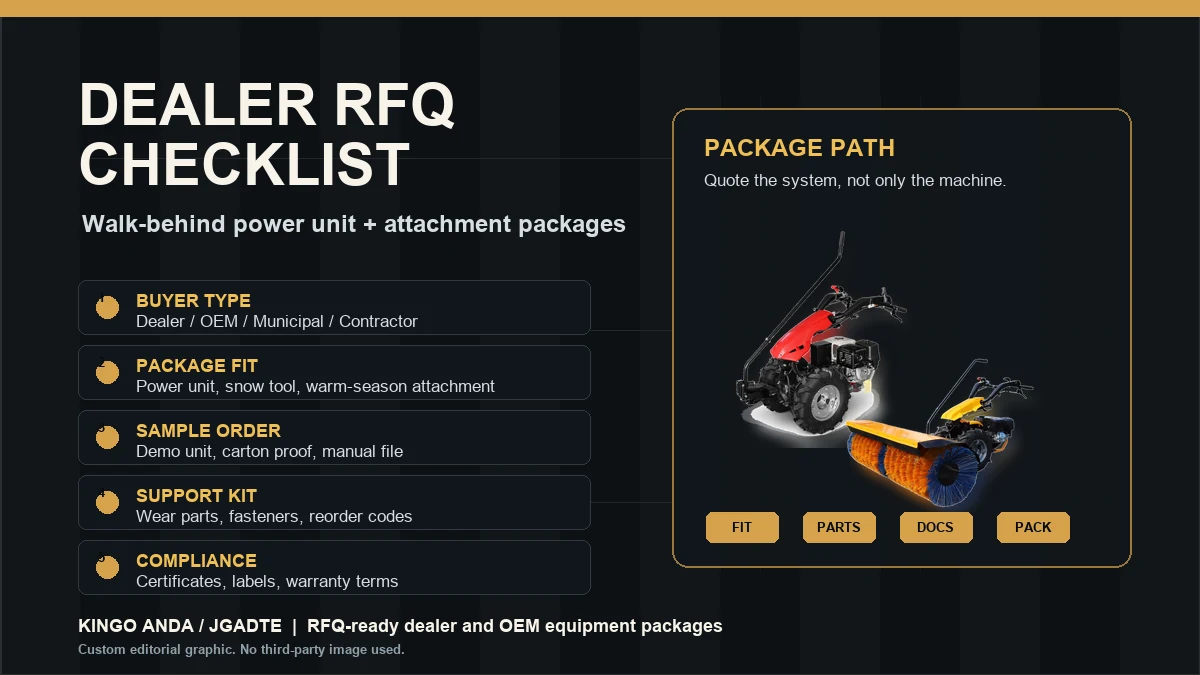
A dealer RFQ for a walk-behind power unit should not read like a spare machine inquiry. If the request says only “send price for one tractor and snow brush,” the supplier can quote a machine, but the dealer still has to solve the real selling problem later: which buyer is it for, which attachment set is being stocked, which parts move with the first order, and what proof will the dealer need before a customer touches the unit.
The better RFQ defines the package. That means power unit, attachment fit, sample plan, support parts, carton/label requirements and the documents needed for a dealer, OEM buyer or municipal channel. For compact equipment, those details are not paperwork. They decide whether the first order becomes a repeatable line or just a one-time sample.
Start with the buyer, not the attachment list
The first line of the RFQ should name the buyer type. A dealer buying for a local winter equipment program has different questions than an OEM/private-label buyer, a municipal channel, a campus maintenance team or a contractor-facing distributor. The same walk-behind power unit can carry a snow sweeper, blade, snow thrower, mower or tiller, but the quote path changes when the sales channel changes.
OPE+ has continued to cover dealer moves, product launches and sales-training topics through 2026, which is a useful reminder that equipment distribution is not only about adding SKUs. It is about how a dealer explains, demos and supports those SKUs. Farm Equipment’s 2026 dealer-group update also shows how concentrated and professional large dealer networks have become. Smaller importers and shortline suppliers have to meet that standard with cleaner RFQ data, not just cheaper unit pricing.
For KINGO ANDA inquiries, the buyer line should state whether the request is for dealer stocking, OEM supply, municipal resale, rental support or a property-maintenance channel. That single line tells the factory what to prepare: a demo package, a repeat-order package, a label-ready private-label set, or a serviceable winter route package.
Define the power unit and attachment fit together
A walk-behind power unit is valuable because it can carry work across seasons. That value is lost if the quote treats the power unit and attachments as separate boxes. The RFQ should name the intended power unit, target attachment set, working widths, mounting interface, drive requirements and whether the buyer expects quick switching between winter and warm-season tools.
Ventrac’s sidewalk snow material is a useful benchmark for how serious equipment brands discuss fit. Their pages do not present a snow tool in isolation; they explain the mount system, front visibility, hydraulic quick-connects and the idea of moving one tractor between tasks. BOSS takes a similar decision-path approach with its Product Selector and Sidewalk Vehicle Builder, asking buyers to match equipment to a vehicle and then move through options and support information.
For a two-wheel platform, the same discipline applies at a smaller scale. Dealers should confirm whether the first package is centered on a snow sweeper, snow blade, snow thrower, rotary tiller, mower, branch crusher or mixed seasonal set. The RFQ should also say whether the dealer wants one clean demo configuration or a broader attachment bundle for catalog presentation.
Use the sample order to test the support path
A sample order is not only a machine test. It is a support test. The dealer should inspect carton labeling, assembly steps, spare-part markings, manual clarity, attachment changeover, cold-start behavior if relevant, and how quickly a technician can identify common service items. The public-facing unit may look fine while the support path is still weak.
This is where many RFQs are too thin. A dealer asks for one or two samples, then discovers later that the carton label does not match its inventory language, the manual file needs editing, or the wear-part list is not written in a way the service counter can use. Those are not design disasters. They are preventable RFQ omissions.
KINGO ANDA has already published separate notes on attachment compatibility before sample orders and dealer support documents and sample orders. The practical next step is to put those questions into the first quote request, before the supplier prepares the package.
Quote parts, cartons and documents before price negotiation
Outdoor power equipment distributors do not win only by listing products. Outdoor Equipment Distributors, for example, emphasizes independent dealer support, accurate ordering and a “One Call, One Solution” service posture. That language matters because dealers do not want to explain missing parts or unclear documentation to their own customers after the sale.
A dealer RFQ should therefore request three support layers with the machine price: the consumable parts list, the packing and label plan, and the document file set. For snow equipment, that can include brush wafers, skid shoes, belts, scraper edges, shear items, fasteners, attachment pins and guards. For private-label or distributor programs, it can also include carton marks, barcode rules, manual covers, warranty text and parts-list formatting.
None of this requires a bloated proposal. It requires a disciplined checklist. The dealer should ask which parts ship with the demo unit, which parts should be stocked for first-season service, and which parts are replenishment-only. If the package includes both winter and grounds-care attachments, the RFQ should split those lists by season so the first order does not become a mixed carton that nobody can explain.
What to send in a clean RFQ
A useful RFQ for a walk-behind power unit attachment package should include the target market, buyer type, intended attachments, expected sample quantity, first commercial order range, private-label needs, required documents, spare-parts expectations and any certificate or compliance requirement. If the dealer already knows the route type, sidewalk width, property type or local service model, that belongs in the request too.
For KINGO ANDA, the fastest path is to send the buyer type, attachment set and expected volume through the Build Your Package form. The support team can then prepare a package path that connects the machine, attachments, service parts, carton proof and documents instead of returning a bare unit price.
That is the difference between quoting a sample and building a sellable line. A dealer does not need every answer before sending the RFQ. But the RFQ should make the commercial problem visible from the start.
Build the package before quoting the machine.
Send the buyer type, market region, attachment set and sample-order target. KINGO ANDA can prepare the power-unit package, parts list and document path together.
Industry sources checked for this article: OPE+ dealer and product coverage, Ventrac sidewalk snow management, BOSS Product Selector, Outdoor Equipment Distributors dealer support positioning and Farm Equipment 2026 dealer-group update.