English trade-editorial updates from KINGO ANDA
Dealer Support for Compact Snow Equipment: Documents, Parts and Sample Orders
Dealers evaluating compact snow equipment can reduce sample-order risk by checking documents, parts support, packaging and route-use fit before RFQ.
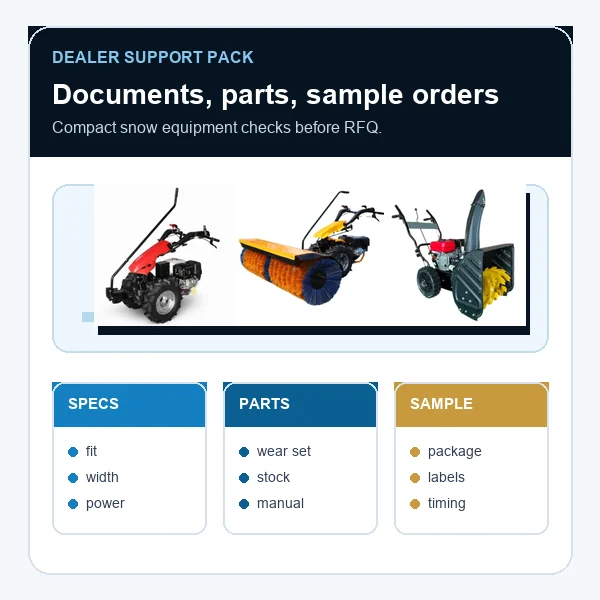
Dealer support for compact snow equipment starts before a quotation is accepted. For a distributor, OEM buyer or property-maintenance channel, a first sample order should create a clear record of the equipment under review, the questions still to be confirmed and the support materials required before wider stocking.
Build the file around exact equipment identifiers
Start with the products that are actually being considered. KINGO ANDA lists a multifunction power unit as the main unit for interchangeable front and rear attachments, a snow sweeper for sidewalks, yards, estates and light commercial snow clearing, a snow blade for walkways, yards and property access routes, and a compact snow thrower for residential, estate and property-maintenance channels.
Those published descriptions are a useful starting point, not a substitute for an order confirmation. Put each product name and its intended channel in the dealer file. Then ask the supplier to confirm the exact configuration, attachment fit, included items and current quotation details for the proposed sample. This keeps a sales conversation from turning into an assumption about compatibility or scope.
Define the purpose of the sample order
A sample order is a review tool. It lets a dealer inspect the product presentation, organize internal questions and decide what needs to be clarified before a broader order. It does not need to become a full line launch. A narrow request built around one base unit and the winter attachments the dealer wants to evaluate is easier to document and follow up.
State the buyer type, destination market, intended use case and sample quantity in the RFQ. If the request includes private-label, dealer-label or OEM requirements, state that separately. Pricing, packaging and attachment compatibility for these products are confirmed by inquiry, so those items should remain open until the supplier has answered in writing.
Ask for documents before making a sales promise
Documents should be requested as part of the sample-order discussion, not after the dealer has promoted an item. A practical checklist can include the materials needed for the intended review: product naming, available product images, parts information, manual or operating-information availability, labeling needs, packaging questions and any market-specific documentation the buyer requires.
Use the request to distinguish what has been provided from what still needs confirmation. Do not describe a manual, certificate, warranty term, packing method or spare-parts package as included unless it has been confirmed for the exact order. That record is useful for both the purchasing team and the people who will later answer customer questions.
Keep parts questions specific and traceable
Parts support becomes easier when every question is attached to an exact product and proposed configuration. Instead of asking whether parts are generally available, ask for the part-identification process, the parts information available for the quoted item, and the options for a first spare-parts request. If a dealer wants to hold spares, it should ask which items are relevant to its own proposed sample and market.
The Parts & Service page is the appropriate starting point for a support inquiry. Keep the RFQ, supplier response and later order confirmation together. A simple written trail is more useful than relying on a product image or a general sales statement after the sample arrives.
Confirm packaging, labels and commercial details separately
Commercial details need their own questions. Ask about packaging format, carton or crate markings, labeling, lead-time expectations, minimum order conditions and the information required for a destination-market quotation. For OEM or private-label work, identify the requested brand presentation and artwork process without assuming that a specific label or package has already been approved.
A dealer should also record the contacts responsible for the request and the date each answer was received. That makes it possible to compare a later order confirmation with the original sample request and prevents old notes from being presented as current facts.
Use a review record before wider stocking
After the sample is reviewed, capture what was received, the configuration reviewed, outstanding supplier questions and the decision for the next step. The next step may be a revised quotation, an additional document request, a parts inquiry or a separate commercial discussion. It should not be assumed from the first sample alone.
For help preparing a product-specific request, contact Dealer Support or send an inquiry to KINGO ANDA. Include the product links, target market and the documents or commercial details you need confirmed. That gives the supplier a concrete brief and gives the dealer a support record it can use before committing to wider inventory.
Frequently asked questions
Can a dealer assume every attachment fits every power unit?
No. Request confirmation of the exact configuration and attachment compatibility for the proposed quotation. The published product pages are an introduction; compatibility is confirmed by inquiry.
What should be included in the first support request?
Include the exact products, intended market, sample quantity, buyer type, requested documents, parts questions, packaging needs and any dealer-label or OEM requirements.
Where should a dealer ask about parts or service?
Use the Parts & Service route and identify the product and configuration under discussion. This helps the support team respond to the right item rather than a general product category.
Dealer package planning
Need a compact snow equipment support file before RFQ?