Tag: Industry News

  • Compact Snow Thrower Attachment Parts: What Dealers Should Stock Before Winter

    Compact Snow Thrower Attachment Parts: What Dealers Should Stock Before Winter

    KINGO ANDA dealer planning notesBuild a winter equipment package

    Industry Products

    Compact Snow Thrower Attachment Parts: What Dealers Should Stock Before Winter

    Dealers stocking compact snow thrower attachments should separate shear items, belts, skid shoes, chute parts and manuals before winter demand hits.
    Published July 14, 2026Snow Thrower PartsDealer Stocking
    Compact snow thrower attachment parts checklist for dealer winter stocking

    A compact snow thrower attachment can sell as a simple winter add-on, but it is not a simple support item. Once a dealer puts the attachment into a sidewalk, campus or property-maintenance program, the parts conversation starts immediately: shear items, belts, chute controls, skid shoes, scraper edges, fasteners, manuals and model-fit records.

    Dealers that prepare those parts before the first storm look organized. Dealers that wait until an auger stops turning or a chute handle binds end up using winter service time to build a parts system they should have had in September. For compact equipment, the inventory does not have to be large. It has to be correctly separated, labeled and tied to the power unit and attachment model.

    Start with model fit, not parts volume

    The first question is not how many parts to buy. It is which attachment version, power unit and connection package the dealer is actually supporting. BCS lists snow thrower attachments with compatible tractor models and notes required connection accessories such as a PTO extension or quick hitch. That is the right frame for any dealer program: parts planning follows the matched system, not a generic snow-blower shelf.

    For KINGO ANDA, this means the dealer should map the compact snow thrower attachment to the selected walk-behind power unit, coupling point, working width, chute-control layout and intended route. A dealer selling to sidewalk contractors may need a different starter pack than a dealer selling to estates, schools or small municipal crews.

    The same rule belongs in the quote process. Before asking for a container price, the buyer should confirm attachment fit, first-season spare parts, manual files and carton labeling. The dealer RFQ checklist is the best internal link for that step.

    Stock shear items and belts as first-response parts

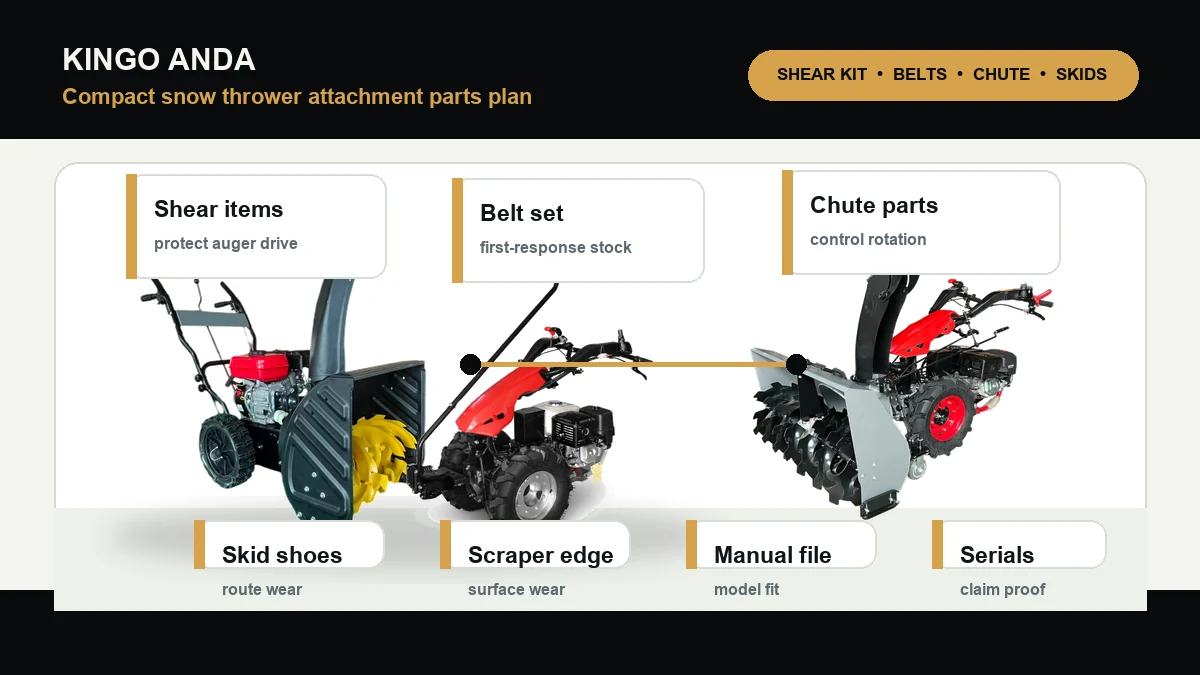
    Shear items and belts should be treated as first-response parts, not emergency discoveries. Ariens maintenance guidance reminds owners to remove shear pins before greasing augers and then replace the shear bolts after lubrication. Ariens operator material also treats broken shear bolts as a normal response when an obstruction stops auger rotation, with OEM replacements recommended.

    That does not mean every compact thrower uses the same hardware. It means dealers should not open winter with a vague note saying “order later.” The starter kit should identify shear bolts or pins by model, compatible fasteners, belt set, pulley or tensioner references where applicable, and the expected restock path. If a dealer sells the attachment as part of a private-label or regional program, that part naming has to be clear in the manual and parts sheet.

    Cub Cadet’s parts catalog is useful as a public benchmark because it separates snow blower belts, shear pins, slide shoes, cables, friction wheels, discharge chutes and auger gearboxes into distinct categories. A dealer does not need to copy that retail structure, but the same separation helps counter staff find the right item quickly.

    Treat chute, skid shoe and scraper wear as route-specific

    Thrower attachments fail in different ways depending on the route. A paved campus sidewalk, a mixed gravel estate lane and a municipal path with curb edges do not put the same wear on skid shoes, scraper edges and chute controls. BCS describes adjustable skids on its snow thrower as a way to set height for surfaces such as gravel or rocky routes. That surface detail should be visible in the dealer’s setup conversation.

    For a compact program, put route type into the parts plan. If the buyer is clearing abrasive surfaces, the skid-shoe and scraper-edge line matters. If the operator frequently changes direction near parked cars, chute-control parts and handle protection matter. If the buyer runs wet snow, the dealer should pay attention to chute cleanliness and the fasteners around the discharge path.

    This article pairs with the earlier KINGO ANDA piece on snow sweeper wear parts. Sweepers and throwers do not consume the same parts, but the dealer habit is the same: name the wear items before winter, not after the first service complaint.

    Keep manuals, serials and service notes in the same file

    Parts support is only as good as the file behind it. BCS maintains service information, bulletins and operator manuals for tractors and attachments, including model and serial-number guidance. For compact equipment dealers, that is not just a manufacturer service habit. It is a sales-support habit.

    Every stocked snow thrower attachment should have a basic dealer file: model, serial or batch record, matched power unit, first shipment date, carton label, exploded-parts reference if available, service-parts starter kit, warranty boundary and photo record. If the attachment is being sold under an OEM/private-label arrangement, the file should also include the buyer’s item code and manual-cover naming.

    This connects directly to the dealer warranty packet published yesterday. A warranty claim without model and serial records becomes slow. A parts counter without a parts naming system becomes expensive. The two documents should be built together.

    Put the parts kit into the dealer quote

    Compact snow equipment demand is moving toward smaller routes and mixed fleets. Sno-Way’s 2026 trend note points to more compact equipment for walkways, HOA properties, campuses and municipal sidewalk networks, alongside continuing labor pressure. Those buyers do not want a parts mystery. They want the dealer to support the package after the first snowfall.

    The dealer quote should therefore include more than the attachment price. It should show the power unit, thrower attachment, connection accessories, first-response parts kit, wear-part list, manual file, carton-label requirements and restock contact. The kit can be modest, but it must be clear.

    The best parts kit is not the largest kit. It is the kit that matches the exact attachment, route and support promise the dealer is selling.

    Dealers preparing compact snow thrower orders can use Parts & Service and the spare-parts starter kit guide as planning references. For a quote path, send the target market, attachment set, route type and expected winter volume through Build Your Package.

    Build the attachment quote with parts included.

    Share power unit selection, route type, thrower attachment and first-season volume. KINGO ANDA can align the quote with parts and documents.

    Request Quote

    Industry references checked: Sno-Way 2026 snow removal trends, BCS snow thrower attachment information, BCS service bulletins and manuals, Ariens snow blower maintenance guidance, Cub Cadet snow blower parts categories, Ariens operator manual shear-bolt guidance.
  • Dealer Warranty Packets for Compact Snow Equipment: What to Prepare Before Winter Claims

    Dealer Warranty Packets for Compact Snow Equipment: What to Prepare Before Winter Claims

    KINGO ANDA dealer planning notesBuild a winter equipment package

    Dealer Support

    Dealer Warranty Packets for Compact Snow Equipment: What to Prepare Before Winter Claims

    Dealers stocking compact snow equipment should prepare serial records, parts lists, photos and service rules before winter warranty claims start.

    Published July 13, 2026Warranty PacketsService Claims
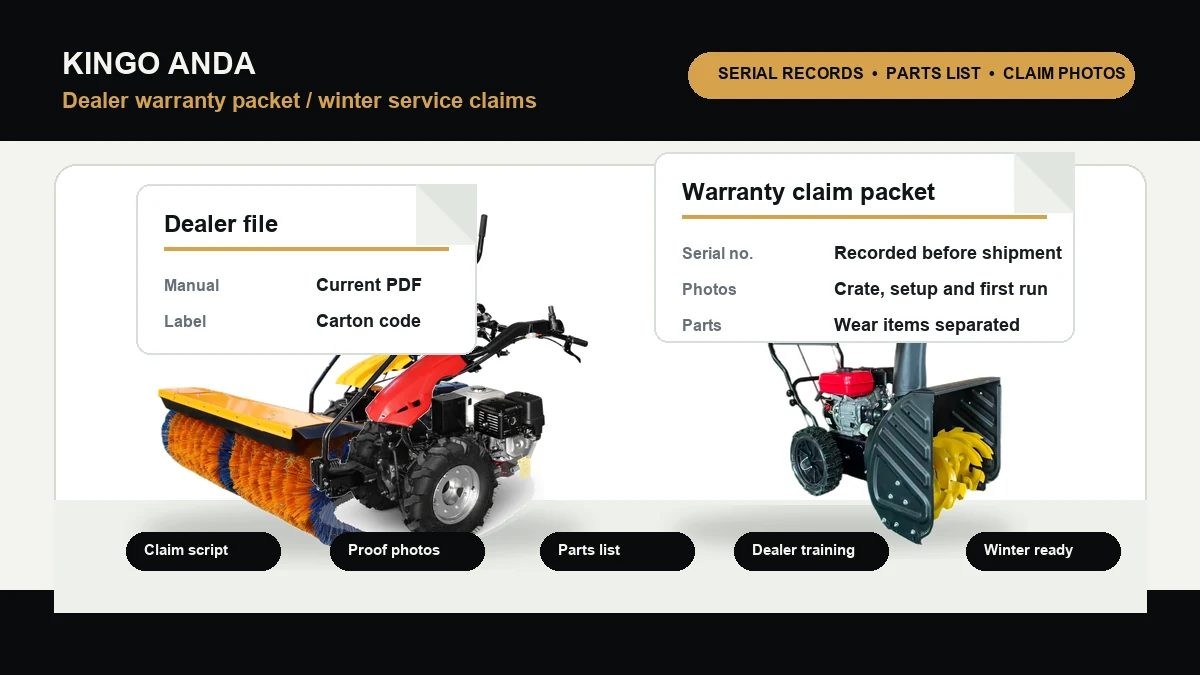
    Dealer warranty packet checklist for compact snow equipment and walk-behind attachments

    A dealer warranty packet is not paperwork for the back office. In winter equipment, it is part of the product. When the first storm hits, the dealer counter is dealing with cold machines, impatient contractors, municipal buyers, missing serial numbers and photographs taken after the damage already happened. If the packet is weak, every small claim becomes a longer argument.

    Compact walk-behind snow equipment makes this more important, not less. These machines often work on sidewalks, campus paths, HOA routes, shop fronts and other tight-access jobs where operators change frequently. Dealers stocking a power unit, snow sweeper, blade or compact thrower should prepare the warranty and service file before the season starts. By the time claims arrive, it is already late.

    Put serial numbers and purchase records in the same packet

    The first rule is simple: the dealer should be able to match a machine, an attachment and a sale without searching through three systems. M-B Companies’ manual library is a useful reminder because the company asks buyers to provide the serial number when they need specific assistance. That is standard equipment practice, but many small programs still treat serial numbers as an afterthought.

    For a walk-behind program, the dealer file should record the power unit serial number, attachment serial or batch code, invoice date, carton label, buyer name, delivery photo and setup notes. If the attachment can move between power units, make that visible. A later claim on a sweeper brush, belt guard or snow-thrower housing will be easier to judge when the dealer knows exactly which unit carried which attachment.

    That record belongs in the same commercial package as the dealer RFQ checklist. A clean RFQ names the buyer type, first-season attachment set and expected annual volume. A clean warranty packet proves that the same package can be supported after it ships.

    Treat wear parts separately from warranty parts

    The second mistake is mixing normal wear with warranty discussion. Snow sweepers, blades and throwers have parts that should wear: brush wafers, scraper edges, skid shoes, belts, shear items, pins, fasteners and guards. A dealer should stock those parts and explain them up front. If every worn scraper edge is handled like a warranty claim, the program will lose time and credibility.

    Green Industry Pros’ snow-season preparation guidance puts spare parts directly into preseason work: inspect equipment and stock items such as hoses, pins, belts and electrical parts before the season starts. The lesson carries over to compact equipment. The supplier should help the dealer decide what goes into the starter kit and what belongs in the warranty language.

    KINGO ANDA dealers can pair this packet with the dealer spare-parts starter kit and the snow sweeper wear-parts checklist. The warranty file should not pretend these parts do not exist. It should define them clearly.

    Record photos before the first storm, not after a claim

    Photographs are strongest when they are boring. The dealer should capture the crate, carton mark, machine condition, attachment mount, guard clearance, control position and first setup before the unit leaves the shop. Those photos are useful for dealer training, but they also protect the warranty process when a later claim involves transport damage, missing hardware or incorrect assembly.

    Do not wait for a broken unit to start documenting the program. A preseason photo set gives the supplier, dealer and buyer a shared reference. It also helps when a dealer is building a private-label or regional stocking program, because the carton mark, manual cover, label language and attachment naming can be checked before the first pallet order.

    For B2B buyers, this is not cosmetic. BOSS presents genuine parts, manuals, registration and dealer service as part of the ownership path. Compact equipment suppliers should learn from that structure. A product page can sell the machine, but the support packet keeps the dealer from looking unprepared when the season gets busy.

    Give counter staff a claim script

    A good warranty packet should include the words a dealer counter needs to use. The script does not need to be theatrical. It should ask for the model, serial number, attachment, purchase date, operating condition, photos, failed part, hours or job count if available, and whether the item is a known wear part. It should also tell staff when to send the buyer to parts support instead of opening a warranty claim.

    RPM Tech’s after-sales page points to technical support, training, dealer/service network and maintenance support around snow equipment. That is the right direction for a dealer program. Training is not only factory-to-technician; it is also counter-to-customer. The buyer should hear the same answer whether they call sales, parts or service.

    KINGO ANDA’s Parts & Service page should be used as the public route for this message. The dealer packet can then carry the internal version: who receives the claim, what files are required, which photos are mandatory and what response time the dealer should expect.

    Make the supplier packet part of the RFQ

    Warranty documents should not be requested only after a container ships. Dealers should ask for the packet during the RFQ stage, especially when the order includes multiple attachments or an OEM/private-label requirement. The supplier should be able to provide current manuals, part names, carton-label examples, serial-number rules, basic warranty language, claim photo requirements and recommended first-season spare parts.

    Sno-Way’s 2026 trend note describes continued pressure around efficiency, labor and compact equipment for campuses, HOA properties and municipal sidewalk networks. Those are dealer markets where downtime creates immediate complaints. A supplier that can show warranty discipline before the order will be easier to trust when the first winter call comes in.

    The warranty packet is a selling document. It tells a dealer whether the factory understands what happens after the product leaves the crate.

    Dealers preparing winter stocking orders can send buyer type, target market, power unit selection, attachment set and expected volume through Build Your Package. Ask for the warranty packet, spare-parts starter list and sample-order support file in the same request. KINGO ANDA can prepare the right catalog set and quote path for dealer, OEM or municipal supply programs.

    Ask for the support packet before winter orders.

    Share your target market, attachment set and stocking volume. KINGO ANDA can align the quote with parts, manuals and warranty documentation.

    Request Quote

    Industry references checked: Green Industry Pros snow-season preparation guidance, RPM Tech after-sales support, BOSS genuine parts and dealer support, M-B Companies manuals and serial-number support, Sno-Way 2026 snow removal trends.

  • Walk-Behind Snow Equipment Sample Orders: What Dealers Should Test Before Stocking

    Walk-Behind Snow Equipment Sample Orders: What Dealers Should Test Before Stocking

    KINGO ANDA dealer planning notesBuild a winter equipment package

    Industry Products

    Walk-Behind Snow Equipment Sample Orders: What Dealers Should Test Before Stocking

    Before stocking walk-behind snow equipment, dealers should test attachment fit, service parts, carton labeling and support documents.

    Published July 10, 2026Sample OrdersDealer Stocking
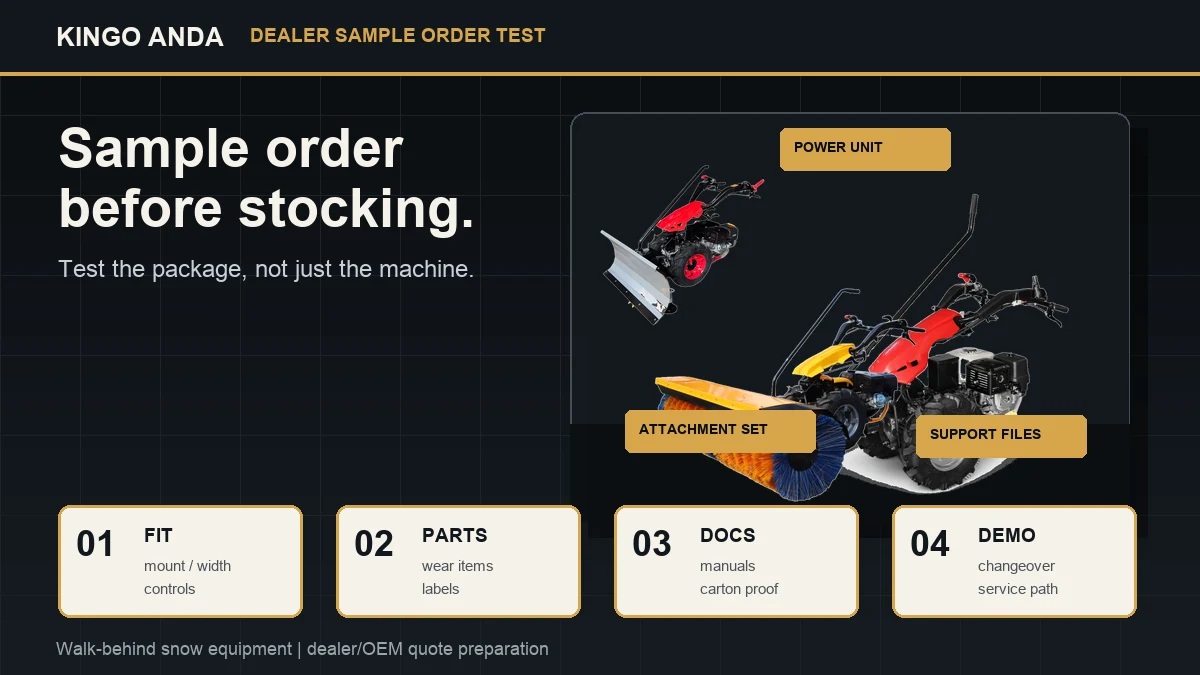
    Walk-behind snow equipment sample order test checklist for dealers

    A sample order is the cheapest place to find out whether a walk-behind snow equipment line can actually be sold and supported. It is not a miniature purchase order. It is a field test for fit, paperwork, parts language, packing discipline and the story a dealer will have to tell at the counter.

    That matters more in 2026 because buyers are not only asking for another winter machine. Contractors want fewer passes from fewer operators, property teams want equipment that works on sidewalks and tight access routes, and dealers want packages that do not create service confusion after the first storm. A sample order should answer those questions before the dealer stocks a full winter program.

    Test the route before testing the price

    Start with the jobsite. A sidewalk route, campus path, municipal walkway, HOA property and small commercial frontage do not need the same first package. Sno-Way’s 2026 trend note points to labor pressure and the expanding use of compact equipment for walkways, HOA communities, campuses and municipal sidewalk networks. That is exactly the territory where a walk-behind power unit can make sense, but only if the sample order is matched to the work.

    Dealers should ask for the target route width, typical snow condition, surface material, storage space and operator skill level before finalizing the sample configuration. If the buyer is mostly clearing narrow sidewalks, a broad attachment that looks impressive in the showroom may be less useful than a cleaner, easier-to-service snow sweeper or blade package.

    Bobcat’s attachment guidance frames the same point well: choice depends on how snow is moved and where the machine is working. For a walk-behind package, the dealer should put that thinking into the RFQ instead of asking only for model numbers.

    Confirm attachment fit as a complete system

    The first sample should prove the platform and attachment together. That means mounting points, working width, control reach, belt or drive interface, guard clearance, transport height and the time needed to switch tools. A dealer does not need a lab report for every detail, but it does need to know whether a technician can explain the setup without calling the factory for every small question.

    This is why the sample order should reference the intended walk-behind power unit and the exact first-season attachment set. If the dealer is planning a winter-first launch, the package may focus on snow sweeper, snow blade and compact snow thrower options. If the same customer base also buys warm-season tools, add mower or rotary tiller fit checks to the same review sheet, but keep the first shipment disciplined.

    KINGO ANDA’s earlier note on attachment compatibility before sample orders is still the right companion piece: fit is not only whether the attachment can connect. It is whether the package can be sold, changed over and serviced by the dealer’s own team.

    Use the sample to inspect parts and labels

    A clean demo is not enough. Dealers should open the crate, identify every loose part, check the label language, and build a first-season wear-parts list while the sample is still on the floor. Snow equipment brings predictable service items: brush wafers, belts, scraper edges, skid shoes, guards, pins, fasteners and shear items where applicable. If those parts are not named clearly, the dealer will pay for the confusion later.

    Outdoor power equipment software companies keep emphasizing seasonal inventory because dealers have to buy, count and price inventory before the rush. Windward’s OPE material, for example, discusses seasonal inventory levels and buying decisions. That is not a software-only issue. It is a supplier issue too. The factory should help the dealer understand what parts belong with the sample, what parts belong with the first stocking order, and what parts can wait for replenishment.

    For KINGO ANDA packages, this should be tied to the Parts & Service path. A dealer sample order should not leave parts planning as a second email thread.

    Check documents like a service counter would

    The manual file, parts list, carton mark and label proof are part of the product. A dealer should read them the way a service counter will use them: can the staff identify the attachment, match the part, explain the changeover and answer the first buyer’s questions without rewriting the supplier’s material?

    BOSS presents snow and ice equipment through product categories, sidewalk vehicle options, parts and service paths. That is a useful standard for smaller equipment suppliers: the buyer should see a system, not a pile of parts. For a sample order, the dealer should request PDF manuals, parts diagrams, carton-label samples, warranty language and any private-label file requirements before negotiating volume price.

    If the program may become OEM or private label, the sample order should also test what the outside of the carton says. The product may be mechanically sound, but a weak carton mark, mismatched item name or unclear manual cover can make the line look unfinished.

    Write the sample order as a repeat-order rehearsal

    A good sample order should be written so the second order is easier, not harder. It should list buyer type, target route, power unit model, attachment set, requested spare parts, labeling requirements, documents, sample quantity and the expected follow-up decision. That gives the supplier a clear package path and gives the dealer a useful internal checklist.

    Municipal and public works procurement notices, such as the 2026 snow removal equipment acquisition listing from Grand Rapids, show how early winter equipment decisions can enter the calendar. Dealers serving those channels should not wait until the first cold week to learn that a sample package lacks the right support material.

    The point of a sample is not to prove that one machine can run. The point is to prove that a dealer can stock, explain and support the package after the first order.

    Dealers preparing a KINGO ANDA sample order can use the dealer RFQ checklist as a starting point, then add route width, first-season attachment plan and support-part requirements. For a quote path, send the buyer type, target market, sample quantity and attachment set through Build Your Package.

    Build a sample package before stocking.

    Share route type, attachment set, sample quantity and support-part needs. KINGO ANDA can prepare a dealer or OEM sample quote path.

    Request Quote

    Industry references checked: Sno-Way 2026 snow removal trends, Bobcat snow attachment selection guidance, BOSS snow and ice equipment categories, Windward OPE inventory planning, Grand Rapids 2026 snow equipment acquisition notice.

  • Snow Sweeper Wear Parts Dealers Should Confirm Before Winter Orders

    Snow Sweeper Wear Parts Dealers Should Confirm Before Winter Orders

    KINGO ANDA dealer planning notes Build a winter equipment package

    Industry Products

    Snow Sweeper Wear Parts Dealers Should Confirm Before Winter Orders

    Dealers stocking compact snow sweepers should confirm brush wafers, skid shoes, scraper edges and fasteners before winter orders lock.

    Published July 8, 2026 Dealer Parts Planning Snow Sweepers
    Dealer checklist for snow sweeper wear parts before winter orders

    Snow sweeper orders are often discussed as machine orders. That is convenient for the first quote, but it is not how the first winter is won. A dealer can place a compact sweeper in front of a municipality, campus buyer or property-maintenance contractor and still lose confidence if the wear parts are vague.

    The question is not whether a brush will wear. It will. The question is whether the dealer knows which brush wafers, skid shoes, scraper edges, belts, pins and fasteners belong with the first shipment. For compact sidewalk equipment, that conversation should happen before winter orders lock, not after the first operator calls from a route.

    Parts planning is now part of the sale

    Dealer aftermarket demand gives the parts conversation more weight. Farm Equipment’s 2026 aftermarket coverage reported that more than half of surveyed dealers expected parts revenue to increase over 2025, while service revenue expectations also remained positive. For a snow-equipment dealer, that is more than a revenue note. It is a reminder that the machine sale and the support sale are tied together.

    Commercial snow operations also leave little room for weak support. Facility-maintenance cost guides continue to point to equipment maintenance, repairs and replacement parts as real operating costs for winter service providers. Municipal news out of New Haven in early 2026 showed how heavy snow can create budget and equipment pressure at the same time, with some snow-removal vehicles temporarily out of service during a storm response. Dealers do not control the weather, but they can control whether common wear items are named, stocked and reorderable.

    This is why a compact snow sweeper should be quoted with a parts path. The buyer may not ask for every item on day one. The dealer still needs the list before the first demo, sample order or container plan is finalized.

    Brush wafers and broom rings come first

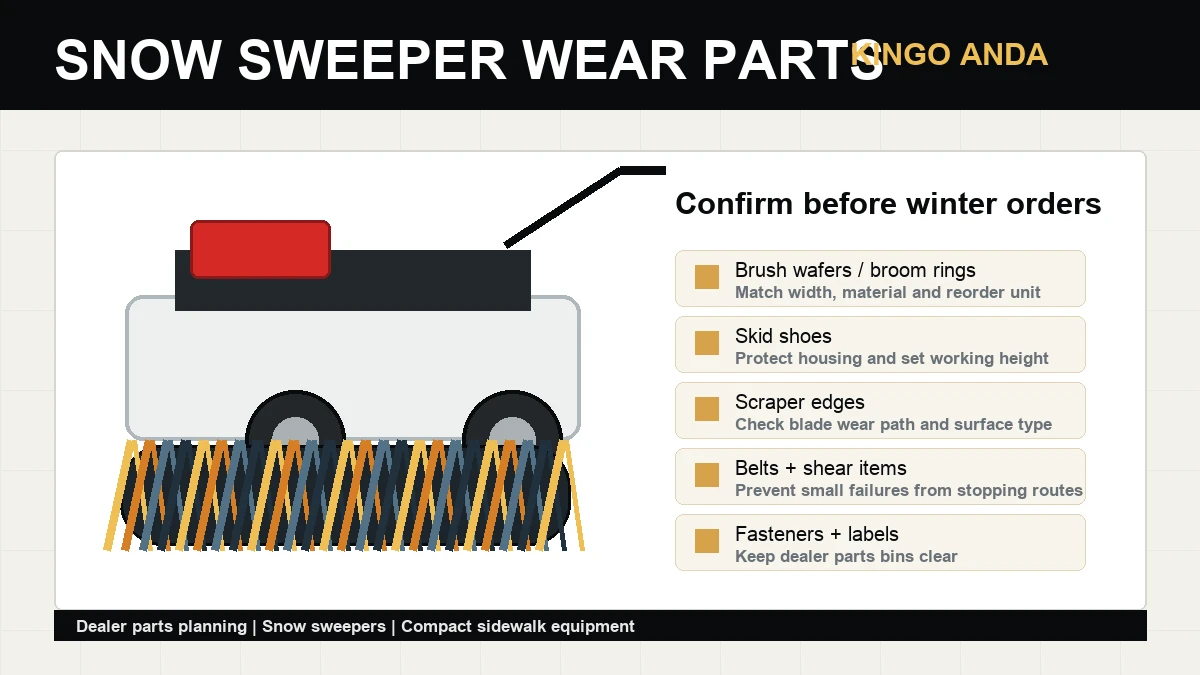
    The brush is the visible working part of a snow sweeper. It is also the item most likely to create confusion if the parts description is loose. Dealers should confirm the brush style, working width, wafer or ring count, material, left/right orientation if applicable, and whether the factory sells replacement brushes as individual pieces, sections or complete assemblies.

    For a dealer program, the best parts list is not just a name and a price. It should identify the sweeper model, brush width, matching power-unit model, packing quantity, minimum reorder unit and any seasonal lead-time warning. If a brush is shared across more than one attachment or model year, that should be written clearly. If it is not shared, that should be written even more clearly.

    Sno-Way’s 2026 snow-removal trend discussion pointed to more attention on sidewalk precision and efficient material use. The same logic applies to sweepers: buyers working around entries, schools, transit stops, campus paths and storefronts are buying control as much as clearing power. Uneven brush wear or unclear replacement supply undermines that control.

    Skid shoes and scraper edges protect route uptime

    Skid shoes and scraper edges do not always look important in catalog photos, but they decide how the attachment meets the surface. Sidewalk routes are rarely perfect. They include concrete joints, pavers, ramps, curb cuts, patched asphalt and transitions around landscaping. A dealer should know which wear points are intended to contact the ground and which parts should be replaced before the housing or brush frame is damaged.

    The checklist should separate consumable wear parts from structural service parts. Skid shoes, scraper strips and edge items belong in the first category. Housings, shafts, frames and drive components should not become emergency replacements because a low-cost wear item was not stocked.

    Bobcat’s snow-removal equipment pages position snow attachments around different job areas, including narrow sidewalks and broader work sites. That language reflects how buyers think. They do not buy a sweeper in isolation. They buy a route solution, and the parts kit has to match the route surface.

    Belts, pins and fasteners need named bins

    Small hardware can stop a winter route just as easily as a brush problem. Dealers should confirm belt sizes, shear items, locking pins, cotter pins, mounting bolts, guards and any attachment-specific fasteners that are likely to be removed during routine service. These parts are not glamorous, but they are the difference between a clean service counter and a parts bin built from guesses.

    For imported compact equipment, naming matters. A dealer should not rely on a translated description that says only “belt” or “bolt.” The useful version names the model, position, dimensions, compatible attachment and reorder code. If private-label packaging is planned, the dealer should decide whether those parts need its own labels, barcode structure or service manual references.

    The July KINGO ANDA note on dealer spare-parts starter kits covers the broader stocking logic. For snow sweepers, the tighter rule is this: every wear item in the first shipment should have a name that a service counter can repeat without opening the machine.

    What dealers should ask before the RFQ

    A strong RFQ for a snow sweeper should not ask only for machine price. It should list the target buyer, route type, expected working width, intended power unit, sample quantity, first-season volume, private-label needs and the wear parts expected in the first shipment. The dealer should also ask which items are usually paired with a demo unit and which are kept for replenishment.

    For KINGO ANDA, the practical package can connect the walk-behind power unit, snow-removal attachments, starter wear parts, documents and carton labels into one quote path. That matters for dealers and OEM/private-label buyers because the first winter is not a showroom event. It is a support test.

    Before ordering, dealers should send the intended attachment set, buyer type, region, first shipment volume and service expectations through the RFQ path. The more precise the parts conversation is before the order, the easier it is to build a winter package that can actually be supported.

    The first sweeper order should include the machine, the attachment fit, the wear-part list and the reorder rule. Anything less pushes winter support back onto guesswork.

    Build the sweeper order with the wear-part kit.

    Send the sweeper width, power-unit model, expected route type and first-season volume. KINGO ANDA can prepare the attachment quote, parts list and document path together.

    Request Quote

    Industry sources checked for this article: Farm Equipment 2026 aftermarket outlook, Sno-Way 2026 snow-removal trends, Bobcat snow-removal equipment guidance, Trillium commercial snow-removal cost guide and New Haven Register municipal snow-removal budget coverage.

  • Sidewalk Snow Equipment Preseason Order Calendar for Dealers

    Sidewalk Snow Equipment Preseason Order Calendar for Dealers

    KINGO ANDA dealer planning notes Build a winter equipment package

    Industry News

    Sidewalk Snow Equipment Preseason Order Calendar for Dealers

    A preseason order calendar helps compact snow equipment dealers align demos, attachments, parts and documents before winter demand hits.

    Published July 7, 2026 Dealer Planning Sidewalk Snow Equipment
    Preseason order calendar for sidewalk snow equipment dealers

    Preseason snow orders usually fail quietly before the first storm. The dealer waits too long to confirm the attachment mix. The factory sends a quote without the wear-part path. The buyer asks for manuals, carton labels or sample photos after the container plan is already tight. By November, everyone is still talking, but the season has already moved.

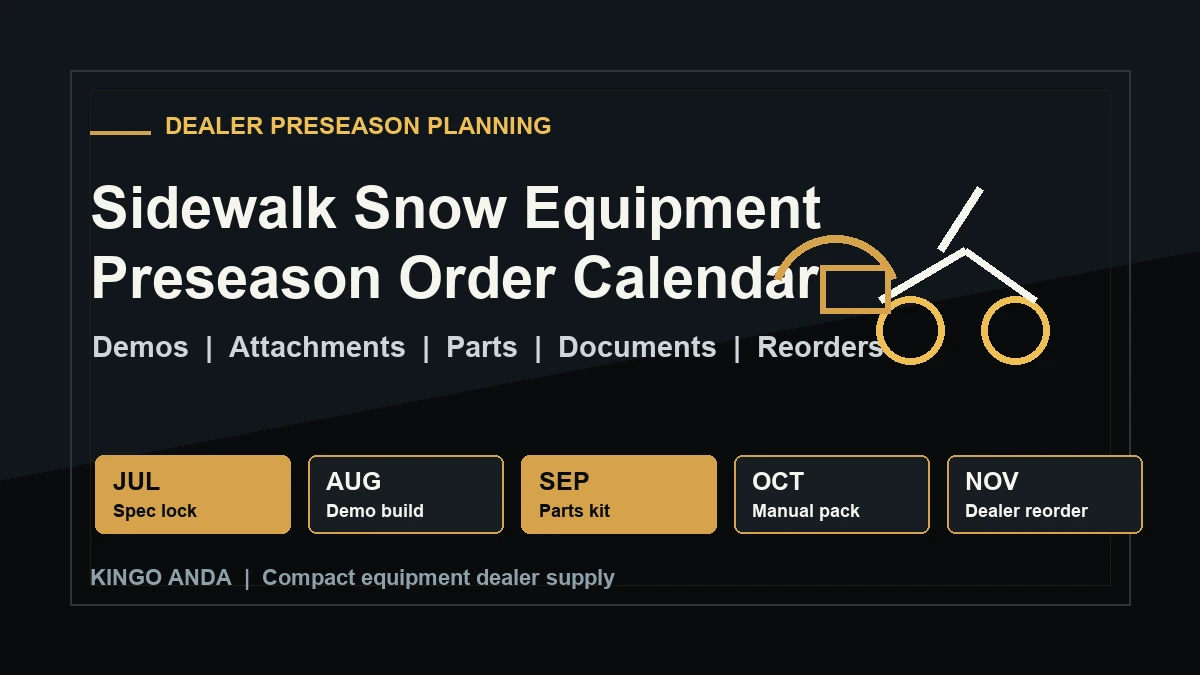
    For compact sidewalk snow equipment, July through October should be managed as a calendar, not as a loose inquiry queue. Dealers need enough time to compare sweepers, compact throwers and blades, decide which units can be demonstrated, confirm the attachment package, and prepare the first parts order before route managers begin winter scheduling.

    Why the calendar starts before buyers feel winter pressure

    Dealer outlook data makes one point clear: aftermarket and service work still matter even when wholegoods demand is uneven. Farm Equipment’s 2026 aftermarket outlook reported that more than half of surveyed dealers expected service revenue to increase over 2025, with a similar outlook for parts revenue. That is useful context for snow equipment because winter products are not sold only as machines. They are sold as route uptime, parts availability and dealer confidence.

    Municipal and campus sidewalk work adds another reason to start early. A 2026 Michigan sidewalk agreement reported by the Big Rapids Pioneer showed how snow removal responsibility can become the practical blocker on a sidewalk project when the owner lacks the proper equipment or personnel. For dealers, that is the commercial signal: buyers are not simply shopping for steel. They are trying to solve a maintenance obligation.

    July: lock the buyer type and first attachment set

    July is the month for narrowing the market, not filling a warehouse. A dealer should decide whether the first package is built for municipalities, campus facilities, property-maintenance contractors, rental counters or rural property owners. Each buyer group changes the attachment mix.

    • Municipal sidewalk teams often care about route width, operator visibility, service parts and documentation.
    • Campus and HOA buyers usually compare sweepers, blades and throwers against mixed surfaces, tight turns and pedestrian safety needs.
    • Contractor channels need simple quoting, fast replenishment and equipment that can be explained to crews without a long handover.
    • Dealer showrooms need a demo unit that looks complete, with compatible attachments and clear literature.

    For KINGO ANDA packages, July is also the right time to separate the core power unit from the seasonal attachments. One buyer may need a snow sweeper and blade first. Another may need a sweeper, compact thrower and spare brush kit. A year-round dealer may want snow removal plus soil or mowing attachments so the unit is not presented as a one-season product.

    August: build the demo and photo proof

    By August, the dealer should know what will be shown to buyers. A demo unit does not need to represent every configuration, but it must answer the first practical questions: how the attachment connects, what the working width is, where the wear items sit, how the controls feel and what photos the sales team can use.

    This is where many small equipment programs look weaker than they are. The machine may be capable, but the buyer sees a loose image, a missing spec sheet or a configuration that does not match the quoted package. Dealers should request a clean photo set for each attachment family, a basic compatibility table and the document files that will be used in RFQ follow-up.

    Snow equipment manufacturers have trained buyers to expect fit tools, service libraries and dealer support paths. Sno-Way’s 2026 snow-removal trend coverage, for example, points to compact and mixed fleets serving walkways, HOA communities, campuses and municipal sidewalk networks. Even when a dealer is selling smaller walk-behind equipment rather than truck plows or UTV plows, the buyer expectation is similar: the package should look planned.

    September: confirm parts before the first winter order

    September is late enough for winter buyers to pay attention and early enough to fix the package. It is the right month to confirm the wear-part kit, not the right month to discover that parts were never discussed.

    The starter list should be tied to the attachment set: brush wear parts for sweepers, belts or shear items for throwers, scraper edges and skid parts for blades, plus the basic service items for the power unit. The point is not to overstock. The point is to protect the first season so the dealer can support the machines already sold.

    The recent KINGO ANDA note on dealer spare-parts starter kits covers the parts logic in detail. For preseason planning, the rule is simpler: never quote the winter package without a parts path. If the buyer has to ask later, the dealer has already made the package feel incomplete.

    October: finish documents, labels and reorder rules

    October should be the clean-up month. The dealer should not still be debating basic fit, model names or carton marks. This is when quote files, manuals, carton labels, spare-parts names, warranty notes and reorder contacts are checked against the final shipment plan.

    Public snow-removal budgets show why this matters. In Connecticut, CT Insider reported a 2026 municipal snow-removal overrun tied to labor, salt, sand and equipment pressures. That story is about a city budget, not a walk-behind machine order, but it reflects a buyer reality that dealers should respect: snow operations are unforgiving when cost, materials and equipment readiness collide.

    A dealer-ready October package should include the equipment quote, attachment list, spare-parts starter kit, product images, manual files, carton label requirements and a clear reorder process. If private-label or OEM work is involved, packaging and manual files should be confirmed before artwork changes start moving through the factory.

    What dealers should send with the RFQ: a strong request is short, but it should be specific. Send the target market, region, first attachment set, intended demo quantity, expected preseason volume, document needs, certification requirements and whether private-label packaging is required. That gives the supplier enough context to build a practical package rather than a price-only reply.

    KINGO ANDA can support compact snow equipment programs around walk-behind power units, snow removal attachments and dealer/OEM document needs. The most useful conversation starts before the winter rush: what needs to be shown, stocked, labeled and reordered before the first buyer depends on the machine.

    Treat preseason ordering as a calendar: July locks the package, August proves the demo, September protects parts and October cleans the document path.

    Plan the winter package before the rush.

    Send the target market, attachment mix, expected volume and document requirements. KINGO ANDA can prepare the equipment, parts and quote path together.

    Request Quote

    Industry sources checked for this article: Rural Lifestyle Dealer June 2026 industry roundup, Farm Equipment dealer revenue outlook, Farm Equipment 2026 aftermarket outlook, Big Rapids sidewalk plowing agreement coverage, CT Insider municipal snow-removal cost coverage and Sno-Way 2026 snow-removal trends.

  • Dealer Spare-Parts Starter Kits for Compact Snow Equipment

    Dealer Spare-Parts Starter Kits for Compact Snow Equipment

    KINGO ANDA dealer operations notes Build a winter equipment package

    Industry News

    Dealer Spare-Parts Starter Kits for Compact Snow Equipment

    A practical spare-parts starter kit helps compact snow equipment dealers quote, service and restock sweepers, throwers and blades before winter.

    Published July 6, 2026 Dealer Program Parts & Service
    Dealer spare-parts starter kit checklist for compact snow equipment

    A spare-parts starter kit is not a box of leftovers. For a dealer handling compact snow equipment, it is the difference between selling a winter package and supporting that package when the first route fails in bad weather. The machine sale starts the relationship, but the wear parts decide whether the buyer trusts the dealer after the first storm.

    That is why the starter kit belongs in the first commercial conversation, not after the container is already packed. If the dealer is quoting a snow sweeper, compact snow thrower, snow blade or multi-attachment power unit, the quote should also answer a simple service question: what parts will the dealer need on hand before winter work begins?

    Why parts planning is moving into the front of the quote

    The aftermarket is carrying more weight in equipment channels. Rural Lifestyle Dealer reported that more than half of surveyed dealers expected parts revenue to rise at least 2 percent in 2026, and service revenue expectations were also broadly positive. That does not mean every dealer should overstock. It means the parts conversation is no longer a back-room detail.

    Outdoor power equipment dealer metric guides also put service revenue, parts and accessory sales, customer retention and inventory turnover close to daily management. Those numbers turn a parts kit into a working capital question: too little stock slows service, but random stock ties up money in parts that do not move.

    Snow equipment makes the problem sharper because demand arrives in a narrow window. A municipal buyer, campus maintenance team or property contractor may accept a delayed attachment shipment in July. They will not be patient when a scraper edge, belt, bearing or brush component is missing in January.

    What belongs in a dealer starter kit

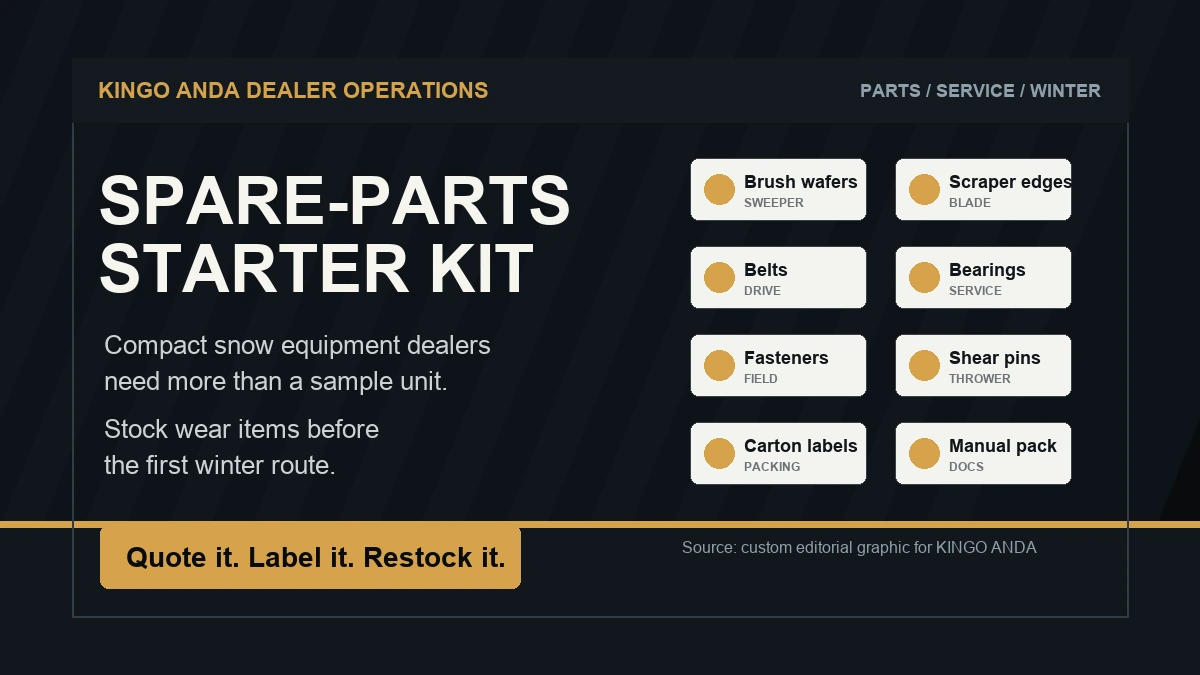
    The exact list depends on the attachment mix, but the logic is consistent. The kit should cover the parts most likely to be damaged, consumed, misplaced or needed during first service. It should not try to be a full warehouse.

    • For sweepers: brush wafers or brush sections, side wear items, guard hardware and the fasteners most likely to be removed during adjustment.
    • For compact throwers: shear pins, belts, scraper or skid items, common bearings and small hardware that can stop a repair if missing.
    • For blades: scraper edges, skid shoes, pivot hardware and visible fasteners that take route abuse.
    • For power units: belts, cables, filters, common service hardware and labels needed for dealer handover.

    A useful first kit also includes a document pack. The parts list, exploded view, carton label file and basic service notes should travel with the parts, not sit in a separate email thread. Large snow brands make this visible by keeping parts, manuals, service libraries and dealer support paths close to the product experience. BOSS Genuine Parts, SnowEx service publications and Blizzard parts and service all present support as part of the buyer’s operating path, not as an afterthought.

    Size the kit from route risk, not from a fixed percentage

    Many factories default to a percentage of order value when they suggest spare parts. That is simple, but it is not always useful. A dealer ordering a few demo units needs a different kit from a distributor preparing preseason stock for multiple service counters.

    The better method starts with the route and customer type. Sidewalk sweepers working around curbs, pavers and mixed debris need different wear coverage from a thrower sold for cleaner snow conditions. Campus and municipal buyers usually care about downtime and documentation. Rental or contractor channels need quick part identification and a stocking list that a counter employee can use without calling the factory.

    For first orders, KINGO ANDA buyers should separate three groups: demo parts, first-service parts and reorder parts. Demo parts keep the sample unit presentable. First-service parts protect the first buyer deliveries. Reorder parts are the items the dealer should replenish after early season sales reveal the actual pattern.

    Make the kit easy to sell and easy to restock

    The strongest starter kit is labeled in dealer language. Part names should match the catalog. Each bag or carton should connect to the model and attachment family. The dealer should be able to look at a part, find the item number, confirm the fit and quote the replacement without rebuilding the answer from photos.

    This is also where packaging work matters. The article on compact snow equipment packaging for dealers covers carton marks and label discipline in more detail. The same principle applies here: if the warehouse cannot identify the kit quickly, the customer-facing support promise becomes weak.

    A starter kit should also connect back to the Parts & Service page and the Dealer Support path. Dealers need a route for catalog files, spec sheets, manuals, sample-order questions and replenishment. The parts kit is only useful if the support path is obvious after the first shipment.

    How to request a KINGO ANDA starter kit

    When requesting a quote, buyers should send the target market, first attachment set, expected annual volume and the type of dealer support needed. A snow-focused package may start with a sweeper, thrower and blade mix. A year-round equipment channel may combine snow removal with mowing, tilling or utility attachments.

    From there, the starter kit can be built around the real first shipment rather than a generic parts percentage. That gives the dealer a cleaner showroom story, a better first-service plan and a stronger reorder path before winter pressure exposes the gaps.

    The practical goal is simple: quote the machine, quote the attachment set and quote the parts path before the buyer has to ask.

    Build a dealer-ready winter package.

    Send the attachment mix, target buyer type and expected volume. KINGO ANDA can prepare the equipment quote, document set and starter-parts recommendation together.

    Request Quote

    Industry sources checked for this article: Rural Lifestyle Dealer 2026 dealer revenue outlook, BOSS Genuine Parts support page, Ideal Computer Systems dealership metrics guide, SnowEx service publications and Blizzard parts-service library.

  • Dealer Demo Unit Setup for Walk-Behind Power Units Before Fall Equipment Shows

    Dealer Demo Unit Setup for Walk-Behind Power Units Before Fall Equipment Shows

    KINGO ANDA compact equipment editorial Dealer, OEM and property-maintenance buying notes
    Industry News Dealer Demo Unit Setup for Walk-Behind Power Units Before Fall Equipment Shows

    Dealers preparing walk-behind power unit demos should lock attachments, test photos, spare parts and quote files before fall equipment shows.

    Published July 3, 2026 Dealer Demo Units Walk-Behind Equipment
    Dealer demo unit setup checklist for walk-behind power units and attachments

    A dealer demo unit is not a showroom ornament. It is a commercial test. The buyer wants to know whether the machine can be explained quickly, moved safely, photographed cleanly, supported with parts and quoted without the factory rebuilding the file every time a new attachment is added.

    That matters more as the fall equipment-show calendar moves closer. Equip Exposition lists its 2026 Louisville show for October 20-23 and promotes a large outdoor demo yard where dealers and contractors can test equipment, not just look at it. For compact equipment suppliers, that is a useful reminder: a demo package has to survive the real questions that come after the first photograph.

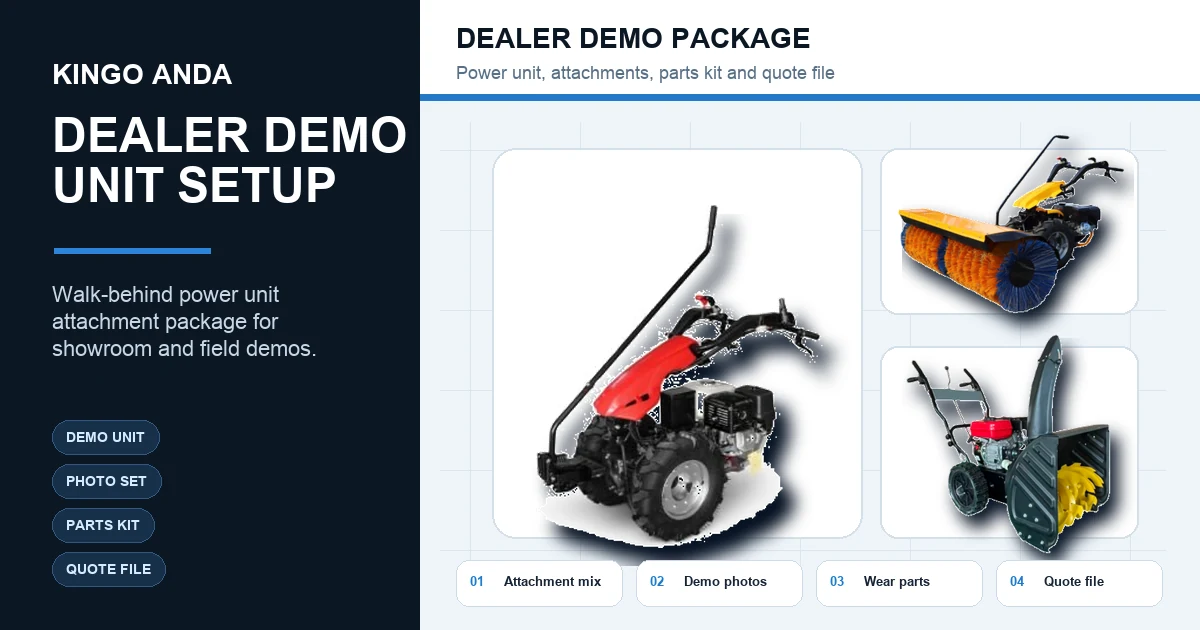
    For a walk-behind power unit, the strongest demo package is rarely one machine by itself. It is the power unit, the first two or three attachments, the wear-parts plan, the photo set and the quote file arranged so a dealer can present the package with confidence.

    Start with the job mix, not the machine label

    The mistake is to begin with a model code and then hope the buyer understands the use case. A better demo starts with the work: sidewalk snow removal, mixed facility maintenance, property cleanup, small estate grounds care, rental counter use or dealer showroom comparison.

    A multifunction power unit can carry different stories depending on the attachment set. A snow dealer may want the power unit shown with a snow sweeper and compact snow thrower. A grounds-care dealer may want mowing, tilling or washing attachments in the same conversation. The demo unit should make that job mix obvious before the sales team starts explaining.

    Dealers should define the first demo route in practical language: route width, expected snow depth or soil condition, transport method, storage limits, operator skill level and the kind of customer who will see the unit first. That information decides which attachments belong in the first sample, and which should wait.

    Build the demo unit around proof points

    A useful demo package should prove five things. The power unit starts cleanly. The attachment locks in correctly. The working width is clear. The wear parts are easy to identify. The dealer can explain the package without opening a technical manual in front of the buyer.

    That does not require a huge sample order. It requires a disciplined one. The first package should normally include the core power unit, one hero attachment, one comparison attachment, the most important consumable parts and a simple document set. If the market is winter-focused, the hero attachment may be a sweeper, with a thrower or blade used as the comparison. If the market is year-round maintenance, the snow attachment can sit beside mowing or soil-preparation equipment.

    The point is not to show every SKU. The point is to show that the dealer can build a repeatable package from the snow-removal attachment line and expand from there.

    Photograph the package before the buyer asks

    Dealers lose time when the photo set is treated as an afterthought. A good demo unit should be photographed before it leaves the factory: power unit alone, power unit with each attachment, side view, operator position, label placement, spare-parts pack, carton or crate, and one clean composition for a quote sheet.

    Those photos are not just for marketing. They help the dealer’s sales team, parts counter, service bench and buyer contact speak from the same file. If the sample arrives and the only available photo is a cropped product image on a white background, the dealer has to rebuild the story locally.

    For private-label or OEM discussions, the photo set also prevents confusion around labels and finish details. The buyer can see what is fixed, what can be branded, and what still belongs to the manufacturer’s support identity.

    Test the service items that stop a demonstration

    The spare-parts pack should be built around failure points, not catalog width. A demo can be stopped by a belt, brush, scraper edge, skid shoe, cable, shear pin, bearing, fastener or filter long before the dealer needs a complete parts wall.

    The Parts & Service file should travel with the demo quote. It should name fast-wear items, recommended starter quantities, replacement intervals where available, and the support path for the dealer’s first season. If the sales team has to ask for those details after the unit is already in the showroom, the supplier has made the dealer do avoidable work.

    For compact snow equipment, the service file should match the attachment. A sweeper has different first-season concerns than a thrower. A mixed package needs the differences stated clearly.

    Separate show assets from shipment assets

    A dealer preparing for a fall show needs one set of assets for selling and another set for receiving. The selling set includes product photos, short descriptions, buyer-use notes, attachment comparisons and a clean quote sheet. The receiving set includes carton marks, label maps, packing photos, spare-parts lists and document files.

    Do not mix those into one loose folder. A buyer-facing quote should not force the dealer to sort through crate photos. A warehouse file should not hide the model code under sales copy. Clean separation makes the package easier for the dealer to use and easier for the factory to repeat.

    KINGO ANDA’s dealer path should keep both sides ready: the product story for the buyer, and the shipment story for the team that has to receive, stock and service the unit.

    What to send before asking for the demo quote

    A strong RFQ should include the target market, dealer type, first demo purpose, attachment mix, expected order volume, private-label needs, required photos, spare-parts expectations and any document requirement already known. For snow-focused buyers, add route width, snow condition, surface type and storage limits.

    The better the RFQ, the less likely the supplier is to quote a generic machine that still needs to be rebuilt into a sellable dealer package. A useful demo unit should arrive with the attachments, files and support pieces that let the dealer start real conversations.

    Dealers can begin with the Dealer Support page, compare related equipment notes in the blog, and send the final buyer profile through the contact page. The goal is not a bigger first sample. The goal is a demo package that can turn into a repeatable dealer program.

    Build Your Package

    Send the target market, attachment mix and demo-unit requirements.

    Request Demo Quote
  • Compact Snow Equipment Packaging for Dealers: Carton Marks, Labels and Spare-Parts Packs

    Compact Snow Equipment Packaging for Dealers: Carton Marks, Labels and Spare-Parts Packs

    KINGO ANDA compact equipment editorial Dealer, OEM and property-maintenance buying notes
    Industry Products Compact Snow Equipment Packaging for Dealers: Carton Marks, Labels and Spare-Parts Packs

    Dealers importing compact snow equipment should confirm carton marks, labels, spare-parts packs and document sets before preseason orders.

    Published July 2, 2026 Dealer Packaging Snow Equipment
    Compact snow equipment packaging checklist for dealers with carton marks labels and spare parts

    Packaging is where a compact snow equipment program stops being a product idea and becomes something a dealer can receive, store, explain and service. A good carton does not sell the machine by itself. A bad one can make the first order look improvised before the buyer has even unpacked the power unit.

    The calendar is already tight. SIMA’s 2026 snow show has just put contractors and suppliers through another June buying cycle, Equip Exposition is pointing outdoor power equipment dealers toward its October 2026 Louisville program, and APWA keeps public-works snow planning tied to training, fleet readiness and winter operations. Dealers who wait until autumn to settle carton marks, labels, spare-parts packs and document files are late.

    For a distributor, OEM buyer or property-maintenance channel, compact snow equipment should arrive as a package, not a loose collection of machines. That package has to move through a warehouse, a dealer counter, a service bench and a first customer visit without forcing the buyer to guess.

    Carton marks should answer warehouse questions

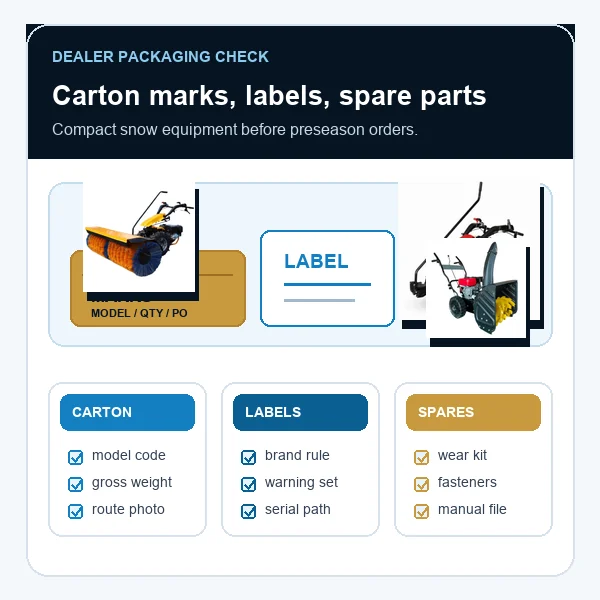
    Carton marks are not decoration. They are a low-cost way to prevent receiving mistakes. A practical carton mark should show the model code, attachment name, purchase order or batch reference, quantity, gross weight, carton size, country requirement if applicable, and any handling note that keeps the equipment from being stacked or opened the wrong way.

    For compact snow equipment, the mark should also separate the power unit from the attachment. A multifunction power unit is not the same inventory item as a snow sweeper, even when both are sold as one winter package. If the cartons are unclear, the dealer’s first inventory count is already weak.

    The better question is not whether the factory can print a mark. It is whether the mark matches the quote, the packing list, the spare-parts file and the photo set used by the dealer’s own team.

    Label approval belongs before the first shipment

    Labels become sensitive when the buyer plans dealer branding, private label work, or a mixed product line that must sit beside established machines. A small warning label, serial label or model sticker can delay a shipment if the size, language, material or placement is decided after production.

    Dealers should ask for the label map before the sample order: where each label sits, which labels are mandatory, which can carry a dealer brand, which must stay with the manufacturer’s model identity, and how serial numbers will be recorded. The goal is not to over-design the first order. The goal is to avoid discovering during receiving that the product cannot be shown cleanly.

    This matters for OEM buyers as well. A private-label snow attachment still needs consistent naming, safe warning placement and a repeatable serial path. If the first batch uses one label rule and the second batch uses another, after-sales support gets harder than it needs to be.

    Spare-parts packs should be built around downtime

    The common mistake is to make the spare-parts pack look broad instead of useful. A dealer does not need every low-probability component in the first sample shipment. It needs the parts most likely to stop a demonstration, delay a repair or make the first customer lose confidence.

    For winter attachments, that usually means wear parts and fast-moving service items: brushes, scraper edges, belts, skid shoes, shear pins, fasteners, bearings, cables, guards and filters where the package requires them. For a compact snow thrower or sweeper, the spare pack should be tied to actual route use, not copied from a full catalog.

    The Parts & Service conversation should happen with the quote. If the dealer has to ask for a wear-kit recommendation after the sample arrives, the RFQ was not specific enough.

    Crates, pallets and import checks need early attention

    Compact equipment often looks simple until it crosses a border. Pallet type, crate material, wood-packaging treatment, carton strength, moisture protection, accessory separation and label visibility can all affect receiving. International wood-packaging requirements vary by market, and buyers should confirm the applicable rules before a shipment is packed.

    This is not legal paperwork for the sake of paperwork. It is a commercial issue. A dealer that loses a week to unclear pallet marks or a broken crate is not thinking about reorder volume. It is thinking about whether the supplier is ready for export business.

    The safest approach is to agree on a packaging photo set before shipment: closed carton, open carton, inner protection, accessory bag, spare-parts pack, label placement, carton mark, pallet or crate, and the final loaded view where possible.

    Photo assets make the dealer’s job easier

    Most suppliers send product photos and stop there. A dealer needs more. It needs enough packaging and support photos to show its own team what is arriving and to answer simple buyer questions without opening every box.

    A compact snow package should include clean product photos, attachment photos, package photos, parts-kit photos and one or two route-use images if available. The dealer may use those assets in a product sheet, a sales email, a counter conversation or a service note. Bad photos create extra work. Missing photos slow the buyer down.

    KINGO ANDA already has a broad snow-removal attachment line. The next level is to make each quote easier to handle by tying the product photo, carton mark, label rule and spare-parts pack into one consistent file.

    What dealers should send in the RFQ

    A strong dealer RFQ should not ask only for price. It should tell the factory which market is being served, which buyer type is targeted, the first order or sample quantity, the attachment mix, expected annual volume, private-label or dealer-label needs, carton mark requirements, spare-parts expectations, and any import or document requirement the dealer already knows.

    For snow equipment, add the route detail: sidewalk width, expected snow depth, surface type, storage limits, whether the buyer needs sweeping, throwing, pushing or a mixed package, and whether the dealer expects a demonstration unit before stock orders. That information helps narrow the package before the quote is written.

    The most useful path is to start with Dealer Support, compare related posts in the blog, and send the final buyer profile through the contact page. The best compact snow equipment order is not just a machine order. It is a receiving-ready, sellable, serviceable dealer package.

    Build Your Package

    Send the market, volume, label and spare-parts requirements.

    Request Quote Path
  • Dealer Support for Compact Snow Equipment: Documents, Parts and Sample Orders

    Dealer Support for Compact Snow Equipment: Documents, Parts and Sample Orders

    Dealer support and compact snow-equipment planning
    English trade-editorial updates from KINGO ANDA

    Industry Products
    Dealer Support for Compact Snow Equipment: Documents, Parts and Sample Orders

    Dealers evaluating compact snow equipment can reduce sample-order risk by checking documents, parts support, packaging and route-use fit before RFQ.

    Published July 1, 2026
    Dealer Program
    KINGO ANDA Blog

    Dealer support pack for compact snow equipment documents parts and sample orders

    Dealer support for compact snow equipment is not only a sales promise. For a distributor, OEM buyer or rental-channel operator, it is the difference between a clean sample order and a winter complaint that should have been prevented in June.

    The timing matters. The 2026 SIMA Snow & Ice Symposium has just put snow contractors, manufacturers and suppliers together in Cincinnati, while Equip Exposition is already steering outdoor power equipment dealers toward its October 2026 education calendar in Louisville. APWA’s snow conference language points in the same direction for public works buyers: winter maintenance is an operating system, not a machine purchase.

    That is the right frame for compact snow equipment. A buyer can like the look of a power unit, sweeper, thrower or blade. The dealer still has to prove that the package can be quoted, sampled, stocked, serviced and explained when the first storm exposes every weak assumption.

    Start with the dealer’s approval file

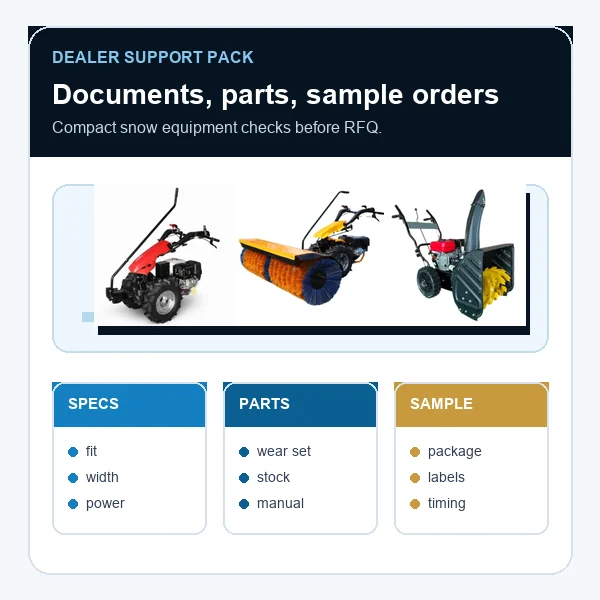
    A dealer does not need a glossy brochure before every first conversation. It needs a compact approval file that answers the questions a buyer will ask before money moves. The file should include model names, working width, basic power-unit fit, attachment weight, package dimensions, crate information, wear-part list, recommended spare set and the documents available after order confirmation.

    This is where many compact-equipment quotes become soft. The supplier sends a picture and a price. The dealer then has to ask again for fit details, packaging, labels, parts, manuals and service notes. By the time those answers arrive, the buyer may have moved back to a familiar brand or a local substitute.

    For a compact snow line, the approval file should be built around the job the dealer is trying to win: sidewalk cleanup, campus routes, municipal pedestrian areas, property-maintenance fleets, dealer demo stock, or OEM/private-label winter programs.

    Separate the sample order from the catalog

    A sample order should not be treated as a small catalog order. It has a different purpose. The dealer is testing whether the platform is sellable, whether the attachment story is easy to explain, and whether the first customer can be supported without a long email chain.

    That means a sample package should be narrow. A dealer might test the multifunction power unit with one winter lead attachment, such as the snow sweeper, plus a second attachment that changes the sales conversation, such as the compact snow thrower or snow blade. Adding every possible tool to the first shipment usually makes the test harder, not better.

    The practical sample-order question is simple: what must the dealer see, assemble, operate, photograph and explain before committing to a broader winter package? That answer should drive the first shipment.

    Parts support belongs in the quote, not after the sale

    Snow equipment fails commercially when small parts become large delays. Brushes, belts, scraper edges, skid shoes, shear pins, bearings, cables, filters, fasteners and guards do not look important in a hero photo. They decide whether the dealer can keep the buyer running after the first serious route.

    For that reason, the Parts & Service path should be part of the first RFQ. A dealer should ask which items wear fastest, which parts are shared across attachments, which parts are unique to a specific attachment, and which spare set should ship with the first sample order. If the answer is vague, the price is not ready yet.

    Dealer buyers should also separate emergency spares from normal stocking. A starter wear kit is not a full parts program. But it is enough to keep a demo unit useful, protect the first buyer experience and collect field notes before larger stock is ordered.

    Documents are a B2B product feature

    In compact snow equipment, documents are not administrative leftovers. They are part of the product. A dealer may need assembly instructions, parts diagrams, maintenance intervals, carton marks, serial-number rules, label placement, product photos, warranty boundaries and private-label packaging details before the equipment can move through its own sales channel.

    For OEM/private-label buyers, the document set matters even more. A buyer may approve the machine only after checking packaging, logo placement, certificate needs, manual language, spare-part naming and whether the supplier can keep future shipments consistent. A machine that works but cannot be documented cleanly is still a weak OEM product.

    That is why the document checklist should be discussed before the sample order. It is much cheaper to settle naming, labeling, manuals and spare parts before the first crate leaves the factory than after the dealer has built a sales story around the wrong assumptions.

    Use current trade-show activity as a planning deadline

    SIMA’s June snow-industry calendar and Equip Exposition’s October dealer calendar create a useful rhythm. June is the right time to turn winter product interest into a tighter support package. October is late for discovering that the dealer still lacks parts guidance, sample-order logic or documents.

    APWA’s snow conference cycle also shows how public-works buyers think. Their winter-maintenance decisions are tied to routes, crews, safety, equipment support and operating continuity. A dealer that wants those buyers should not lead only with horsepower or working width. It should lead with a package that can be supported through the season.

    For KINGO ANDA, that means a compact snow equipment package should be described as a working system: base platform, snow attachment, secondary attachment, spare set, document pack, sample-order path and dealer/OEM follow-up.

    What to send before asking for pricing

    A useful dealer RFQ should be short but specific. Send the target market, buyer type, expected annual volume, first attachment set, sample-order quantity, packaging needs, label or private-brand requirements, spare-parts expectations, and the route conditions the equipment must handle.

    For winter equipment, also include the typical sidewalk width, snow depth range, surface type, storage limits and whether the buyer expects sweeping, throwing, pushing or a mixed route package. That information lets a supplier narrow the package before quoting.

    KINGO ANDA’s Dealer Support path is the right place to start that conversation. Buyers can review the broader snow-removal attachment line, compare package needs through the blog, and send the final dealer or OEM request through the contact page. The strongest compact snow equipment quote is rarely the fastest price. It is the one that arrives with the support file already in order.

    Dealer package planning

    Need a compact snow equipment support file before RFQ?

    Request Specs

  • Campus Sidewalk Snow Removal Equipment: Sweepers, Throwers and Blades

    Campus Sidewalk Snow Removal Equipment: Sweepers, Throwers and Blades

    Campus and facility snow-equipment planning
    English trade-editorial updates from KINGO ANDA

    Industry Products
    Campus Sidewalk Snow Removal Equipment: Sweepers, Throwers and Blades

    Facility teams can compare sweepers, throwers and blades by route width, snow type, priority zones, parts support and operator readiness.

    Published June 25, 2026
    Campus Routes
    KINGO ANDA Blog

    Campus sidewalk snow removal equipment choice guide for sweepers, throwers and blades

    The useful question for campus sidewalk snow removal equipment is not which attachment looks strongest in a catalog. It is which tool keeps priority routes open when the storm is still changing.

    That question is active again this week. The 2026 SIMA Snow & Ice Symposium is running June 23-26 in Cincinnati, with snow contractors, manufacturers and suppliers comparing equipment and operating strategies before the winter buying season. APWA has also just closed another North American Snow Conference cycle, and its event language keeps the focus where public works buyers actually live: safer winter maintenance solutions for communities.

    Campus facility teams sit between those two worlds. They are not only buying a machine. They are protecting students, staff, visitors, service entrances, ADA routes, event access, steps, plazas and curb transitions with limited crews and changing weather.

    A campus is not one route

    Large campuses make the equipment choice harder because the job is split into many route types. A university may have broad pedestrian malls, narrow sidewalks, stairs, loading doors, residential entries, curb cuts and parking-lot edges. One attachment cannot be expected to handle all of those conditions equally well.

    University of Michigan’s winter-maintenance page is a good example of the route problem. Its grounds operation describes mapped equipment routes, geographic zones and the use of plow and rotary broom attachments on sidewalks and plazas. Pitt’s facilities team gives another scale reference: close to 32 miles of sidewalks and pathways, more than 2,000 steps, and a mix of trucks, tractors, utility vehicles, snow blowers, shovels and ice scraping equipment.

    That is why a campus equipment package should start with the route map, not the machine list. The buyer needs to separate light snow from packed snow, entry cleanup from long sidewalk passes, and immediate egress routes from second-pass cleanup.

    Where a sweeper belongs

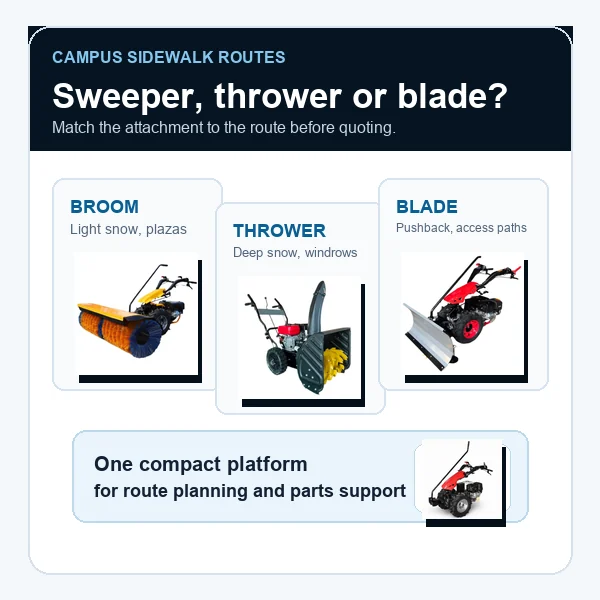
    A snow sweeper earns its place when the route needs clean pavement, repeated passes and less surface damage. It is often most useful on plazas, pedestrian walks, building approaches and routes where a thin snow layer can turn into a slip problem if it is left behind.

    For dealers and facilities teams, the sweeper discussion should include route width, brush wear, snow depth, pavement type and whether the surface is usually treated before the storm. If the route is mostly light accumulation with frequent cleanup, the sweeper can be the lead attachment. If the campus sees heavy accumulation or windrows pushed across sidewalk edges, it should not be the only answer.

    That is also where the multifunction power unit becomes a buying point. A compact platform can support a winter attachment without forcing the buyer into a single-purpose machine that sits for the rest of the year.

    Where the thrower or blade changes the quote

    A compact snow thrower belongs in the conversation when the route has deeper snow, narrow edges, piles that need relocation, or places where pushing snow would block access. A thrower is not automatically faster on every sidewalk, but it solves a different problem from a broom.

    A snow blade is often easier to explain for straight pushes, access lanes and early clearing before cleanup. It can be a practical tool when the buyer needs to move accumulation quickly and has room to place snow safely. But on tight campus walks, blades create their own decisions: where does the snow go, what happens at curb ramps, and who cleans the edges after the first pass?

    Purchase College’s snow response plan shows why that matters. Its procedures prioritize emergency egress, main access points, entrances, fire exits, curb transitions and accessible paths. In that kind of plan, equipment choice is tied to priority order, not only snowfall depth.

    Parts and training are part of the equipment

    The attachment decision is incomplete without the service path. Brushes, belts, scraper edges, skid shoes, shear pins, cables, fasteners and filters decide whether a campus crew can keep operating during a multi-day event. A facility team can tolerate a slow first quote; it cannot tolerate a common wear part becoming a winter emergency.

    Dealers should build the Parts & Service discussion into the first equipment package. Which parts wear fastest on treated concrete? Which items should be stocked locally? Which parts are shared across snow attachments? Which documents should go with the sample order?

    Operator readiness belongs in the same package. Campus routes run near pedestrians, doors, parked vehicles and steps. The buyer needs to know turning space, transport width, controls, fatigue, visibility and what the tool feels like when snow gets heavier than the forecast promised.

    Build the package before the RFQ

    A better RFQ starts with a small route table. List the priority zones, route widths, usual snow condition, surface type, expected operator group and storage limits. Then map each route to a lead attachment and a backup attachment.

    For example, plazas and main walks may start with the snow sweeper. Tight corridors and pushed piles may need the compact thrower. Access lanes and early pushback may use the blade. The same walk-behind tractor or power unit can then be evaluated as a platform rather than a single SKU.

    This also gives dealers a cleaner way to sell. Instead of offering a campus buyer a long equipment list, the dealer can say: here is the priority-route package, here is the cleanup package, here are the parts that should ship with the first order, and here is the document set needed for approval.

    What facility buyers should send

    Before asking for final pricing, facility buyers should send the target route widths, expected snowfall range, priority zones, storage conditions, operator experience, sample-order needs and required documents. Dealers and OEM buyers should add annual volume, preferred package mix, labeling needs and parts-stocking expectations.

    KINGO ANDA can help buyers compare compact snow equipment packages through the Dealer Support path, then convert the route table into a clearer request through the contact page. The best campus snow package is rarely the one with the most attachments. It is the one that matches route priority, operator reality and parts support before the first storm tests it.

    Campus package planning

    Need a compact sidewalk snow package for facility routes?

    Request Specs