Industry Products
Walk-Behind Snow Equipment Sample Orders: What Dealers Should Test Before Stocking
Before stocking walk-behind snow equipment, dealers should test attachment fit, service parts, carton labeling and support documents.
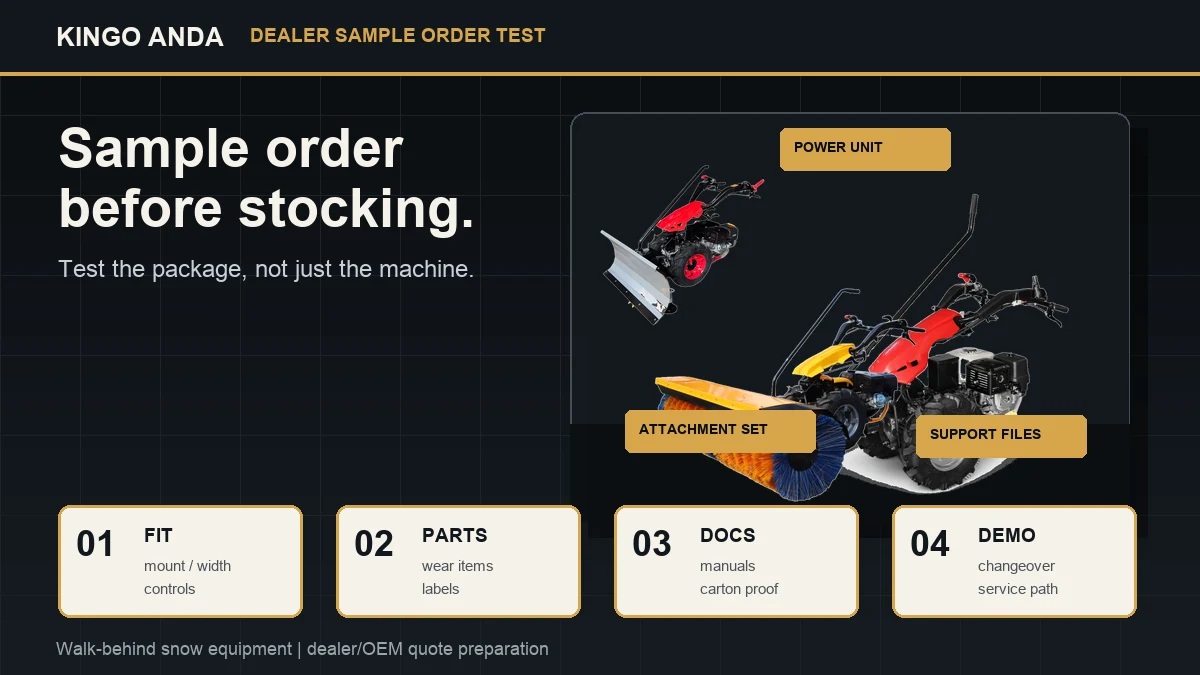
A sample order is the cheapest place to find out whether a walk-behind snow equipment line can actually be sold and supported. It is not a miniature purchase order. It is a field test for fit, paperwork, parts language, packing discipline and the story a dealer will have to tell at the counter.
That matters more in 2026 because buyers are not only asking for another winter machine. Contractors want fewer passes from fewer operators, property teams want equipment that works on sidewalks and tight access routes, and dealers want packages that do not create service confusion after the first storm. A sample order should answer those questions before the dealer stocks a full winter program.
Test the route before testing the price
Start with the jobsite. A sidewalk route, campus path, municipal walkway, HOA property and small commercial frontage do not need the same first package. Sno-Way’s 2026 trend note points to labor pressure and the expanding use of compact equipment for walkways, HOA communities, campuses and municipal sidewalk networks. That is exactly the territory where a walk-behind power unit can make sense, but only if the sample order is matched to the work.
Dealers should ask for the target route width, typical snow condition, surface material, storage space and operator skill level before finalizing the sample configuration. If the buyer is mostly clearing narrow sidewalks, a broad attachment that looks impressive in the showroom may be less useful than a cleaner, easier-to-service snow sweeper or blade package.
Bobcat’s attachment guidance frames the same point well: choice depends on how snow is moved and where the machine is working. For a walk-behind package, the dealer should put that thinking into the RFQ instead of asking only for model numbers.
Confirm attachment fit as a complete system
The first sample should prove the platform and attachment together. That means mounting points, working width, control reach, belt or drive interface, guard clearance, transport height and the time needed to switch tools. A dealer does not need a lab report for every detail, but it does need to know whether a technician can explain the setup without calling the factory for every small question.
This is why the sample order should reference the intended walk-behind power unit and the exact first-season attachment set. If the dealer is planning a winter-first launch, the package may focus on snow sweeper, snow blade and compact snow thrower options. If the same customer base also buys warm-season tools, add mower or rotary tiller fit checks to the same review sheet, but keep the first shipment disciplined.
KINGO ANDA’s earlier note on attachment compatibility before sample orders is still the right companion piece: fit is not only whether the attachment can connect. It is whether the package can be sold, changed over and serviced by the dealer’s own team.
Use the sample to inspect parts and labels
A clean demo is not enough. Dealers should open the crate, identify every loose part, check the label language, and build a first-season wear-parts list while the sample is still on the floor. Snow equipment brings predictable service items: brush wafers, belts, scraper edges, skid shoes, guards, pins, fasteners and shear items where applicable. If those parts are not named clearly, the dealer will pay for the confusion later.
Outdoor power equipment software companies keep emphasizing seasonal inventory because dealers have to buy, count and price inventory before the rush. Windward’s OPE material, for example, discusses seasonal inventory levels and buying decisions. That is not a software-only issue. It is a supplier issue too. The factory should help the dealer understand what parts belong with the sample, what parts belong with the first stocking order, and what parts can wait for replenishment.
For KINGO ANDA packages, this should be tied to the Parts & Service path. A dealer sample order should not leave parts planning as a second email thread.
Check documents like a service counter would
The manual file, parts list, carton mark and label proof are part of the product. A dealer should read them the way a service counter will use them: can the staff identify the attachment, match the part, explain the changeover and answer the first buyer’s questions without rewriting the supplier’s material?
BOSS presents snow and ice equipment through product categories, sidewalk vehicle options, parts and service paths. That is a useful standard for smaller equipment suppliers: the buyer should see a system, not a pile of parts. For a sample order, the dealer should request PDF manuals, parts diagrams, carton-label samples, warranty language and any private-label file requirements before negotiating volume price.
If the program may become OEM or private label, the sample order should also test what the outside of the carton says. The product may be mechanically sound, but a weak carton mark, mismatched item name or unclear manual cover can make the line look unfinished.
Write the sample order as a repeat-order rehearsal
A good sample order should be written so the second order is easier, not harder. It should list buyer type, target route, power unit model, attachment set, requested spare parts, labeling requirements, documents, sample quantity and the expected follow-up decision. That gives the supplier a clear package path and gives the dealer a useful internal checklist.
Municipal and public works procurement notices, such as the 2026 snow removal equipment acquisition listing from Grand Rapids, show how early winter equipment decisions can enter the calendar. Dealers serving those channels should not wait until the first cold week to learn that a sample package lacks the right support material.
Dealers preparing a KINGO ANDA sample order can use the dealer RFQ checklist as a starting point, then add route width, first-season attachment plan and support-part requirements. For a quote path, send the buyer type, target market, sample quantity and attachment set through Build Your Package.
Build a sample package before stocking.
Share route type, attachment set, sample quantity and support-part needs. KINGO ANDA can prepare a dealer or OEM sample quote path.
Industry references checked: Sno-Way 2026 snow removal trends, Bobcat snow attachment selection guidance, BOSS snow and ice equipment categories, Windward OPE inventory planning, Grand Rapids 2026 snow equipment acquisition notice.