English trade-editorial updates from KINGO ANDA
Campus Sidewalk Snow Removal Equipment: Sweepers, Throwers and Blades
Facility teams can compare sweepers, throwers and blades by route width, snow type, priority zones, parts support and operator readiness.
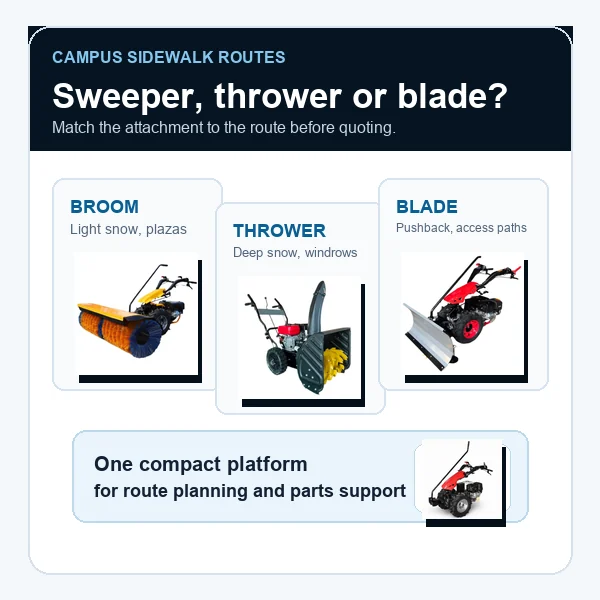
The useful question for campus sidewalk snow removal equipment is not which attachment looks strongest in a catalog. It is which tool keeps priority routes open when the storm is still changing.
That question is active again this week. The 2026 SIMA Snow & Ice Symposium is running June 23-26 in Cincinnati, with snow contractors, manufacturers and suppliers comparing equipment and operating strategies before the winter buying season. APWA has also just closed another North American Snow Conference cycle, and its event language keeps the focus where public works buyers actually live: safer winter maintenance solutions for communities.
Campus facility teams sit between those two worlds. They are not only buying a machine. They are protecting students, staff, visitors, service entrances, ADA routes, event access, steps, plazas and curb transitions with limited crews and changing weather.
A campus is not one route
Large campuses make the equipment choice harder because the job is split into many route types. A university may have broad pedestrian malls, narrow sidewalks, stairs, loading doors, residential entries, curb cuts and parking-lot edges. One attachment cannot be expected to handle all of those conditions equally well.
University of Michigan’s winter-maintenance page is a good example of the route problem. Its grounds operation describes mapped equipment routes, geographic zones and the use of plow and rotary broom attachments on sidewalks and plazas. Pitt’s facilities team gives another scale reference: close to 32 miles of sidewalks and pathways, more than 2,000 steps, and a mix of trucks, tractors, utility vehicles, snow blowers, shovels and ice scraping equipment.
That is why a campus equipment package should start with the route map, not the machine list. The buyer needs to separate light snow from packed snow, entry cleanup from long sidewalk passes, and immediate egress routes from second-pass cleanup.
Where a sweeper belongs
A snow sweeper earns its place when the route needs clean pavement, repeated passes and less surface damage. It is often most useful on plazas, pedestrian walks, building approaches and routes where a thin snow layer can turn into a slip problem if it is left behind.
For dealers and facilities teams, the sweeper discussion should include route width, brush wear, snow depth, pavement type and whether the surface is usually treated before the storm. If the route is mostly light accumulation with frequent cleanup, the sweeper can be the lead attachment. If the campus sees heavy accumulation or windrows pushed across sidewalk edges, it should not be the only answer.
That is also where the multifunction power unit becomes a buying point. A compact platform can support a winter attachment without forcing the buyer into a single-purpose machine that sits for the rest of the year.
Where the thrower or blade changes the quote
A compact snow thrower belongs in the conversation when the route has deeper snow, narrow edges, piles that need relocation, or places where pushing snow would block access. A thrower is not automatically faster on every sidewalk, but it solves a different problem from a broom.
A snow blade is often easier to explain for straight pushes, access lanes and early clearing before cleanup. It can be a practical tool when the buyer needs to move accumulation quickly and has room to place snow safely. But on tight campus walks, blades create their own decisions: where does the snow go, what happens at curb ramps, and who cleans the edges after the first pass?
Purchase College’s snow response plan shows why that matters. Its procedures prioritize emergency egress, main access points, entrances, fire exits, curb transitions and accessible paths. In that kind of plan, equipment choice is tied to priority order, not only snowfall depth.
Parts and training are part of the equipment
The attachment decision is incomplete without the service path. Brushes, belts, scraper edges, skid shoes, shear pins, cables, fasteners and filters decide whether a campus crew can keep operating during a multi-day event. A facility team can tolerate a slow first quote; it cannot tolerate a common wear part becoming a winter emergency.
Dealers should build the Parts & Service discussion into the first equipment package. Which parts wear fastest on treated concrete? Which items should be stocked locally? Which parts are shared across snow attachments? Which documents should go with the sample order?
Operator readiness belongs in the same package. Campus routes run near pedestrians, doors, parked vehicles and steps. The buyer needs to know turning space, transport width, controls, fatigue, visibility and what the tool feels like when snow gets heavier than the forecast promised.
Build the package before the RFQ
A better RFQ starts with a small route table. List the priority zones, route widths, usual snow condition, surface type, expected operator group and storage limits. Then map each route to a lead attachment and a backup attachment.
For example, plazas and main walks may start with the snow sweeper. Tight corridors and pushed piles may need the compact thrower. Access lanes and early pushback may use the blade. The same walk-behind tractor or power unit can then be evaluated as a platform rather than a single SKU.
This also gives dealers a cleaner way to sell. Instead of offering a campus buyer a long equipment list, the dealer can say: here is the priority-route package, here is the cleanup package, here are the parts that should ship with the first order, and here is the document set needed for approval.
What facility buyers should send
Before asking for final pricing, facility buyers should send the target route widths, expected snowfall range, priority zones, storage conditions, operator experience, sample-order needs and required documents. Dealers and OEM buyers should add annual volume, preferred package mix, labeling needs and parts-stocking expectations.
KINGO ANDA can help buyers compare compact snow equipment packages through the Dealer Support path, then convert the route table into a clearer request through the contact page. The best campus snow package is rarely the one with the most attachments. It is the one that matches route priority, operator reality and parts support before the first storm tests it.
Campus package planning
Need a compact sidewalk snow package for facility routes?