Industry News
Sidewalk Route Widths and Turning Space: How Dealers Size Compact Snow Packages
Dealers quoting compact sidewalk snow equipment should match attachment width, turning room, passing space and surface limits to each winter route.
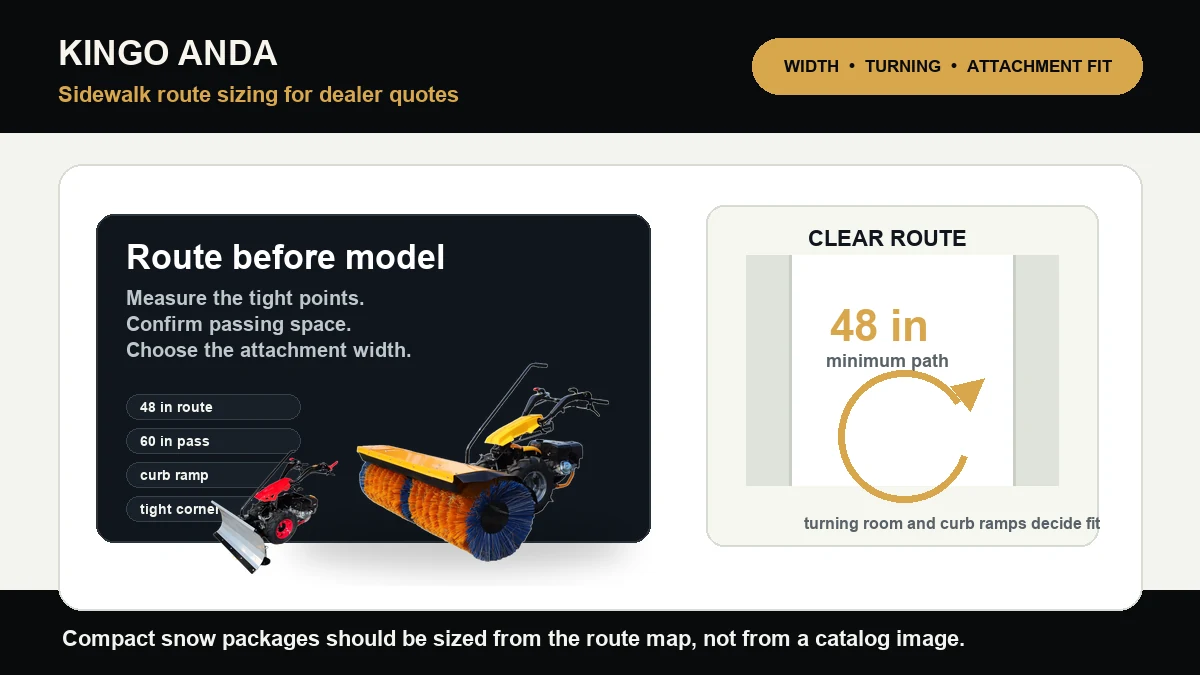
A compact sidewalk snow package should be sized from the route, not from the machine photo. The difference matters. A buyer may ask for a sweeper, blade or compact snow thrower, but the route decides whether that attachment can actually move through the property, turn at entrances, clear curb ramps and leave enough usable path after the storm.
Dealers that sell into campuses, municipal accounts, hospitals, shopping centers and property-maintenance channels should treat route width as an RFQ item. It belongs beside working width, snow type, surface limits, spare parts and delivery timing. If the route is not measured, the quote is still half blind.
Start with the narrowest usable path
The U.S. Access Board’s public right-of-way accessibility guidelines list a 48-inch minimum continuous clear width for pedestrian access routes in most cases, and a 60-inch requirement for certain medians, refuge islands and passing spaces. They also call for passing spaces at 200-foot maximum intervals when the clear route is under 60 inches. Dealers should not turn those figures into legal advice, but the numbers are useful planning anchors: a snow package that cannot respect the narrow points of a pedestrian route will create buyer-side objections quickly.
The first quote question is therefore simple: what is the tightest section that must be cleared? Measure between walls, bollards, railings, planters, light poles, curb edges and parked-vehicle zones. A five-foot sidewalk can behave like a three-and-a-half-foot route after obstructions and snow storage are considered. That is where a compact package earns its place.
Match attachment width to snow movement, not only path width
A route that is 48 inches wide does not automatically call for a 48-inch attachment. The dealer has to consider snow windrow, brush throw, discharge direction, curb ramps and where the operator turns. A broom that clears close to the pavement may be right for light accumulation on hard surfaces. A blade may be simpler for pushing light snow if there is somewhere to put the windrow. A thrower becomes more useful when discharge distance matters or when repeated pushing would close the route again.
Ventrac’s sidewalk snow pages present the same operating logic at a larger system level: brooms, blades, blowers and spreaders are separate choices because light snow, heavy snow and surface finish are different jobs. BCS publishes snow-removal attachments and a snow thrower with 24-inch and 28-inch width options, which shows why working width cannot be separated from the power unit and the route. KINGO ANDA dealers should apply the same discipline when presenting the attachment lineup.
Turning space is where many quotes fail
Straight sidewalk footage is the easy part. The difficult points are turns, door approaches, curb ramps, loading zones, bus stops, gates and transitions from sidewalk to storage areas. A compact machine may fit through the path but still be awkward if the operator has to reverse repeatedly or lift snow into a corner with no discharge room.
Dealers should ask for a route map or a short phone video before quoting a larger dealer package. Mark the 90-degree turns, dead ends, stairs, ramps, bollards and places where pedestrians must pass. Then match each section to the attachment: sweeper for clean surface finish, blade for short pushes, thrower for discharge, and spare wear items for routes with curb contact. The earlier KINGO ANDA article on snow sweeper versus compact thrower route fit is still a good comparison point.
Public and institutional buyers need support notes
FHWA has long treated snow removal on federally funded pedestrian facilities as a maintenance issue, and its pedestrian-facility research summary notes that winter-maintenance guidance compares different equipment types for sidewalk snow removal. For a dealer, that means the quote should not read like a retail listing. It should show how the package supports a maintenance policy: route priority, snow trigger, surface protection, attachment changeover, spare parts and document availability.
Institutional buyers also care about liability and repeatability. If a campus crew clears the same paths at 5 a.m. after every storm, the dealer should quote a package that is easy to train, easy to service and consistent across the route. This is where links to municipal RFQ documents, spare-parts starter kits and warranty files help the buyer see more than a machine.
Turn the route review into a quote table
The best dealer quote page should convert the route review into a table. Recommended columns are route segment, clear width, obstruction note, surface type, snow condition, attachment choice, support parts and quote status. If a field is unknown, mark it as “confirm before quote” instead of hiding it. This is cleaner than forcing every buyer into the same package.
For KINGO ANDA, the table can sit beside the attachment compatibility table. One table answers what fits the power unit. The second table answers what fits the route. Together they reduce revisions, improve dealer confidence and make it easier for OEM or municipal buyers to approve the package.
Dealers can send route width, tight turns, surface type, target snow depth, buyer type and attachment interest through Build Your Package. KINGO ANDA can then prepare the right compact snow package instead of quoting from a product name alone.
Size the route before the package.
Share sidewalk width, turning points, snow condition and target attachment set. KINGO ANDA can support the dealer quote path with the right compact package.
Industry references checked: U.S. Access Board PROWAG technical requirements, FHWA sidewalk snow-removal memorandum, FHWA pedestrian-facility maintenance research summary, Ventrac sidewalk snow management, Ventrac Sidewalk Snow Vehicle, BCS snow thrower attachment.