Industry News / Dealer Support
Service Videos and Dealer Training Files for Walk-Behind Snow Equipment
A dealer guide to the service videos, manuals, safety notes and parts files buyers expect before stocking walk-behind snow equipment.
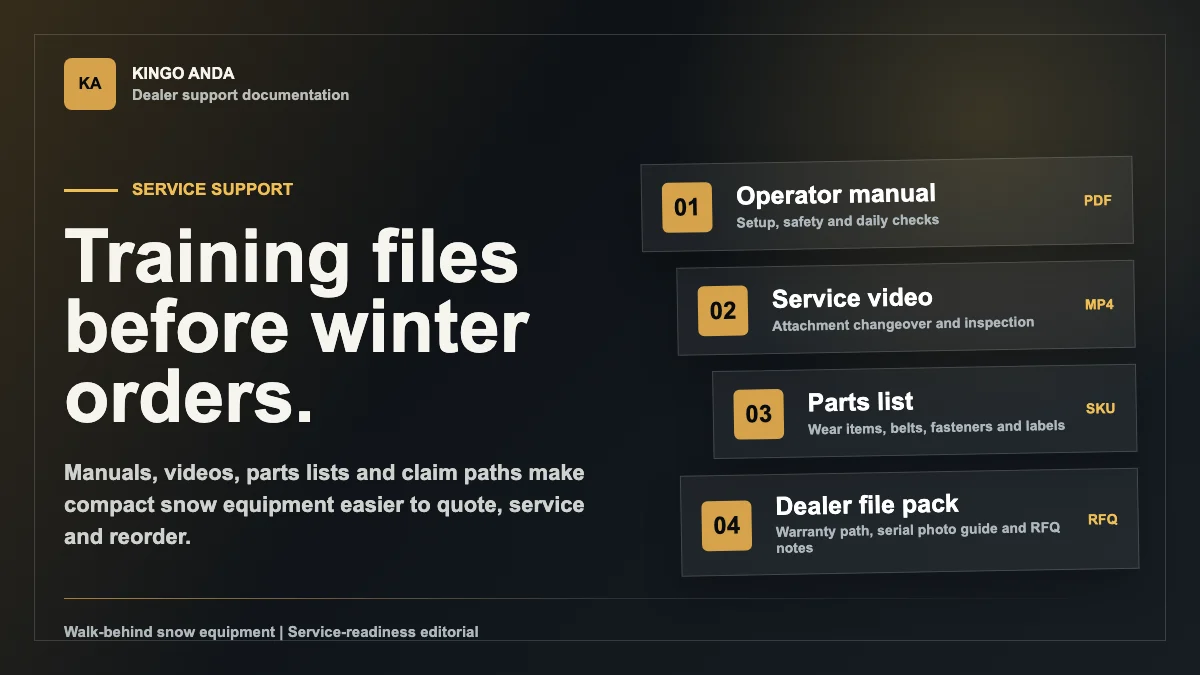
By late summer, a dealer can usually tell which compact snow equipment line is going to be easy to support and which one will turn into a winter help-desk problem. The difference is not only steel, engine size or freight cost. It is the file set behind the machine.
Walk-behind snow equipment is often sold into practical, time-sensitive work: sidewalks, campus paths, storefront routes, apartment entries and service yards. When the first storm arrives, a dealer does not have time to translate a confusing manual, chase an exploded parts diagram or explain an attachment changeover from memory. The support material has to be ready before the first stocking order ships.
For KINGO ANDA’s compact walk-behind equipment line, that means treating service videos, manuals, parts lists and warranty notes as part of the product package. A buyer looking at a multifunction power unit, snow sweeper, snow blade or compact thrower should also see how the dealer will train operators and identify parts after delivery.
Why training files now matter to dealer buying decisions
The outdoor power equipment channel is paying closer attention to support quality. OPE+ reported in April 2026 that parts, inventory and service moved from a supporting role to a strategic issue for B2B outdoor power equipment, with uptime, speed and reliability shaping purchase decisions. That is exactly the environment where a clean training file pack helps a compact equipment supplier look serious.
Established snow-equipment brands already make this visible. BOSS gives Parts & Service prominent navigation and points buyers to manuals, technical information and training videos. SnowEx puts a service publications library, document search, maintenance videos and maintenance checklist on its support path. Western gives buyers a document library and parts-finder route. Honda Power Equipment separates owner manuals, parts information, shop manuals, warranty information and how-to videos into its support structure.
The pattern is not accidental. Dealers do not want a support answer buried in a private chat thread. They want a repeatable file path that sales, service, warehouse and warranty staff can all use.
The minimum file set a dealer should request
A serious walk-behind snow equipment quote should include more than a model list. At minimum, a dealer should ask for the operator manual, quick-start sheet, safety notes, attachment compatibility table, parts list, serial-label guide, warranty claim path and storage checklist. If the buyer is considering multiple attachments, each attachment needs its own fit notes and service points.
For a snow sweeper, the file pack should explain brush inspection, brush replacement, belt or drive checks, skid or wheel adjustment and end-of-season cleaning. For a snow blade, it should cover scraper edge wear, skid shoes, fasteners, surface limits and safe operating angles. For a compact thrower, dealers need shear or wear items, chute checks, belt inspection and storage guidance.
The parts list matters as much as the manual. Dealers should be able to identify common wear items by clear name, photo, part code and attachment model. If the parts sheet forces a service writer to guess, the dealer will either overstock the wrong item or avoid the line.
Video topics that prevent avoidable support calls
Not every service topic needs a long video. The most useful dealer training videos are short, specific and repeatable. A practical set starts with uncrating and pre-delivery inspection, then moves into attachment installation, daily operator checks, safe startup, first-hour inspection, seasonal storage and basic troubleshooting.
Attachment changeover deserves special attention. One power unit with multiple work heads is commercially attractive only if the dealer can show the changeover clearly. A two-minute video that shows the coupling points, belt path, guard position and final inspection is often more valuable than a polished brand film.
Dealers should also ask for service videos around wear parts. Brush modules, scraper edges, belts, skid shoes and chute components are normal consumables. Showing a technician how to inspect and replace them reduces avoidable calls during the first winter and gives the parts counter a better reason to stock a starter kit.
Organize files around one power unit and multiple attachments
Multi-attachment platforms need disciplined file names. A dealer should not receive a folder called “manuals” with ten unrelated PDFs inside. Use the base unit model first, then the attachment model, then the document type and revision date. That simple naming rule prevents confusion when the same dealer stocks a sweeper, blade, thrower and warm-season attachment.
The structure can follow the sales path: power unit file, snow attachment file, parts file, service video file and warranty file. The parts and manuals download-page checklist published earlier goes deeper on how dealers can organize public support downloads. The same principle belongs inside the quote package before the order is placed.
If private-label or OEM supply is involved, add artwork and label control to the file pack. The model code on the carton, serial label, manual cover and parts list should match. A mismatch looks minor before shipment. It becomes expensive when a distributor has to trace warranty claims by photo.
What KINGO ANDA dealers should request with the first quote
Before asking only for price, dealers should send buyer type, target route, primary attachment set, expected first-order volume and support requirements. That lets KINGO ANDA prepare the equipment recommendation and the support package together.
A clean first request should name the intended power unit, the winter attachments being compared, the preferred spare-parts starter kit and the file formats needed by the dealer team. If the dealer will sell to municipalities, campuses or contractors, add any language, label or certificate requirements at the beginning rather than after samples arrive.
This is the practical standard: the dealer should be able to receive a machine, identify its attachments, train an operator, find the likely wear parts and explain the warranty path without waiting for a factory reply in the middle of a storm week.
Request the dealer support file pack.
Send buyer type, target attachment set, market region, annual volume and support requirements. KINGO ANDA can prepare a quote path with manuals, service files and spare-parts notes.
Industry references checked: OPE+ parts and service outlook for 2026, BOSS manuals and technical information, SnowEx parts and service library, WESTERN document library, Honda Power Equipment shop manuals and service support materials.