Industry Products / Dealer Planning
Seasonal Attachment Bundles for Walk-Behind Power Units: A Dealer Stocking Guide
A dealer guide to bundling snow, soil and grounds-care attachments around one walk-behind power unit for year-round stocking and quoting.
Dealers rarely lose a compact equipment quote because the buyer dislikes the machine name. They lose it because the package is not clear enough. The buyer sees a power unit, a list of attachments and a price, but not a practical answer to a seasonal work problem.
That is why attachment bundles deserve more attention than long accessory menus. A distributor or municipal buyer may ask first about winter sidewalk snow removal, then come back in spring for soil preparation, mowing or cleanup work. If those paths are not connected early, the dealer has to restart the sales conversation each season.
For KINGO ANDA’s compact walk-behind equipment line, the commercial point is straightforward: one power platform should be quoted around a buyer’s route, season and service plan. The bundle is not a discount pack. It is a stocking and support logic that helps the dealer decide what to demo, what to keep in parts inventory and what to order only after the buyer confirms the job.
Why seasonal bundles fit the 2026 dealer environment
Dealer planning for 2026 is not only about wholegoods volume. Farm Equipment’s 2026 dealer outlook notes a more cautious new-equipment view, while aftermarket and service expectations remain comparatively strong. That matters for compact equipment because a dealer can improve the value of one base machine by attaching more work, more parts and more service conversations to it.
Outdoor power equipment also remains a broad, seasonally uneven market. Rural Lifestyle Dealer’s market summary points to growth across lawn mowing, snow removal and garden maintenance, but also names seasonal demand fluctuation as a real operating challenge. Dealers feel that challenge directly. Winter inventory cannot sit idle all year, and warm-season tools cannot be sold as if snow routes do not exist.
Snow and ice contractors are also changing how they buy. Sno-Way’s 2026 snow-removal trend note points to compact equipment, mixed fleets and flexible routing. Hiniker makes a similar point from the truck-plow side: labor is tighter, routes are denser and operators need equipment that reduces wasted movement. For walk-behind platforms, the same thinking applies at sidewalk scale.
Start with the power unit, then group work by season
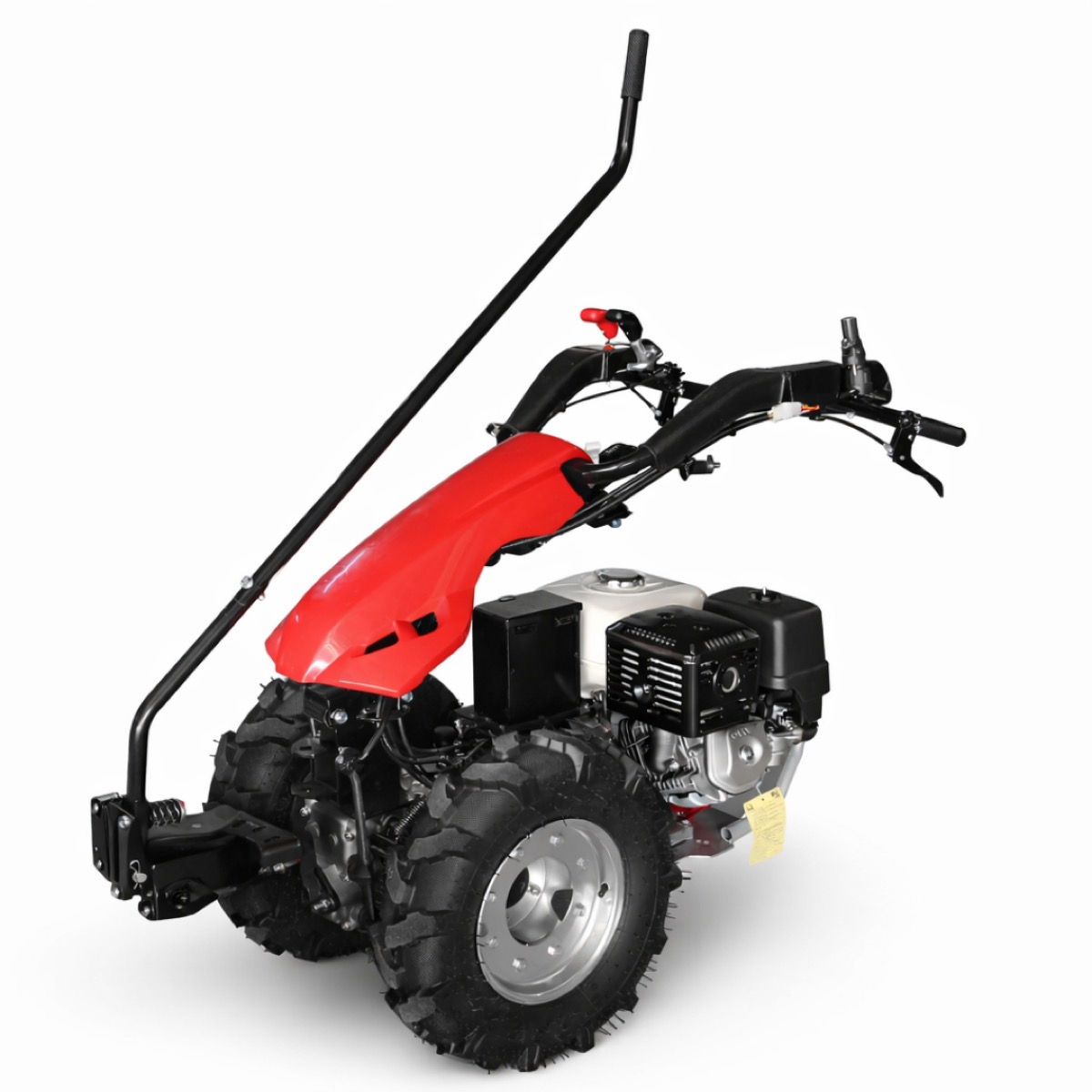
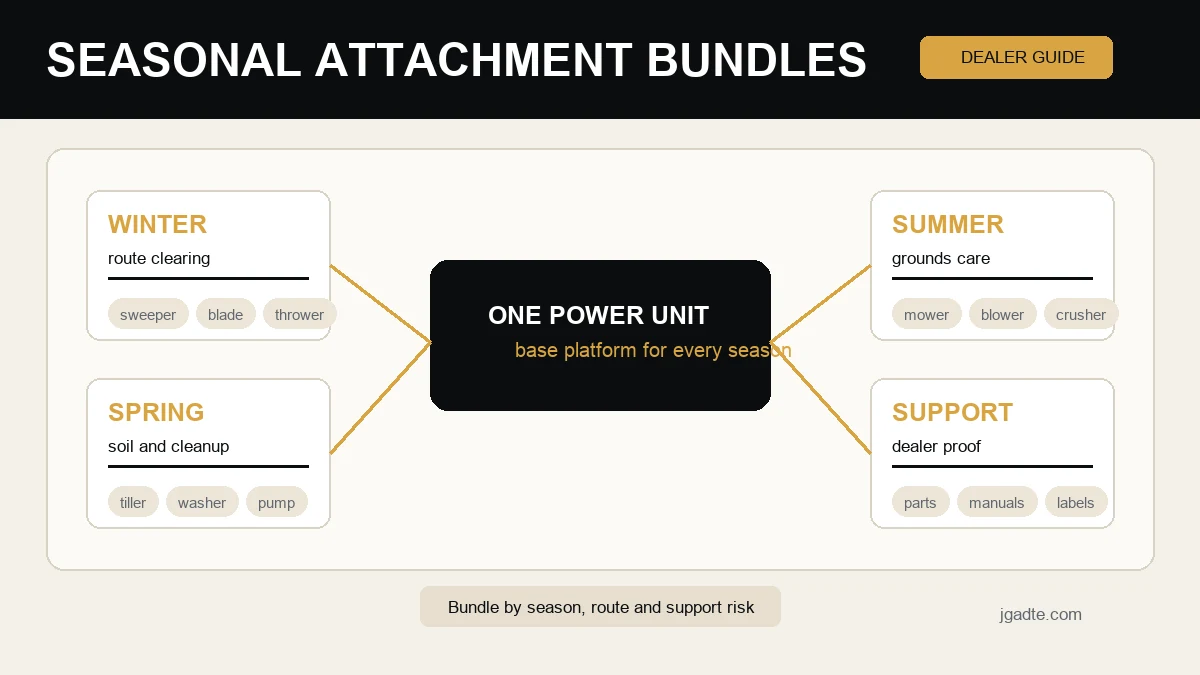
The first bundle decision is the base platform. A dealer should separate the multifunction power unit or walk-behind tractor from the work heads it carries. The power unit is the buyer’s long-term machine. Attachments are the seasonal work plan.
A winter bundle normally starts with a snow sweeper, snow blade or compact snow thrower. The exact mix depends on route width, snow depth, surface sensitivity and where the snow can be placed. A college sidewalk route may need a sweeper for frequent light storms and a blade for wet accumulation. A property manager with narrow access lanes may ask for a thrower because pushing snow to the side is not always possible.
A spring and summer bundle moves the same buyer into soil, mowing and cleanup work. A rotary tiller fits seedbed preparation and small-property cultivation. A mower, branch crusher, leaf blower, washer or pump may belong in the package if the buyer handles grounds care in-house. The dealer should not force every attachment into one quote. The better approach is to show the logical next attachments and identify which ones should be stocked, sampled or ordered later.
Build three packages instead of one long attachment list
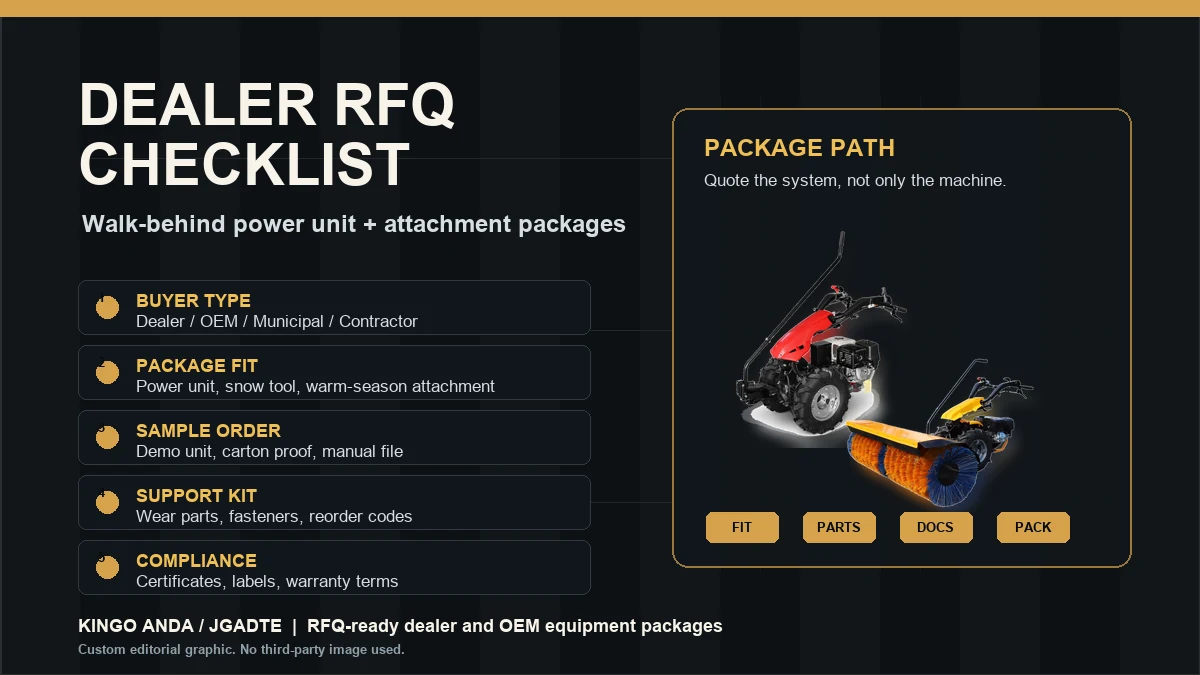
The strongest dealer quote usually has three package levels. The first is a starter package: one power unit, one primary winter attachment, the required fitting hardware, a basic spare-parts kit and the manual set. This is the package for a dealer testing demand or a buyer comparing compact snow tools for the first time.
The second is a seasonal expansion package. It adds the attachment that solves the next most likely job: sweeper plus blade, blade plus thrower, or winter equipment plus a warm-season mower or tiller. This package is useful when the buyer has multiple departments involved, such as facilities, landscape maintenance and winter operations.
The third is a dealer demo package. This is not necessarily the largest package. It should be the clearest. One clean power unit, two high-demand attachments, printed specification sheets, carton and label proof, spare wear items and a simple route-fit checklist are often more useful than a crowded trailer of attachments nobody can explain in five minutes.
What belongs in the quote beyond equipment
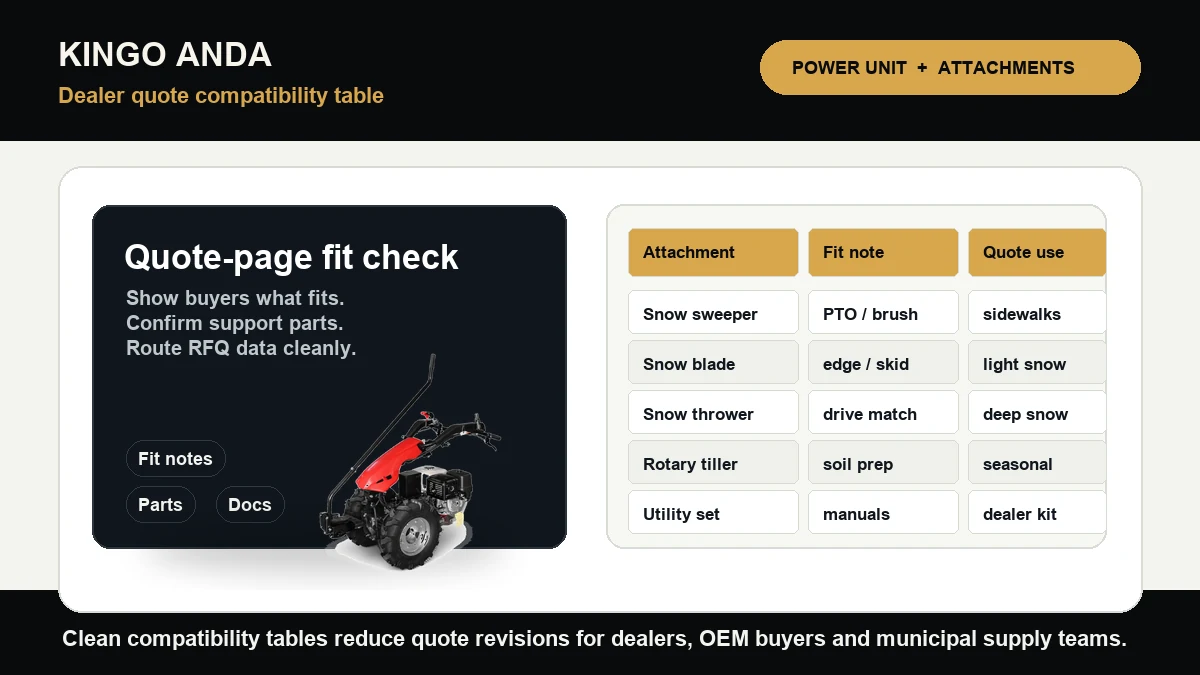
A bundle quote should include the documents and support items that make the dealer credible. That means attachment compatibility notes, work width, shipping dimensions, wear-parts list, sample-order terms, serial-label rules, carton marking requirements and service-document availability.
This is where many compact equipment sellers underperform. They send photos and model names but leave the dealer to ask later about manuals, replacement parts and packaging. For B2B buyers, those details are not paperwork. They affect warranty handling, spare-parts stocking, warehouse receiving and whether the sales team can quote the machine without calling the factory every time.
KINGO ANDA already has separate product pages for the main power units and attachments. The next step for a dealer is to turn those pages into a working package: which attachments fit the buyer’s season, which wear parts should ship with the first order and which documents should be ready before the buyer approves a sample.
Keep inventory risk visible
A seasonal bundle should reduce inventory risk, not hide it. Dealers should avoid stocking every attachment before they know the local route mix. Start with the base unit, one or two winter tools, one warm-season attachment that matches the region and a parts kit that covers the expected first-service items.
When a buyer asks for a broader program, treat it as an ordering sequence. Confirm the winter route first, then the warm-season maintenance work, then the support documents and carton requirements. That sequence gives the dealer a reason to follow up without sounding like a seller pushing extra accessories.
Build a seasonal package.
Send buyer type, target season, expected route or work area, preferred attachments and first-order volume. KINGO ANDA can help prepare a dealer/OEM package path with compatibility and support notes.
Industry references checked: Sno-Way snow removal trends for 2026, Hiniker snow removal industry trends in 2026, Farm Equipment 2026 dealer outlook, Rural Lifestyle Dealer OPE market forecast, Western Implement BCS attachment lineup.