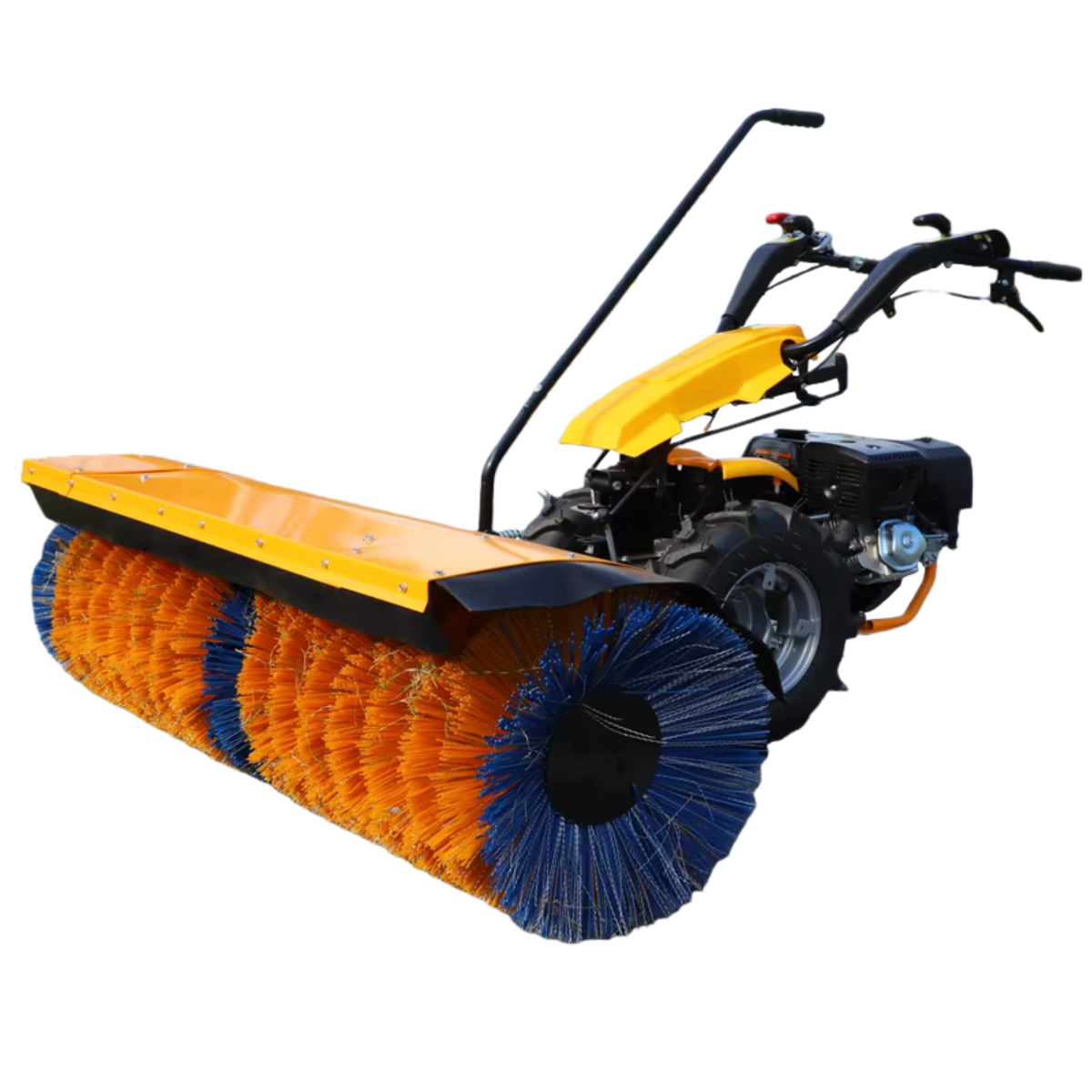
Tag: Industry Products

  • Dealer Demo Unit Setup for Walk-Behind Power Units Before Fall Equipment Shows

    Dealer Demo Unit Setup for Walk-Behind Power Units Before Fall Equipment Shows

    KINGO ANDA compact equipment editorial Dealer, OEM and property-maintenance buying notes
    Industry News Dealer Demo Unit Setup for Walk-Behind Power Units Before Fall Equipment Shows

    Dealers preparing walk-behind power unit demos should lock attachments, test photos, spare parts and quote files before fall equipment shows.
    Published July 3, 2026 Dealer Demo Units Walk-Behind Equipment
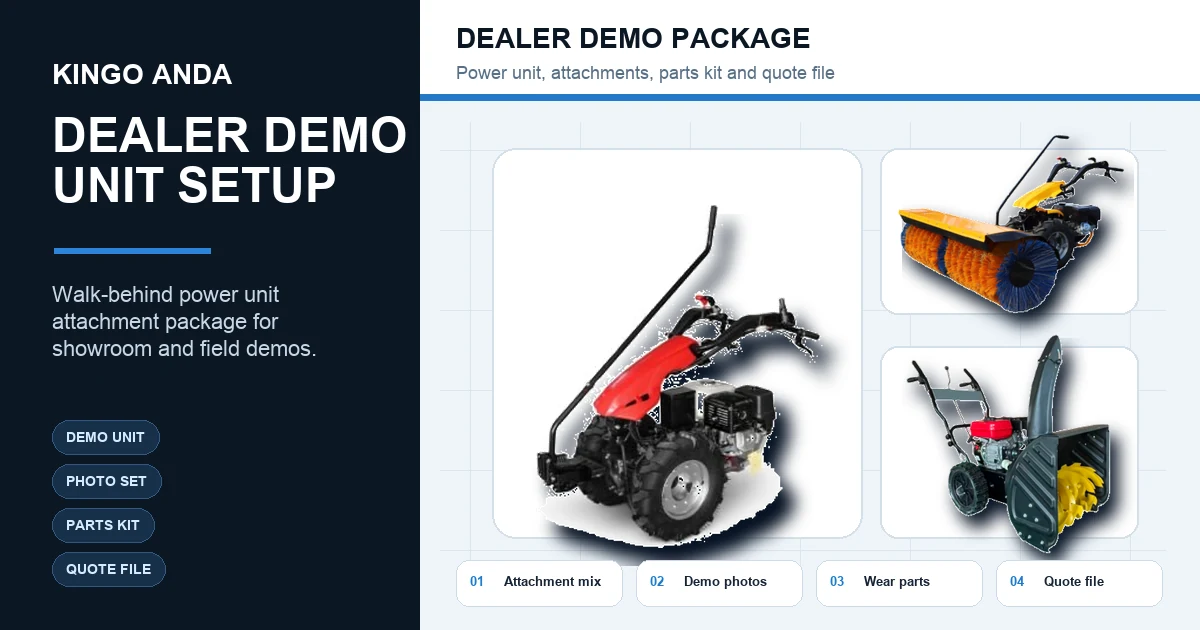
    Dealer demo unit setup checklist for walk-behind power units and attachments

    A dealer demo unit is not a showroom ornament. It is a commercial test. The buyer wants to know whether the machine can be explained quickly, moved safely, photographed cleanly, supported with parts and quoted without the factory rebuilding the file every time a new attachment is added.

    That matters more as the fall equipment-show calendar moves closer. Equip Exposition lists its 2026 Louisville show for October 20-23 and promotes a large outdoor demo yard where dealers and contractors can test equipment, not just look at it. For compact equipment suppliers, that is a useful reminder: a demo package has to survive the real questions that come after the first photograph.

    For a walk-behind power unit, the strongest demo package is rarely one machine by itself. It is the power unit, the first two or three attachments, the wear-parts plan, the photo set and the quote file arranged so a dealer can present the package with confidence.

    Start with the job mix, not the machine label

    The mistake is to begin with a model code and then hope the buyer understands the use case. A better demo starts with the work: sidewalk snow removal, mixed facility maintenance, property cleanup, small estate grounds care, rental counter use or dealer showroom comparison.

    A multifunction power unit can carry different stories depending on the attachment set. A snow dealer may want the power unit shown with a snow sweeper and compact snow thrower. A grounds-care dealer may want mowing, tilling or washing attachments in the same conversation. The demo unit should make that job mix obvious before the sales team starts explaining.

    Dealers should define the first demo route in practical language: route width, expected snow depth or soil condition, transport method, storage limits, operator skill level and the kind of customer who will see the unit first. That information decides which attachments belong in the first sample, and which should wait.

    Build the demo unit around proof points

    A useful demo package should prove five things. The power unit starts cleanly. The attachment locks in correctly. The working width is clear. The wear parts are easy to identify. The dealer can explain the package without opening a technical manual in front of the buyer.

    That does not require a huge sample order. It requires a disciplined one. The first package should normally include the core power unit, one hero attachment, one comparison attachment, the most important consumable parts and a simple document set. If the market is winter-focused, the hero attachment may be a sweeper, with a thrower or blade used as the comparison. If the market is year-round maintenance, the snow attachment can sit beside mowing or soil-preparation equipment.

    The point is not to show every SKU. The point is to show that the dealer can build a repeatable package from the snow-removal attachment line and expand from there.

    Photograph the package before the buyer asks

    Dealers lose time when the photo set is treated as an afterthought. A good demo unit should be photographed before it leaves the factory: power unit alone, power unit with each attachment, side view, operator position, label placement, spare-parts pack, carton or crate, and one clean composition for a quote sheet.

    Those photos are not just for marketing. They help the dealer’s sales team, parts counter, service bench and buyer contact speak from the same file. If the sample arrives and the only available photo is a cropped product image on a white background, the dealer has to rebuild the story locally.

    For private-label or OEM discussions, the photo set also prevents confusion around labels and finish details. The buyer can see what is fixed, what can be branded, and what still belongs to the manufacturer’s support identity.

    Test the service items that stop a demonstration

    The spare-parts pack should be built around failure points, not catalog width. A demo can be stopped by a belt, brush, scraper edge, skid shoe, cable, shear pin, bearing, fastener or filter long before the dealer needs a complete parts wall.

    The Parts & Service file should travel with the demo quote. It should name fast-wear items, recommended starter quantities, replacement intervals where available, and the support path for the dealer’s first season. If the sales team has to ask for those details after the unit is already in the showroom, the supplier has made the dealer do avoidable work.

    For compact snow equipment, the service file should match the attachment. A sweeper has different first-season concerns than a thrower. A mixed package needs the differences stated clearly.

    Separate show assets from shipment assets

    A dealer preparing for a fall show needs one set of assets for selling and another set for receiving. The selling set includes product photos, short descriptions, buyer-use notes, attachment comparisons and a clean quote sheet. The receiving set includes carton marks, label maps, packing photos, spare-parts lists and document files.

    Do not mix those into one loose folder. A buyer-facing quote should not force the dealer to sort through crate photos. A warehouse file should not hide the model code under sales copy. Clean separation makes the package easier for the dealer to use and easier for the factory to repeat.

    KINGO ANDA’s dealer path should keep both sides ready: the product story for the buyer, and the shipment story for the team that has to receive, stock and service the unit.

    What to send before asking for the demo quote

    A strong RFQ should include the target market, dealer type, first demo purpose, attachment mix, expected order volume, private-label needs, required photos, spare-parts expectations and any document requirement already known. For snow-focused buyers, add route width, snow condition, surface type and storage limits.

    The better the RFQ, the less likely the supplier is to quote a generic machine that still needs to be rebuilt into a sellable dealer package. A useful demo unit should arrive with the attachments, files and support pieces that let the dealer start real conversations.

    Dealers can begin with the Dealer Support page, compare related equipment notes in the blog, and send the final buyer profile through the contact page. The goal is not a bigger first sample. The goal is a demo package that can turn into a repeatable dealer program.
    Build Your Package

    Send the target market, attachment mix and demo-unit requirements.

    Request Demo Quote
  • Compact Snow Equipment Packaging for Dealers: Carton Marks, Labels and Spare-Parts Packs

    Compact Snow Equipment Packaging for Dealers: Carton Marks, Labels and Spare-Parts Packs

    KINGO ANDA compact equipment editorial Dealer, OEM and property-maintenance buying notes
    Industry Products Compact Snow Equipment Packaging for Dealers: Carton Marks, Labels and Spare-Parts Packs

    Dealers importing compact snow equipment should confirm carton marks, labels, spare-parts packs and document sets before preseason orders.

    Published July 2, 2026 Dealer Packaging Snow Equipment
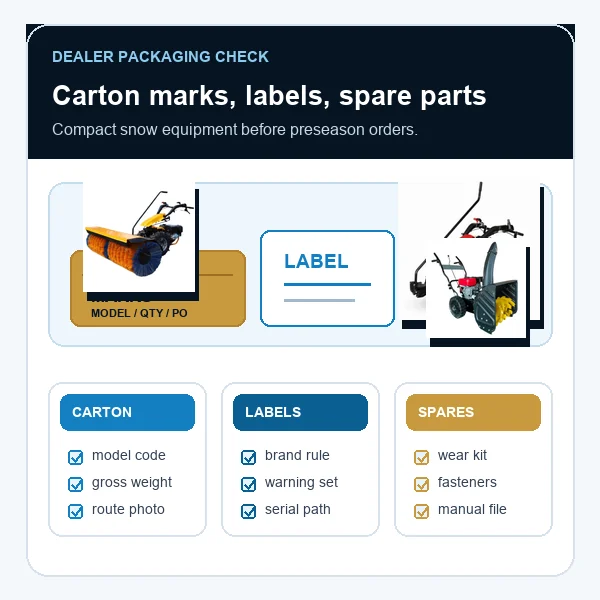
    Compact snow equipment packaging checklist for dealers with carton marks labels and spare parts

    Packaging is where a compact snow equipment program stops being a product idea and becomes something a dealer can receive, store, explain and service. A good carton does not sell the machine by itself. A bad one can make the first order look improvised before the buyer has even unpacked the power unit.

    The calendar is already tight. SIMA’s 2026 snow show has just put contractors and suppliers through another June buying cycle, Equip Exposition is pointing outdoor power equipment dealers toward its October 2026 Louisville program, and APWA keeps public-works snow planning tied to training, fleet readiness and winter operations. Dealers who wait until autumn to settle carton marks, labels, spare-parts packs and document files are late.

    For a distributor, OEM buyer or property-maintenance channel, compact snow equipment should arrive as a package, not a loose collection of machines. That package has to move through a warehouse, a dealer counter, a service bench and a first customer visit without forcing the buyer to guess.

    Carton marks should answer warehouse questions

    Carton marks are not decoration. They are a low-cost way to prevent receiving mistakes. A practical carton mark should show the model code, attachment name, purchase order or batch reference, quantity, gross weight, carton size, country requirement if applicable, and any handling note that keeps the equipment from being stacked or opened the wrong way.

    For compact snow equipment, the mark should also separate the power unit from the attachment. A multifunction power unit is not the same inventory item as a snow sweeper, even when both are sold as one winter package. If the cartons are unclear, the dealer’s first inventory count is already weak.

    The better question is not whether the factory can print a mark. It is whether the mark matches the quote, the packing list, the spare-parts file and the photo set used by the dealer’s own team.

    Label approval belongs before the first shipment

    Labels become sensitive when the buyer plans dealer branding, private label work, or a mixed product line that must sit beside established machines. A small warning label, serial label or model sticker can delay a shipment if the size, language, material or placement is decided after production.

    Dealers should ask for the label map before the sample order: where each label sits, which labels are mandatory, which can carry a dealer brand, which must stay with the manufacturer’s model identity, and how serial numbers will be recorded. The goal is not to over-design the first order. The goal is to avoid discovering during receiving that the product cannot be shown cleanly.

    This matters for OEM buyers as well. A private-label snow attachment still needs consistent naming, safe warning placement and a repeatable serial path. If the first batch uses one label rule and the second batch uses another, after-sales support gets harder than it needs to be.

    Spare-parts packs should be built around downtime

    The common mistake is to make the spare-parts pack look broad instead of useful. A dealer does not need every low-probability component in the first sample shipment. It needs the parts most likely to stop a demonstration, delay a repair or make the first customer lose confidence.

    For winter attachments, that usually means wear parts and fast-moving service items: brushes, scraper edges, belts, skid shoes, shear pins, fasteners, bearings, cables, guards and filters where the package requires them. For a compact snow thrower or sweeper, the spare pack should be tied to actual route use, not copied from a full catalog.

    The Parts & Service conversation should happen with the quote. If the dealer has to ask for a wear-kit recommendation after the sample arrives, the RFQ was not specific enough.

    Crates, pallets and import checks need early attention

    Compact equipment often looks simple until it crosses a border. Pallet type, crate material, wood-packaging treatment, carton strength, moisture protection, accessory separation and label visibility can all affect receiving. International wood-packaging requirements vary by market, and buyers should confirm the applicable rules before a shipment is packed.

    This is not legal paperwork for the sake of paperwork. It is a commercial issue. A dealer that loses a week to unclear pallet marks or a broken crate is not thinking about reorder volume. It is thinking about whether the supplier is ready for export business.

    The safest approach is to agree on a packaging photo set before shipment: closed carton, open carton, inner protection, accessory bag, spare-parts pack, label placement, carton mark, pallet or crate, and the final loaded view where possible.

    Photo assets make the dealer’s job easier

    Most suppliers send product photos and stop there. A dealer needs more. It needs enough packaging and support photos to show its own team what is arriving and to answer simple buyer questions without opening every box.

    A compact snow package should include clean product photos, attachment photos, package photos, parts-kit photos and one or two route-use images if available. The dealer may use those assets in a product sheet, a sales email, a counter conversation or a service note. Bad photos create extra work. Missing photos slow the buyer down.

    KINGO ANDA already has a broad snow-removal attachment line. The next level is to make each quote easier to handle by tying the product photo, carton mark, label rule and spare-parts pack into one consistent file.

    What dealers should send in the RFQ

    A strong dealer RFQ should not ask only for price. It should tell the factory which market is being served, which buyer type is targeted, the first order or sample quantity, the attachment mix, expected annual volume, private-label or dealer-label needs, carton mark requirements, spare-parts expectations, and any import or document requirement the dealer already knows.

    For snow equipment, add the route detail: sidewalk width, expected snow depth, surface type, storage limits, whether the buyer needs sweeping, throwing, pushing or a mixed package, and whether the dealer expects a demonstration unit before stock orders. That information helps narrow the package before the quote is written.

    The most useful path is to start with Dealer Support, compare related posts in the blog, and send the final buyer profile through the contact page. The best compact snow equipment order is not just a machine order. It is a receiving-ready, sellable, serviceable dealer package.

    Build Your Package

    Send the market, volume, label and spare-parts requirements.

    Request Quote Path
  • Dealer Support for Compact Snow Equipment: Documents, Parts and Sample Orders

    Dealer Support for Compact Snow Equipment: Documents, Parts and Sample Orders

    Dealer support and compact snow-equipment planning
    English trade-editorial updates from KINGO ANDA

    Industry Products
    Dealer Support for Compact Snow Equipment: Documents, Parts and Sample Orders

    Dealers evaluating compact snow equipment can reduce sample-order risk by checking documents, parts support, packaging and route-use fit before RFQ.

    Published July 1, 2026
    Dealer Program
    KINGO ANDA Blog

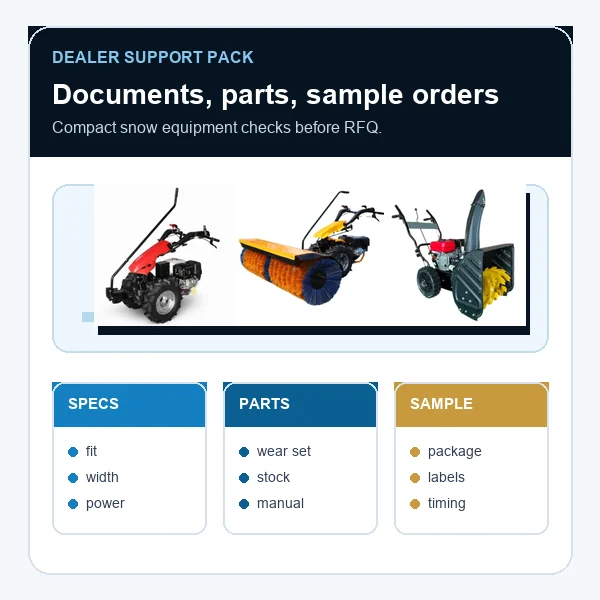
    Dealer support pack for compact snow equipment documents parts and sample orders

    Dealer support for compact snow equipment is not only a sales promise. For a distributor, OEM buyer or rental-channel operator, it is the difference between a clean sample order and a winter complaint that should have been prevented in June.

    The timing matters. The 2026 SIMA Snow & Ice Symposium has just put snow contractors, manufacturers and suppliers together in Cincinnati, while Equip Exposition is already steering outdoor power equipment dealers toward its October 2026 education calendar in Louisville. APWA’s snow conference language points in the same direction for public works buyers: winter maintenance is an operating system, not a machine purchase.

    That is the right frame for compact snow equipment. A buyer can like the look of a power unit, sweeper, thrower or blade. The dealer still has to prove that the package can be quoted, sampled, stocked, serviced and explained when the first storm exposes every weak assumption.

    Start with the dealer’s approval file

    A dealer does not need a glossy brochure before every first conversation. It needs a compact approval file that answers the questions a buyer will ask before money moves. The file should include model names, working width, basic power-unit fit, attachment weight, package dimensions, crate information, wear-part list, recommended spare set and the documents available after order confirmation.

    This is where many compact-equipment quotes become soft. The supplier sends a picture and a price. The dealer then has to ask again for fit details, packaging, labels, parts, manuals and service notes. By the time those answers arrive, the buyer may have moved back to a familiar brand or a local substitute.

    For a compact snow line, the approval file should be built around the job the dealer is trying to win: sidewalk cleanup, campus routes, municipal pedestrian areas, property-maintenance fleets, dealer demo stock, or OEM/private-label winter programs.

    Separate the sample order from the catalog

    A sample order should not be treated as a small catalog order. It has a different purpose. The dealer is testing whether the platform is sellable, whether the attachment story is easy to explain, and whether the first customer can be supported without a long email chain.

    That means a sample package should be narrow. A dealer might test the multifunction power unit with one winter lead attachment, such as the snow sweeper, plus a second attachment that changes the sales conversation, such as the compact snow thrower or snow blade. Adding every possible tool to the first shipment usually makes the test harder, not better.

    The practical sample-order question is simple: what must the dealer see, assemble, operate, photograph and explain before committing to a broader winter package? That answer should drive the first shipment.

    Parts support belongs in the quote, not after the sale

    Snow equipment fails commercially when small parts become large delays. Brushes, belts, scraper edges, skid shoes, shear pins, bearings, cables, filters, fasteners and guards do not look important in a hero photo. They decide whether the dealer can keep the buyer running after the first serious route.

    For that reason, the Parts & Service path should be part of the first RFQ. A dealer should ask which items wear fastest, which parts are shared across attachments, which parts are unique to a specific attachment, and which spare set should ship with the first sample order. If the answer is vague, the price is not ready yet.

    Dealer buyers should also separate emergency spares from normal stocking. A starter wear kit is not a full parts program. But it is enough to keep a demo unit useful, protect the first buyer experience and collect field notes before larger stock is ordered.

    Documents are a B2B product feature

    In compact snow equipment, documents are not administrative leftovers. They are part of the product. A dealer may need assembly instructions, parts diagrams, maintenance intervals, carton marks, serial-number rules, label placement, product photos, warranty boundaries and private-label packaging details before the equipment can move through its own sales channel.

    For OEM/private-label buyers, the document set matters even more. A buyer may approve the machine only after checking packaging, logo placement, certificate needs, manual language, spare-part naming and whether the supplier can keep future shipments consistent. A machine that works but cannot be documented cleanly is still a weak OEM product.

    That is why the document checklist should be discussed before the sample order. It is much cheaper to settle naming, labeling, manuals and spare parts before the first crate leaves the factory than after the dealer has built a sales story around the wrong assumptions.

    Use current trade-show activity as a planning deadline

    SIMA’s June snow-industry calendar and Equip Exposition’s October dealer calendar create a useful rhythm. June is the right time to turn winter product interest into a tighter support package. October is late for discovering that the dealer still lacks parts guidance, sample-order logic or documents.

    APWA’s snow conference cycle also shows how public-works buyers think. Their winter-maintenance decisions are tied to routes, crews, safety, equipment support and operating continuity. A dealer that wants those buyers should not lead only with horsepower or working width. It should lead with a package that can be supported through the season.

    For KINGO ANDA, that means a compact snow equipment package should be described as a working system: base platform, snow attachment, secondary attachment, spare set, document pack, sample-order path and dealer/OEM follow-up.

    What to send before asking for pricing

    A useful dealer RFQ should be short but specific. Send the target market, buyer type, expected annual volume, first attachment set, sample-order quantity, packaging needs, label or private-brand requirements, spare-parts expectations, and the route conditions the equipment must handle.

    For winter equipment, also include the typical sidewalk width, snow depth range, surface type, storage limits and whether the buyer expects sweeping, throwing, pushing or a mixed route package. That information lets a supplier narrow the package before quoting.

    KINGO ANDA’s Dealer Support path is the right place to start that conversation. Buyers can review the broader snow-removal attachment line, compare package needs through the blog, and send the final dealer or OEM request through the contact page. The strongest compact snow equipment quote is rarely the fastest price. It is the one that arrives with the support file already in order.

    Dealer package planning

    Need a compact snow equipment support file before RFQ?

    Request Specs

  • Campus Sidewalk Snow Removal Equipment: Sweepers, Throwers and Blades

    Campus Sidewalk Snow Removal Equipment: Sweepers, Throwers and Blades

    Campus and facility snow-equipment planning
    English trade-editorial updates from KINGO ANDA

    Industry Products
    Campus Sidewalk Snow Removal Equipment: Sweepers, Throwers and Blades

    Facility teams can compare sweepers, throwers and blades by route width, snow type, priority zones, parts support and operator readiness.

    Published June 25, 2026
    Campus Routes
    KINGO ANDA Blog

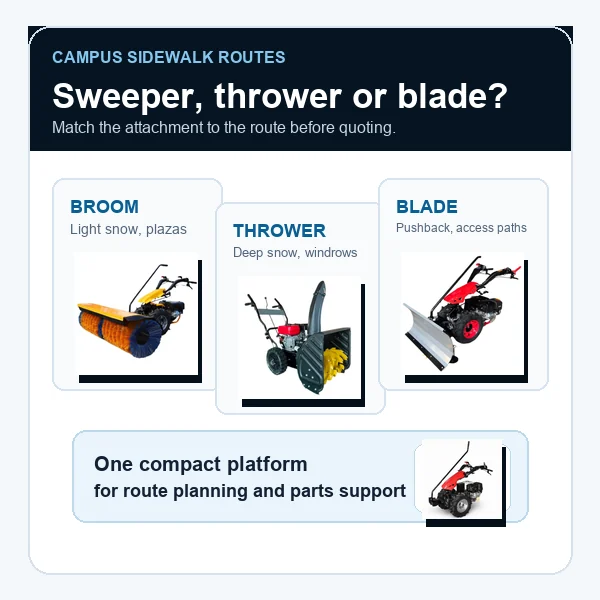
    Campus sidewalk snow removal equipment choice guide for sweepers, throwers and blades

    The useful question for campus sidewalk snow removal equipment is not which attachment looks strongest in a catalog. It is which tool keeps priority routes open when the storm is still changing.

    That question is active again this week. The 2026 SIMA Snow & Ice Symposium is running June 23-26 in Cincinnati, with snow contractors, manufacturers and suppliers comparing equipment and operating strategies before the winter buying season. APWA has also just closed another North American Snow Conference cycle, and its event language keeps the focus where public works buyers actually live: safer winter maintenance solutions for communities.

    Campus facility teams sit between those two worlds. They are not only buying a machine. They are protecting students, staff, visitors, service entrances, ADA routes, event access, steps, plazas and curb transitions with limited crews and changing weather.

    A campus is not one route

    Large campuses make the equipment choice harder because the job is split into many route types. A university may have broad pedestrian malls, narrow sidewalks, stairs, loading doors, residential entries, curb cuts and parking-lot edges. One attachment cannot be expected to handle all of those conditions equally well.

    University of Michigan’s winter-maintenance page is a good example of the route problem. Its grounds operation describes mapped equipment routes, geographic zones and the use of plow and rotary broom attachments on sidewalks and plazas. Pitt’s facilities team gives another scale reference: close to 32 miles of sidewalks and pathways, more than 2,000 steps, and a mix of trucks, tractors, utility vehicles, snow blowers, shovels and ice scraping equipment.

    That is why a campus equipment package should start with the route map, not the machine list. The buyer needs to separate light snow from packed snow, entry cleanup from long sidewalk passes, and immediate egress routes from second-pass cleanup.

    Where a sweeper belongs

    A snow sweeper earns its place when the route needs clean pavement, repeated passes and less surface damage. It is often most useful on plazas, pedestrian walks, building approaches and routes where a thin snow layer can turn into a slip problem if it is left behind.

    For dealers and facilities teams, the sweeper discussion should include route width, brush wear, snow depth, pavement type and whether the surface is usually treated before the storm. If the route is mostly light accumulation with frequent cleanup, the sweeper can be the lead attachment. If the campus sees heavy accumulation or windrows pushed across sidewalk edges, it should not be the only answer.

    That is also where the multifunction power unit becomes a buying point. A compact platform can support a winter attachment without forcing the buyer into a single-purpose machine that sits for the rest of the year.

    Where the thrower or blade changes the quote

    A compact snow thrower belongs in the conversation when the route has deeper snow, narrow edges, piles that need relocation, or places where pushing snow would block access. A thrower is not automatically faster on every sidewalk, but it solves a different problem from a broom.

    A snow blade is often easier to explain for straight pushes, access lanes and early clearing before cleanup. It can be a practical tool when the buyer needs to move accumulation quickly and has room to place snow safely. But on tight campus walks, blades create their own decisions: where does the snow go, what happens at curb ramps, and who cleans the edges after the first pass?

    Purchase College’s snow response plan shows why that matters. Its procedures prioritize emergency egress, main access points, entrances, fire exits, curb transitions and accessible paths. In that kind of plan, equipment choice is tied to priority order, not only snowfall depth.

    Parts and training are part of the equipment

    The attachment decision is incomplete without the service path. Brushes, belts, scraper edges, skid shoes, shear pins, cables, fasteners and filters decide whether a campus crew can keep operating during a multi-day event. A facility team can tolerate a slow first quote; it cannot tolerate a common wear part becoming a winter emergency.

    Dealers should build the Parts & Service discussion into the first equipment package. Which parts wear fastest on treated concrete? Which items should be stocked locally? Which parts are shared across snow attachments? Which documents should go with the sample order?

    Operator readiness belongs in the same package. Campus routes run near pedestrians, doors, parked vehicles and steps. The buyer needs to know turning space, transport width, controls, fatigue, visibility and what the tool feels like when snow gets heavier than the forecast promised.

    Build the package before the RFQ

    A better RFQ starts with a small route table. List the priority zones, route widths, usual snow condition, surface type, expected operator group and storage limits. Then map each route to a lead attachment and a backup attachment.

    For example, plazas and main walks may start with the snow sweeper. Tight corridors and pushed piles may need the compact thrower. Access lanes and early pushback may use the blade. The same walk-behind tractor or power unit can then be evaluated as a platform rather than a single SKU.

    This also gives dealers a cleaner way to sell. Instead of offering a campus buyer a long equipment list, the dealer can say: here is the priority-route package, here is the cleanup package, here are the parts that should ship with the first order, and here is the document set needed for approval.

    What facility buyers should send

    Before asking for final pricing, facility buyers should send the target route widths, expected snowfall range, priority zones, storage conditions, operator experience, sample-order needs and required documents. Dealers and OEM buyers should add annual volume, preferred package mix, labeling needs and parts-stocking expectations.

    KINGO ANDA can help buyers compare compact snow equipment packages through the Dealer Support path, then convert the route table into a clearer request through the contact page. The best campus snow package is rarely the one with the most attachments. It is the one that matches route priority, operator reality and parts support before the first storm tests it.

    Campus package planning

    Need a compact sidewalk snow package for facility routes?

    Request Specs

  • Walk-Behind Tractor Attachment Compatibility: What Dealers Should Check Before Sample Orders

    Walk-Behind Tractor Attachment Compatibility: What Dealers Should Check Before Sample Orders

    Dealer and OEM equipment planning
    English trade-editorial updates from KINGO ANDA

    Industry Products
    Walk-Behind Tractor Attachment Compatibility: What Dealers Should Check Before Sample Orders

    Dealers can avoid weak sample orders by checking model fit, drive speed, work width, wear parts and documents before quoting walk-behind attachments.

    Published June 24, 2026
    Compatibility Guide
    KINGO ANDA Blog

    Walk-Behind Tractor Attachment Compatibility: What Dealers Should Check Before Sample Orders

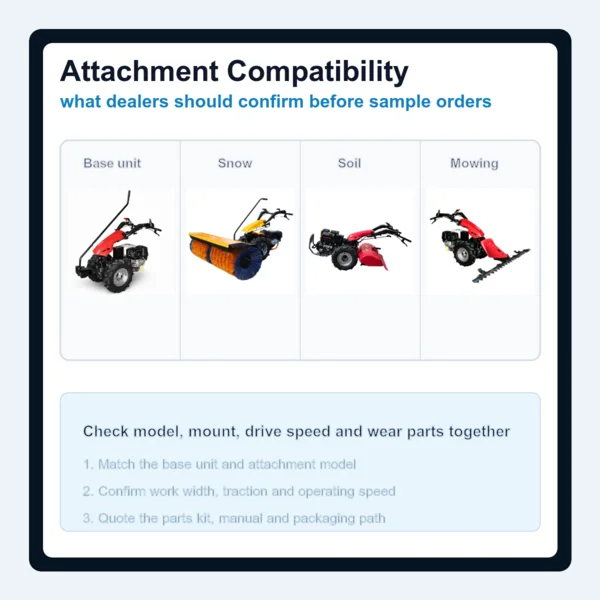
    Dealers do not lose time on attachment programs only because a buyer picked the wrong tool. They lose time when the base unit, attachment, parts list and documents were never checked as one package.

    That is why attachment compatibility should be treated as a sales document, not a back-office note. When a buyer asks for a walk-behind tractor package for snow, mowing or soil work, the first useful answer is not a longer product list. It is a clear compatibility path: which base unit, which attachment, what work width, what operating condition, which wear parts and which documents will ship with the sample.

    The outdoor power equipment market is moving in that direction. Equip Exposition has already sold out its 2026 exhibit space, and major attachment suppliers publish compatibility charts and guides because dealers and contractors expect to compare machines quickly. For a compact walk-behind line, that expectation is even sharper. The buyer may be evaluating several attachments around one power unit, and a weak fit decision can damage the whole program.

    Trade-show season turns compatibility into a selling issue

    A busy trade show floor makes one thing obvious: buyers compare systems, not isolated machines. A dealer may see a snow attachment, a mower, a tiller and a cleanup tool in the same buying cycle. The question becomes, “Can this platform support the package we want to sell?”

    That is where a walk-behind tractor or multifunction power unit has to be explained in practical terms. Horsepower is only one part of the answer. The dealer also needs to know the attachment interface, weight balance, available speeds, wheel setup, operator control position, and how the tool behaves under real work load.

    If that information is not organized before the sample order, the buyer ends up using the sample as a compatibility test. That is expensive, slow and easy to misread.

    Start with the base unit, not the attachment

    The cleaner way to build a dealer package is to start with the base unit. Which model is the lead platform? Which engine range and wheel setup will be used for the first market? Which attachment categories are supposed to be sold with it in year one?

    Once the base unit is fixed, the attachment list becomes easier to control. A dealer can separate tools into three groups: ready for the lead model, possible with a different configuration, and not suitable for the first program. That language is more useful than a loose “fits most models” claim.

    For KINGO ANDA, a winter-focused package might start with a power unit and a snow sweeper. A four-season dealer package may add a rotary tiller, a mower and cleanup tools. Those are different selling stories, but they should still begin with the same question: what is the base platform expected to carry?

    Check work width, traction and speed together

    Compatibility is not only whether an attachment can be mounted. A tool can connect to a machine and still be a poor route fit.

    Work width matters because buyers compare passes, storage and transport. A snow sweeper that is too narrow may not save labor on long sidewalks. A mower that is too wide may become awkward around beds, gates or tight turns. A tiller that asks too much from the platform can create a bad first impression even when the mount is correct.

    Traction and operating speed matter just as much. Snow, wet soil, slopes and uneven pavement change the way a walk-behind unit feels to the operator. Before a dealer quotes a mixed attachment package, the sales team should confirm the intended ground condition, season, route width and expected duty cycle. That is the difference between a product recommendation and a product guess.

    Do not quote without the parts path

    A compatibility matrix is incomplete if it stops at the machine and attachment. Dealers also need the wear-part path.

    Brushes, belts, blades, cables, pins, fasteners and filters are not minor details when the buyer is building a seasonal program. If the first sample order does not include the common wear list, the dealer cannot judge the real after-sales burden. Worse, the buyer may approve the product and then discover later that the parts package was never planned.

    The right place to settle this is before the first quote. The dealer should ask which parts are shared across attachments, which parts are unique, which items should be stocked locally, and what information will appear in the parts list or manual. KINGO ANDA’s Parts & Service path should be part of the same conversation as the equipment package.

    Build the matrix before the sample order

    A useful matrix does not have to be complicated. For each base unit, list the attachments being considered, then add columns for mount, drive requirement, work width, operating speed, normal wear parts, packaging and document status.

    The best version is honest. Some combinations are ready. Some need a different setup. Some may be technically possible but should not be sold as the lead package. That distinction protects the dealer, the OEM buyer and the factory. It also makes the sample order more meaningful because everyone knows what is being tested.

    For a first RFQ, the matrix can be small: one lead power unit, one snow tool, one soil or mowing tool, one cleanup option and the parts kit behind them. That gives the buyer enough structure to compare the package without turning the discussion into a catalog scan.

    A cleaner RFQ for dealers and OEM buyers

    The practical request is simple: send the target market, base-unit model, attachment list, route or job type, expected annual volume and document requirements before asking for a final quote. That gives the supplier enough information to confirm fit, prepare the right sample package and avoid a weak first shipment.

    Dealers and OEM buyers can use KINGO ANDA’s Dealer Support page to compare package options, then send the attachment set and target use case through the contact page. A better compatibility matrix will not make every decision easy, but it will keep the first sample order from becoming the first problem.

    Sample order planning

    Need a compatibility matrix before quoting a mixed attachment package?

    Request Specs

  • Grounds-Care Attachments for Walk-Behind Power Units: What Property Buyers Should Compare

    Grounds-Care Attachments for Walk-Behind Power Units: What Property Buyers Should Compare


    OEM, dealer and municipal equipment coverage
    English trade-editorial updates from KINGO ANDA

    Industry Products

    Grounds-Care Attachments for Walk-Behind Power Units: What Property Buyers Should Compare

    Property-maintenance buyers can compare mowing, tilling, blowing and washing attachments on one walk-behind power-unit platform before RFQs move.

    Published June 22, 2026
    Industry Products
    KINGO ANDA Blog

    Grounds-Care Attachments for Walk-Behind Power Units: What Property Buyers Should Compare

    Summer is when property-maintenance buyers, grounds crews and local dealers make the practical decisions that shape next season’s equipment mix. Winter attachments may carry the headline in January, but June and July are when buyers look at crew utilization, storage, service access and whether one compact platform can stay productive beyond snow season.

    That timing matters for walk-behind power-unit suppliers. Recent dealer and contractor coverage across the OPE market has focused on productivity, demonstrations and keeping crews effective with the people already on staff. For buyers who manage sidewalks, campuses, estates or mixed seasonal contracts, the real question is not whether an attachment works in isolation. It is whether the base machine and the warm-season tools around it will hold up through mowing, soil work, cleanup and utility jobs without creating a parts and training headache.

    For KINGO ANDA, that makes grounds-care attachments more than an off-season add-on. They are what turns a winter-focused machine purchase into a year-round platform decision.

    Start with the power unit, not the attachment headline

    Many inquiries begin with the attachment name. A buyer asks about a mower, a rotary tiller or a blower because that is the job they need to solve right now. In practice, experienced dealers usually work in the opposite direction. They start with the base unit, then judge whether the attachment family is broad enough to support the account for more than one season.

    A compact platform such as the multifunction power unit should be assessed on three points first: power delivery, attachment-change workflow and service access. If those fundamentals are weak, the attachment list on paper does not mean much. If those fundamentals are solid, the same platform can move from late-spring tilling to summer mowing, then into cleanup and pressure-washing work before winter kits come back into the conversation.

    That is especially relevant for property-maintenance contractors and municipal-style buyers who do not want a separate machine for every narrow task. They need a platform that crews can learn once, store easily and keep moving between job types.

    Which grounds-care attachments belong in a practical package

    The warm-season package should be built around the work mix, not around the biggest attachment list a supplier can print in a brochure.

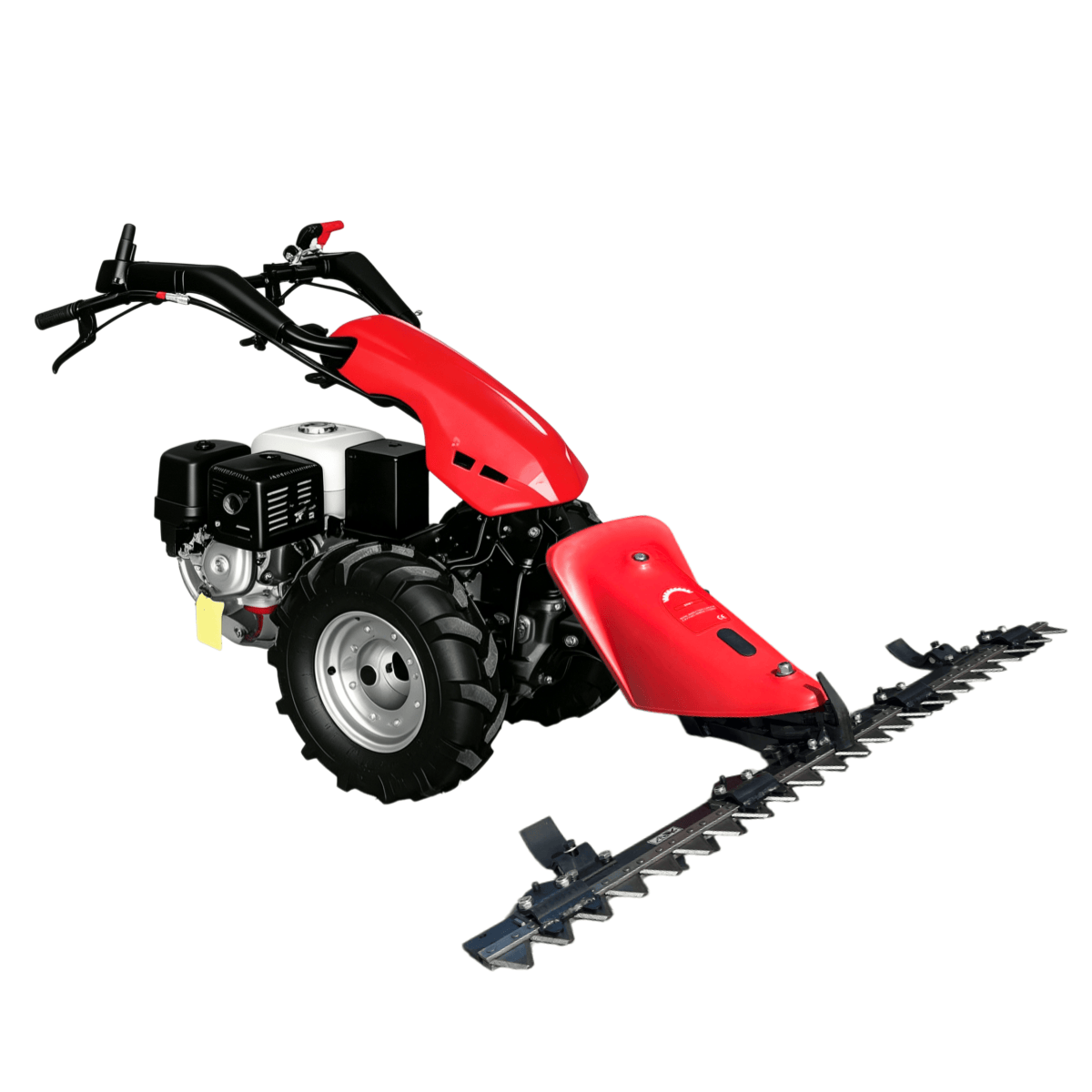
    For grass and verge control, the mower attachment is the most straightforward starting point. Buyers should look beyond cutting width and ask where the tool fits: roadside edges, property lanes, campus walkways or mixed open-space maintenance. The right mower attachment earns its place when crews can move quickly through narrow areas that are awkward for larger ride-on equipment.

    For soil preparation and seasonal grounds reset work, the rotary tiller belongs in the discussion. This is less about broad-acre agriculture and more about small-area site work, bed preparation and mixed-use property jobs where maneuverability matters as much as outright width. Dealers serving contractors often find that a tiller attachment becomes more convincing when it is sold as part of a platform that can switch to other work after the soil job is done.

    Cleanup work is where many buyers either gain confidence in the platform or walk away from it. A blower or a high-pressure washer can help a contractor extend the same machine into path cleanup, debris management and washdown tasks, but only if changeover is realistic and the operator controls remain straightforward. If crews avoid swapping attachments because the process is slow or awkward, the package looks good in a catalog and weak in the yard.

    That is why the best grounds-care package is usually a narrow one: one base unit, one lead mowing or soil attachment, and one utility attachment that matches the buyer’s regular service route.

    What property-maintenance buyers should compare before sending an RFQ

    Once a buyer has identified the likely attachment mix, the next stage is not price. It is compatibility and support.

    First, confirm which attachments are truly meant to run on the same power unit without workarounds. Buyers should ask for a clean compatibility list, not a vague statement that the platform can handle “multiple tools.” Second, ask how wear parts, manuals and service items are organized. A platform only saves time if the support side is as coherent as the hardware.

    Third, compare transport and storage logic. Walk-behind platforms often win when access is tight and trailers are limited, but that advantage disappears if each attachment needs awkward handling or special setup every time the crew changes jobs. Fourth, ask whether the supplier can support dealer demos, specification sheets and package building for the actual market you serve.

    That is where the buyer conversation often shifts from equipment to channel support. A contractor may care most about uptime. A distributor may care about sample orders, attachment mix and parts planning. An OEM buyer may focus on labeling, documents and pack-out consistency. The commercial answer should change with the buyer type, which is why dealer and supply support matters as much as the attachment itself. KINGO ANDA’s dealer-support page is the right place to move that part of the conversation forward.

    When one platform beats a stack of single-purpose machines

    There is no virtue in forcing one machine to do everything. On larger grounds programs, dedicated equipment will still make sense for core mowing or large-area maintenance. But on smaller fleets, multi-site property routes and mixed seasonal contracts, one compact platform often wins because it reduces idle equipment, shortens training time and keeps spare-parts planning cleaner.

    That is the practical appeal of grounds-care attachments on a walk-behind power unit. The platform does not need to replace every machine in the yard. It needs to carry enough work through the calendar to justify the dealer’s inventory position and the buyer’s service expectations.

    In other words, the decision should be made the same way strong buyers already make most equipment decisions: not by counting attachments, but by matching one base platform to the jobs that repeat across the year.

    A better warm-season buying question

    Instead of asking, “Which attachment is cheapest to add?” buyers usually get farther by asking, “Which attachment package keeps this platform useful after the first sale?” That question leads to better RFQs, clearer demo priorities and stronger follow-up discussions with dealers and OEM suppliers.

    Buyers who are comparing mowing, tilling and cleanup packages on one compact platform can review KINGO ANDA’s current power-unit and attachment range, then use the contact page to request a package built around their route, region and seasonal work mix.

    Grounds-care package

    Need a warm-season attachment package for your route mix?

    Request Specs

  • OEM Snow Removal Equipment: What Private-Label Buyers Need Before Approval

    OEM Snow Removal Equipment: What Private-Label Buyers Need Before Approval


    OEM, dealer and municipal equipment coverage
    English trade-editorial updates from KINGO ANDA

    Industry Products

    OEM Snow Removal Equipment: What Private-Label Buyers Need Before Approval

    What OEM and private-label buyers should confirm before approving walk-behind snow-removal equipment, from attachment fit to documents and sample orders.

    Published June 22, 2026
    Industry Products
    KINGO ANDA Blog

    OEM Snow Removal Equipment: What Private-Label Buyers Need Before Approval

    Mid-year is when OEM and private-label equipment conversations usually become more concrete. The 2026 OPEI Annual Meeting opens on June 22-24, and the broader Equip Exposition calendar is already pushing dealers, distributors and manufacturers into line-review mode for the next ordering cycle. For buyers evaluating compact winter programs, that timing matters. By the time preseason demand tightens, the real approval questions should already be settled: platform fit, attachment scope, service parts, document quality and whether the supplier can support a sample order without confusion.

    That is especially true in walk-behind snow equipment. Private-label buyers are rarely approving one attachment in isolation. They are evaluating whether a supplier can support a small but credible program around a base platform, a winter attachment set and the operating details that make the line practical for dealer or regional distribution. On the KINGO ANDA side, that means looking beyond a single product image and asking whether the Walk-behind Tractor and the Multifunction Power Unit can anchor a package that is easy to present, document and reorder.

    Start with the program scope, not the paint color

    Weak OEM conversations tend to start with branding questions too early. Strong ones start with program scope. Is the buyer trying to add one snow attachment to an existing line, or build a compact winter package that can support dealers, municipal channels and property-maintenance buyers? Is the target a seasonal promotion, a distributor test, or a longer private-label line with repeat orders and parts support?

    Those questions shape everything else. A buyer approving a one-SKU winter test will judge risk differently from a buyer building a broader regional program. The second case usually needs cleaner attachment logic, clearer parts naming and better documentation from day one. That is why the most useful first review is not cosmetic. It is operational: what is the platform, which attachments belong in the winter set, and where does the supplier draw the line between standard offering, optional accessory and custom discussion?

    Attachment fit must be explained in route terms

    Private-label buyers do not only need to know that an attachment exists. They need to know what problem it solves on the route. In compact winter equipment, that usually means explaining the difference between brush-led clearing, blade-led pushing and thrower-led snow movement in plain buying language. If that explanation is vague, the approval process slows down because the importer or dealer cannot translate the package into a clean sales story.

    For example, a buyer reviewing the Snow Removal range should quickly understand where a sweeper leads, where a blade is simpler, and when a thrower becomes necessary because storage space or accumulation depth changes the job. That route-based explanation matters more than broad claims about versatility. Buyers expect versatility. What they really need is confidence that each attachment has a clear role inside the package.

    Document quality often decides whether approval moves forward

    Many OEM discussions stall because the product is acceptable but the document set is weak. A serious buyer normally wants the core specification, attachment naming, packaging details, sample-order logic and a spare-parts view before signing off on a private-label test. If those pieces arrive late or contradict each other, the supplier starts to look harder to support than the equipment is worth.

    For compact walk-behind winter equipment, the minimum useful file set is not complicated. Buyers usually need a platform specification, attachment specification sheets, a compatibility list, packaging dimensions, basic parts support guidance and a clean explanation of how sample and repeat orders will move. That is also where a supplier’s public commercial pages matter. If the Dealer Support and Company paths already show a coherent supply story, the buyer has less work to do to justify the program internally.

    Sample-order readiness matters more than broad promises

    Private-label buyers are trained to distrust big promises that arrive before sample discipline. They know that the first friction usually appears in packaging, document consistency, lead-time communication or replacement-parts handling, not in the sales headline. That is why approval conversations get stronger when the supplier can discuss the sample process clearly: what configuration can be sampled, how attachments are identified, what documents travel with the sample, and what the buyer should review before scaling into a broader order.

    This is also where suppliers often win or lose dealer confidence. Dealers do not want a winter package that sounds flexible but becomes vague when it is time to quote. They want enough structure to explain the line, request the right attachment mix and prepare for in-season parts questions. In practice, that means a supplier should be ready to talk about attachment combinations, packaging logic and reorder clarity before the buyer asks for final artwork or color decisions.

    What buyers should confirm before approval

    Before approving an OEM snow-removal package, a buyer should confirm five things. First, the platform and winter attachments form a coherent package rather than a loose product list. Second, each attachment can be explained in route terms, so the sales side knows where it fits. Third, the supplier can provide clean specifications, compatibility information and packaging details. Fourth, the sample-order path is defined well enough to test the relationship without guesswork. Fifth, the supplier can support the program after the first shipment with parts, naming consistency and a realistic commercial discussion.

    Those checks sound basic, but they prevent most avoidable approval delays. They also help buyers avoid overcommitting to a private-label winter line before the supplier relationship has been tested on the details that actually create work. If you are comparing OEM or private-label snow-removal options for a compact walk-behind platform, KINGO ANDA can support that review with the current tractor platform, the existing winter attachment range, and a direct RFQ path for specification, sample-order and dealer-package discussion.

    Dealer / OEM discussion

    Need a cleaner private-label review or winter-package RFQ?

    Request Specs

  • Snow Sweeper vs. Compact Snow Thrower: Which Sidewalk Route Fits Each?

    Snow Sweeper vs. Compact Snow Thrower: Which Sidewalk Route Fits Each?


    OEM, dealer and municipal equipment coverage
    English trade-editorial updates from KINGO ANDA

    Industry Products

    Snow Sweeper vs. Compact Snow Thrower: Which Sidewalk Route Fits Each?

    Compare snow sweepers and compact snow throwers for sidewalk routes, dealer programs and RFQ planning before winter equipment orders lock in.

    Published June 18, 2026
    Industry Products
    KINGO ANDA Blog

    Snow Sweeper vs. Compact Snow Thrower: Which Sidewalk Route Fits Each?

    Mid-year is when serious winter-equipment decisions usually get cleaner, not louder. APWA’s current winter-maintenance resources and the run-up to the 2026 OPEI Annual Meeting both point to the same reality: municipal teams, property-maintenance contractors and dealers do better when they sort route fit, attachment mix and support requirements before preseason demand compresses lead times. For KINGO ANDA, that makes one comparison especially useful for buyers evaluating compact winter packages: a snow sweeper versus a compact snow thrower on the same walk-behind power-unit platform.

    This is not a beauty-contest comparison. Buyers are usually trying to answer a more practical question: which attachment solves the actual sidewalk route with fewer operator compromises, fewer in-season support problems and a clearer RFQ? On a compact platform, the decision often comes down to route width, surface condition, expected snow profile, throw-distance needs and whether the equipment program has to support dealer inventory planning as well as end-user work.

    Start with the route, not the attachment label

    The fastest way to make a bad winter-equipment decision is to compare attachment names before mapping the route. Sidewalk fleets, campuses, estates and property-maintenance crews rarely work one clean surface under one clean snow condition. They deal with narrow walkways, curb ramps, parked vehicles, pedestrian edges, mixed accumulation and varying snow-storage space.

    That is why experienced buyers usually begin with three questions. How wide are the routes that matter most? What kind of accumulation is most common during the work window? And where does the removed snow have to go? Once those answers are clear, the comparison between the Snow Sweeper and the Compact Snow Thrower becomes much easier and much more defensible in procurement discussions.

    When a snow sweeper is usually the better fit

    A snow sweeper typically gets attention when the priority is controlled clearing on sidewalks, access paths and paved areas where surface finish matters. Buyers who expect frequent light to moderate snowfall often prefer a sweeper because it supports steady route progress, predictable edge control and simpler operator judgment on surfaces that need to stay accessible throughout the event.

    That matters for municipal sidewalk teams and commercial-property crews working around entrances, curb ramps, school paths and healthcare access points. In those settings, the question is often less about maximum throw performance and more about whether the operator can keep routes passable without turning every pass into a snow-placement problem. A sweeper package also tends to fit dealer conversations where buyers want one attachment that is easy to explain, easy to demonstrate and easy to position as part of a broader walk-behind power-unit program.

    When a compact snow thrower earns the conversation

    A compact snow thrower becomes more relevant when buyers expect heavier accumulation, tighter storage conditions or stronger demand for moving snow away from the cleared path rather than brushing it aside. If the route repeatedly creates banks at the walkway edge, or if crews have limited room to stack snow without blocking access, the thrower discussion becomes more serious.

    This is where the comparison should stay disciplined. Buyers should not ask whether a thrower is “better” in the abstract. They should ask whether the route regularly creates conditions that a sweeper handles less efficiently. If deeper events, repeated buildup or confined edges are common, a thrower can be the more practical answer. That is especially true for dealer buyers trying to build a winter package that covers more than one snow profile instead of forcing every customer toward a single attachment.

    Why dealers should evaluate both on the same platform

    For dealers and OEM buyers, the bigger commercial question is not only sweeper versus thrower. It is whether the platform lets them build a clean winter story around one base unit and more than one attachment path. That is why platform businesses usually travel better than one-product winter pitches. A dealer can position one power unit with a brush-led package for routine route work, then add a thrower path for customers facing heavier accumulation or more difficult snow placement.

    That same logic supports broader seasonal selling. A compact platform with winter attachments is easier to defend when it can also link into non-winter categories already visible in KINGO ANDA’s catalog, including the Snow Removal range and the dealer-facing program described on Dealer Support. Buyers are not only evaluating snow performance. They are evaluating service parts, training simplicity, reorder clarity and how easily the supplier can support a multi-attachment relationship.

    The RFQ questions that separate a strong inquiry from a weak one

    Once a buyer narrows the route fit, the next step is to clean up the RFQ. This is where many winter-equipment conversations get fuzzy. Serious inquiries should ask for the power-unit specification, the chosen attachment specification, the attachment-compatibility scope, wear-parts recommendations, packaging details and the expected dealer or OEM order path. If the route is mixed, ask directly where the sweeper is the better tool and where the thrower should take over.

    Dealers should also ask what will make the package easier to support in season. Which parts should be stocked locally? What documentation is available for sample review? How clearly are attachments named and packaged for reorders? Those questions matter more than generic claims about “all-purpose performance,” because winter buyers are usually trying to reduce downtime and ordering confusion, not admire a brochure.

    The practical buying view

    In plain terms, the sweeper usually leads when route control, accessible-surface maintenance and routine sidewalk clearing are the main problem. The compact thrower becomes more attractive when snow depth, edge buildup and throw-distance requirements create repeated bottlenecks. Many buyers will end up concluding that the best answer is not one attachment replacing the other, but one platform supporting both according to route conditions and customer type.

    That is the more useful commercial story as well. Dealers can sell a clearer winter package, municipal and property-maintenance buyers can write better RFQs, and OEM buyers can evaluate the supply relationship with fewer assumptions. If you are reviewing compact winter attachments for sidewalks, campuses, estates or dealer programs, KINGO ANDA can support the comparison with its power-unit platform, the current Snow Sweeper and Compact Snow Thrower options, and a direct RFQ path for specification, package and dealer/OEM discussions.

    Dealer / OEM discussion

    Need a tighter RFQ package or attachment comparison?

    Request Specs