Industry Products
Private-Label Compact Snow Equipment: What OEM Buyers Should Lock Before Artwork
OEM buyers ordering private-label compact snow equipment should lock model codes, serial labels, manuals, carton marks and parts files before artwork starts.
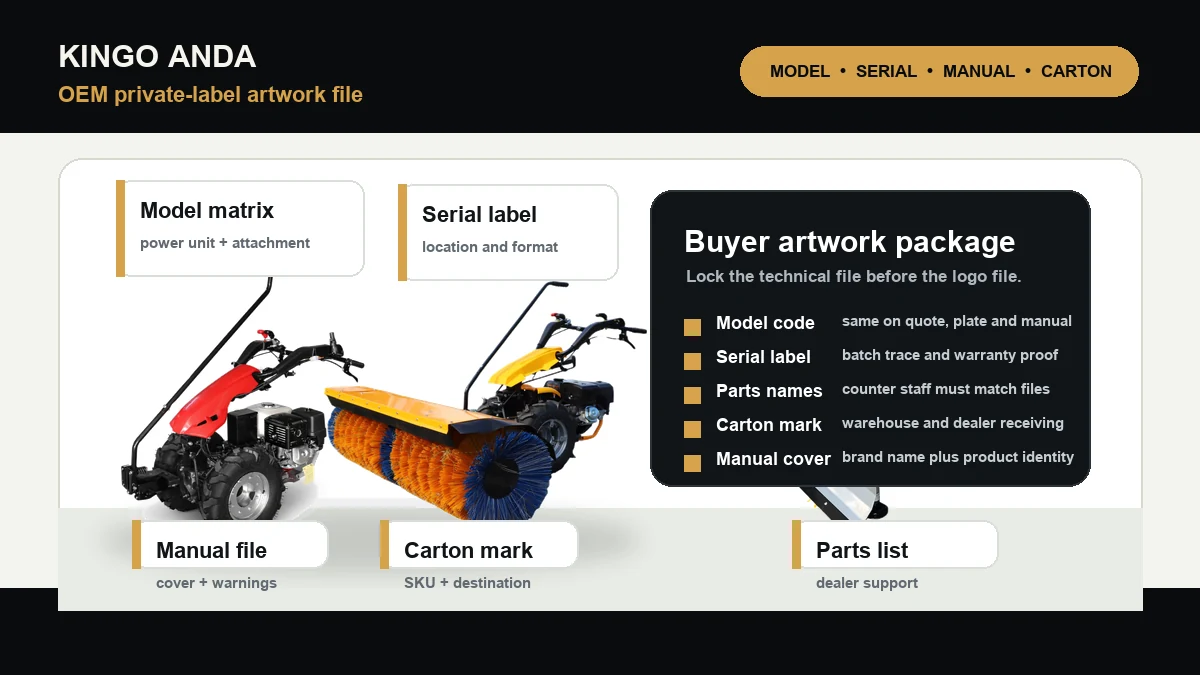
Private-label equipment buyers often treat artwork as the point where a project starts to look real. The logo is on the cover. The carton mark is drafted. The dealer wants a name for the package. That is usually the wrong order. For compact snow equipment, artwork should come after the technical file is already locked.
The reason is simple: a snow sweeper, snow blade, compact thrower or walk-behind power unit becomes a support product as soon as it reaches a dealer. If the model code, serial label, manual name, carton mark and spare-parts file do not match, the first winter service question becomes harder than it needs to be.
Artwork starts with product identity, not the logo
OEM and private-label buyers should first decide how the equipment will be named across the quote, rating plate, manual, carton and parts sheet. BOSS tells parts buyers to identify the product by model, serial number, product family and documentation before ordering replacement parts. That habit is not only useful after the sale. It should shape the buyer file before the first artwork proof is approved.
For a KINGO ANDA compact snow package, the buyer file should separate the walk-behind power unit, the attachment, the working width, the connection kit and the first-season support parts. A private-label name can sit on top of that structure, but it should not replace it.
This is where many early projects become messy. The sales quote says one model. The manual cover uses another. The carton label uses a buyer SKU that the factory cannot map back to the attachment. The product is still usable, but the support path is weak before the first unit ships.
Serial labels are a service system
Serial labels are not decoration. The CPSC recall notice for Amerisun PowerSmart snow blowers identifies model and serial number ranges and explains where those labels are located on the equipment. Briggs & Stratton’s recall and notification page also points owners toward recall notices, model-number lookup, manuals, parts lists and dealer support. The pattern is clear: when equipment needs service, identification data matters.
Private-label buyers should therefore approve more than the look of the label. They should confirm the label location, serial format, batch meaning, durability, language set and whether the same code appears in the packing list, invoice, manual file and warranty record. If the buyer uses its own SKU, the cross-reference between buyer SKU and factory model must be kept in writing.
This connects directly to the KINGO ANDA dealer warranty packet. A warranty packet without a clean serial record is a slow claim. A private-label order without a serial rule is a future support cost.
Manual and parts names must match the dealer counter
Private-label artwork often focuses on the front cover: brand mark, product name, image and color. The more important pages are usually inside the file. The parts list, maintenance section, safety references and service-contact page need names that match the actual stocked product.
If a buyer wants a snow sweeper under a regional brand, the manual should still make the attachment identity clear enough for the dealer counter. Brush wafers, skid shoes, scraper edges, shear items, belts, chute parts and fasteners must be named in a way the dealer can reorder. A nice catalog cover cannot fix a parts sheet that uses vague names.
That is why the earlier compact snow thrower parts guide matters for OEM buyers as well. The best private-label file ties the artwork, model matrix and spare-parts plan together before production begins.
Carton marks should serve receiving, not just branding
Carton artwork has a different job from the brochure. It should help the receiving warehouse, dealer branch and service team identify the shipment quickly. The carton mark should normally carry the buyer item code, factory model reference, attachment type, gross and net weight where applicable, carton count, destination mark and any handling notes the buyer requires.
Cotech presents itself as a snow-removal and agricultural equipment manufacturer with OEM manufacturing agreements and a dealer network across North America. That kind of dealer-channel positioning depends on consistency. The brand promise is not only the finished product. It is also whether dealers can receive, identify, service and reorder the package without rebuilding the file from email threads.
For KINGO ANDA, this is the same logic behind the compact snow equipment packaging guide. Private-label artwork should be reviewed beside carton labels and spare-parts packs, not as a separate design task.
Approve one sample file before mass production
Outdoor power equipment demand continues to grow, and buyers are asking suppliers to support more market-specific product packages. Fortune Business Insights estimates global outdoor power equipment at USD 39.33 billion in 2026, with North America remaining a major market. That scale does not make private-label projects simpler. It raises the cost of unclear files.
Before mass production, the buyer should approve one complete sample file: quote model, product photos, plate or serial label, manual cover, manual PDF, carton mark, parts list, warranty boundary and service-contact path. The sample unit should be checked against that file, not only against the logo proof.
Dealers and OEM buyers preparing compact equipment packages can use the dealer RFQ checklist to organize model, attachment and document requirements before the artwork round starts. If the private-label program includes multiple attachments, the same checklist should be repeated for each attachment family.
For a cleaner quote path, share the target market, buyer brand, model naming rule, attachment set, carton-label requirements and expected annual volume through Build Your Package. KINGO ANDA can align the private-label file before the artwork becomes expensive to change.
Build the private-label file before artwork.
Send the buyer market, attachment set, SKU rule and support expectations. KINGO ANDA can prepare the quote path around the right technical file.
Industry references checked: BOSS parts identification guidance, CPSC Amerisun snow blower recall notice, Briggs & Stratton recall and notification page, Cotech manufacturer and OEM positioning, Fortune Business Insights outdoor power equipment market overview.