EU 2027 / OEM File Control
EU Machinery Regulation 2027: A File Checklist for Snow Equipment OEM Buyers
A practical EU Machinery Regulation 2027 checklist for snow equipment OEM buyers covering model identity, instructions, conformity files and revision control.
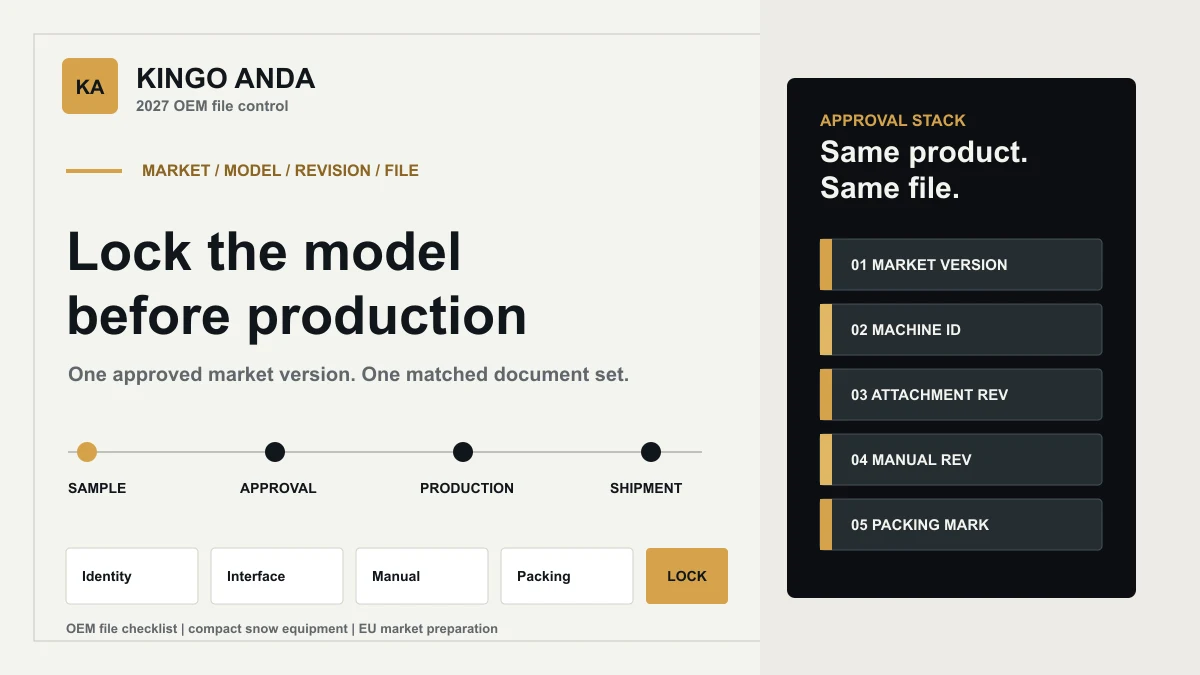
January 20, 2027 is close enough to affect the equipment files being approved now. The European Commission says the new Machinery Regulation (EU) 2023/1230 applies on that date and replaces the current Machinery Directive for machinery placed on the EU market from then onward. For a compact snow-equipment buyer, this is not just a legal department date. It is a sample-approval, artwork, manual and production-control date.
The practical mistake is to treat the machine, attachment, label, instruction set and packing mark as separate purchasing tasks. They must describe the same market version. If the attachment revision changes after the manual is approved, or the serial label identifies a model name that does not match the declaration and carton, the buyer inherits a file problem before the unit reaches a dealer.
This article is a procurement checklist, not a conformity assessment. The exact obligations depend on the product, configuration, intended use and market role. A competent compliance specialist should determine the applicable route. The buyer’s job is to make sure the approved product and the approved file do not drift apart.
Put January 20, 2027 into the buying calendar
The Commission’s machinery page distinguishes the current and future regimes: machinery placed on the EU market before January 20, 2027 follows the current Machinery Directive, while the new regulation becomes mandatory on that date. That makes the placement date and the exact market version important planning fields, not details to settle after shipment.
An OEM buyer should add a regulatory checkpoint before sample approval, another before production release and a final one before shipping documents are closed. If the project crosses the January date, ask which framework the supplier’s file is being prepared against and have the answer confirmed by the party responsible for conformity. Do not assume that an older declaration, label artwork or instruction template can simply be carried forward.
For a walk-behind power unit with multiple winter attachments, the calendar should also show which attachment combinations belong to the approved configuration. A shipment date alone does not tell the buyer whether the broom, blade or thrower documentation matches the power unit being packed.
Approve a market version, not a generic SKU
Regulation (EU) 2023/1230 requires machinery to carry identifying information such as model, series or type, year of construction and an available batch, serial or other identification element. It also requires manufacturer contact information on the product or, where that is not possible, on packaging or accompanying documents. Those fields should be visible in the OEM approval file before production.
A factory SKU may cover several commercial versions. The EU buyer therefore needs a market-specific identity sheet: brand name, commercial model, factory reference, power-unit revision, attachment revision, engine or power-source version, label artwork reference, manual reference and carton mark. That sheet becomes the index for the rest of the file.
Do not ask only for a clean label image. Ask for a photograph of the label applied to the approved sample, plus the editable artwork and its revision code. The photo proves placement and legibility. The artwork controls production. The revision code lets the buyer distinguish an approved label from a later draft. This extends the same discipline described in KINGO ANDA’s guide to serial labels, carton photos and warranty evidence.
Treat the power unit and attachment as a matched set
The EU framework defines machinery and related products broadly enough that buyers should not treat interchangeable equipment as an afterthought. The correct classification and conformity route must be decided by qualified specialists, but the purchasing file can still prevent basic mismatches.
For each snow package, record the power unit, attachment name, interface version, guards, controls, working width and intended use in one compatibility table. If a mounting bracket, control cable, guard or driveline changes, the attachment revision should change with it. The product photo, drawing, parts list and instruction set should then be reviewed together.
This matters most when one platform supports several jobs. A snow sweeper, blade and compact thrower may share the power unit but still have different hazards, wear parts, setup steps and operating limits. The phrase “fits this machine” is not enough. The approval record should show which interface and which version were tested.
Make labels, instructions and declaration links agree
The regulation allows instructions in digital form under specified conditions. It says the access method must be marked on the machinery, packaging or accompanying document; the file must be printable, downloadable and saveable; and online access must be maintained for the expected lifetime and at least 10 years after placement on the market. Essential safety information for machinery intended for, or foreseeably used by, non-professional users still has a paper requirement.
The same source also allows the EU declaration of conformity to be supplied through an internet address or machine-readable code in the instructions and product information. For an OEM buyer, that creates a document-control question: does the QR code or URL resolve to the declaration for this exact model and revision, and will that file remain available?
Before artwork approval, test every printed link and code. Confirm that the model designation in the instructions matches the product label. Check that drawings, setup steps, maintenance notes and attachment references describe the shipped configuration. Keep the buyer-language version and the service-language version clearly identified. A generic manual that covers unknown variants may be easy to print, but it is difficult for a dealer to support.
Freeze one release file before production and shipment
The regulation requires procedures to keep series production in conformity and to account for changes in design, characteristics, production processes and referenced specifications. Buyers can support that discipline by making revision control part of the commercial release process.
The file should be unambiguous. Give every controlled item a name, revision and approval date. Then require the factory to photograph the first production unit, applied labels, packed accessories and carton marks against that release list. Any change after approval should be logged before the shipment file is accepted.
| Controlled item | Approval proof | Shipment check |
|---|---|---|
| Market identity | Commercial model, factory reference and target market. | Product label and invoice use the same identity. |
| Machine and attachment | Matched revisions, interface photos and compatibility table. | Packed configuration matches the approved sample. |
| Label artwork | Editable file, applied-sample photo and revision code. | Production label is legible and in the approved location. |
| Instructions | Correct model, language, drawings, warnings and access link. | Printed and digital files resolve to the released revision. |
| Packing file | Carton mark, accessories, spare parts and document list. | First-lot photos match the released packing record. |
For North American versions, keep the file separate. The US EPA maintains certification requirements for small nonroad spark-ignition engines, while ANSI/OPEI B71.3 covers snow-thrower safety specifications and B71.4 covers commercial turf-care equipment. Those records may be relevant to a US package, but they are not substitutes for the EU market file. One product platform can support several regions only when each regional version is controlled.
The dealer support package and parts and service file should use the same model names and revision references. That keeps sales, compliance and after-sales work tied to one released product instead of three similar descriptions.
Build an OEM approval file before production starts.
Send the target market, power unit, attachment mix and document requirements. KINGO ANDA can organize sample photos, model references, label artwork, packing proof and support-file checkpoints for buyer review.
Editorial references: European Commission machinery overview, consolidated Regulation (EU) 2023/1230, OPEI product standards listing and US EPA nonroad spark-ignition certification resources. Image source: locally produced KINGO ANDA OEM file-control graphic, owned site asset.