Dealer Receiving / Discrepancy Control
Dealer Receiving Discrepancy Report for Walk-Behind Equipment
A practical record for freight damage, missing parts, model mismatches, corrective action and retest closure before equipment reaches stock or a customer.
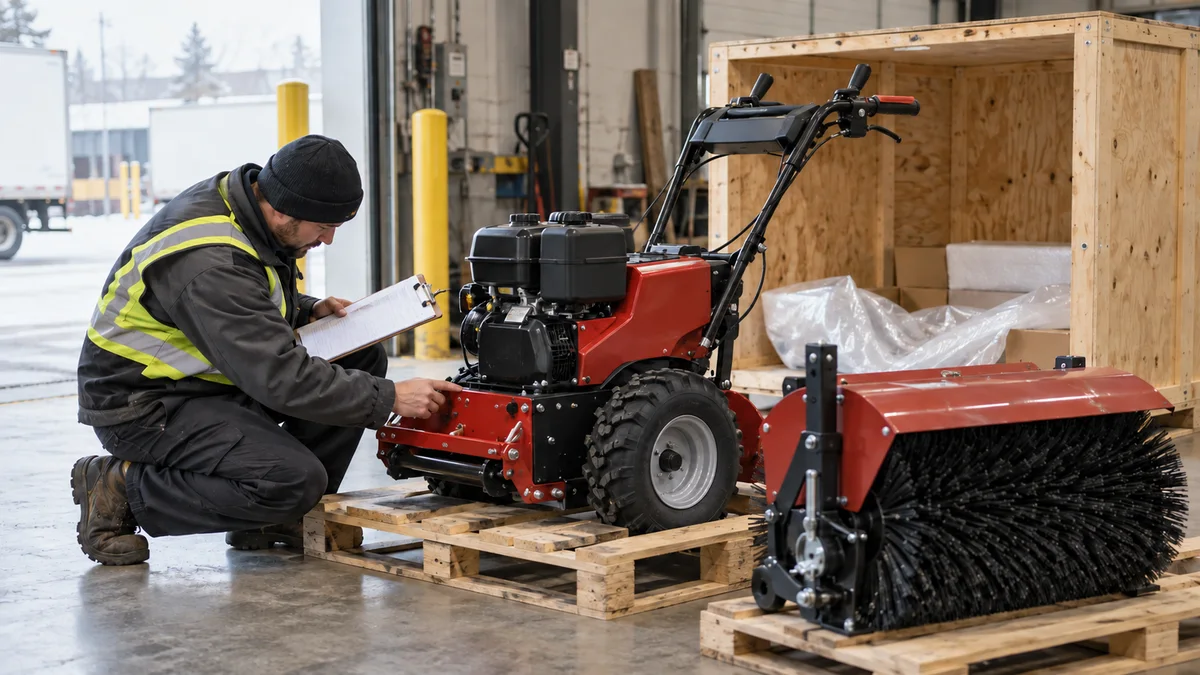
A receiving discrepancy report begins when the delivered package does not agree with the purchase order, packing list or expected physical condition. It gives the dealer one controlled record for transport damage, a missing component, a model mismatch or an incomplete document set.
The report is not a substitute for a carrier claim, a warranty decision or a technical root-cause investigation. Its first job is simpler: preserve what was observed at receipt, contain the affected equipment and assign the next action without turning assumptions into facts.
That distinction matters with walk-behind power units and attachment packages. One shipment can contain a power unit, snow sweeper, blade, compact thrower, interface hardware, controls, manuals and spare parts. A single missing bracket can hold the complete package, while visible carton damage may have no effect on the machine. The dealer needs a record that separates those cases.
Open the report from receiving evidence, not memory
Record the delivery date, carrier reference, purchase order, packing-list number, carton or crate count and the name of the person who received the shipment. Photograph the shipment marks and all sides of the affected package before packing material is removed or discarded. If damage is visible at delivery, retain the notation made with the carrier and the supporting images.
Then identify the exact item: manufacturer model, serial or batch identity where available, attachment type and the dealer’s own stock number. Use the order and identity plates as the reference. Do not rely on carton color, a handwritten nickname or similarity to a previous machine.
This report should follow the initial steps in the walk-behind snow equipment pre-delivery inspection checklist. The inspection establishes what arrived; the discrepancy report controls what does not match.
Describe the discrepancy without assigning an unproven cause
Use an observable description. “Left guard bent inward approximately 15 mm and contacting the brush frame” is more useful than “factory damaged the guard.” “Two M10 fasteners listed on the packing sheet were not found in the sealed hardware bag” is better than “parts missing from production.” Cause and responsibility may be decided later from packing records, carrier handling evidence and technical review.
Classify the issue so the receiving team can route it consistently: transport condition, quantity shortage, wrong model or revision, missing documentation, cosmetic condition, assembly issue or function-check exception. More than one category may apply, but each item should have its own line and evidence reference.
| Report field | What to record | Useful evidence |
|---|---|---|
| Shipment identity | PO, packing list, carrier reference, carton or crate number. | Shipping label and full-package photos. |
| Equipment identity | Model, serial or batch, attachment and interface kit. | Identity plate and item overview. |
| Observed condition | Location, quantity, measurement and operating symptom. | Close views with scale and a short test record. |
| Containment | Quarantine location, parts held and use restriction. | Hold tag and inventory status. |
| Disposition | Replace, repair, adjust, accept or return, with approver. | Approval, part reference and completion record. |
Preserve the freight and packing evidence
Carrier claim procedures commonly ask for shipment details, proof of value and photographs or inspection evidence. Requirements and deadlines vary by carrier, route and contract, so the dealer should check the applicable terms rather than assume one universal window. The receiving file should preserve original packaging, labels and damaged components until the claim owner confirms what can be released.
Keep wide photographs that show the complete shipment as well as close views of the issue. Include a ruler or another neutral scale where size matters. If a crate has shifted internally, photograph blocking, bracing and fastener points before moving components. The guide to compact snow equipment packaging, carton labels and spare-parts packs provides a useful baseline for the evidence expected before and after transport.
Do not repair, clean or discard the affected area before the required evidence is captured. At the same time, do not operate equipment with an uncertain guard, control, attachment interface or structural condition merely to produce a video.
Assign containment, corrective action and ownership
Every discrepancy needs an owner, due date and current status. The first action may be containment rather than repair: mark the unit on hold, separate it from saleable stock and prevent parts from being borrowed without a record. If only one attachment is affected, state whether the power unit and remaining attachments are also held.
The corrective-action line should name the approved disposition and its source. Examples include supplier replacement part, dealer adjustment under supplied instructions, carrier inspection, return authorization or documented acceptance of a cosmetic condition. Record part numbers and instruction revisions instead of writing only “fixed.”
For OEM and private-label packages, link the discrepancy to the approved sample, label file or packing record. KINGO ANDA’s guide to OEM approval records for compact snow equipment explains how those references keep a shipment issue from becoming an argument over which version was approved.
Close only after retest and handover records agree
A replacement part arriving is not closure. Record who completed the correction, when it was completed and which inspection or function check was repeated. Attach the retest result and final photographs. If the discrepancy changed a serial-number record, accessory count, manual set or customer promise, update those records before release.
The closure decision should be clear: accepted for stock, accepted for customer handover, returned, scrapped under authorization or still open. Keep claim status separate from equipment status. A carrier claim can remain under review after the machine has been restored, and a paid claim does not prove the equipment is ready for use.
Route parts and service records through the Parts & Service page, and use the Dealer Support page when the issue affects package configuration, OEM documentation or repeated shipments.
Build one receiving record around the complete package.
Send the power-unit model, attachment mix, packing requirements and dealer acceptance steps. KINGO ANDA can organize package references and support-file checkpoints for buyer review.
Editorial references: FedEx claims guidance, UPS claims support and the OPEI product standards listing. Carrier terms and equipment instructions for the actual shipment always control. Image: custom editorial image created for KINGO ANDA; no third-party brand asset used.