OEM Approval / Dealer Support
OEM Approval Records for Compact Snow Equipment: Sample Notes, QC Photos and Packing Proof
A dealer and OEM guide to approval records for compact snow equipment: samples, QC photos, packing proof, labels and shipment notes.
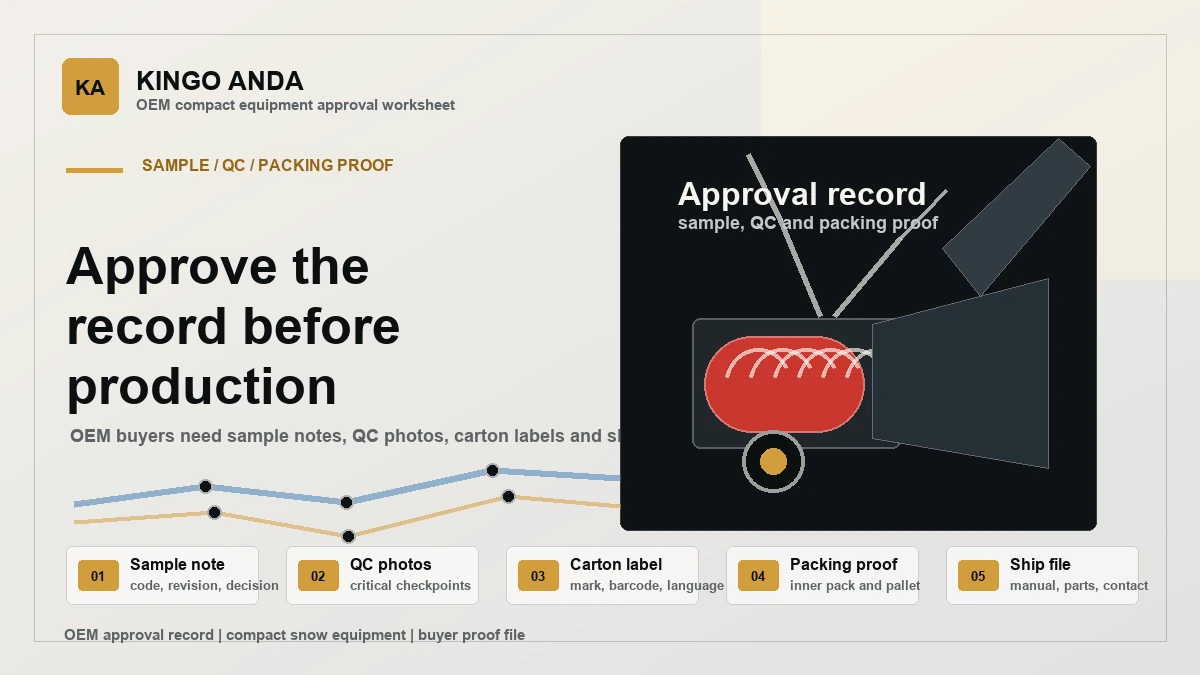
An OEM buyer does not approve compact snow equipment from a clean catalog page alone. The buyer approves a record: what sample was checked, which attachment revision was used, what the carton label looked like, how the product was packed, and what proof will still be available when the shipment is being received months later.
That record matters for walk-behind power units, snow sweepers, blades and compact thrower attachments because the parts are practical, visual and often revised by market. A dealer may ask for a different brush width, a private-label decal, a local-language carton mark or a spare-parts starter kit. If those decisions live only in email threads, the order can drift before production is complete.
Third-party inspection firms such as QIMA, SGS and factory-audit specialists keep pointing to the same operating idea: the inspection only works if agreed specifications, checkpoints and documentation are clear before goods leave the factory. KINGO ANDA dealers and OEM buyers should use the same discipline at the quote and sample stage.
Why the approval record matters before price negotiation
Price negotiation is cleaner when the buyer and supplier are talking about the same approved configuration. A buyer asking for a walk-behind power unit with a snow attachment package should not rely on broad names such as “sweeper set” or “winter package.” The record should name the power unit, attachment type, working width, color, guard style, label requirement, manual language, carton mark and spare-parts kit.
That sounds administrative, but it protects both sides. If a buyer changes a brush color, carton artwork or manual language after sample approval, the change can be priced and scheduled. If there is no record, the same change becomes a dispute about what was originally promised.
Keep sample notes tied to product codes and attachments
The sample note is the first page of the approval record. It should list the product code, attachment code, sample date, revision, buyer market, buyer type, decision status and any open items. For compact snow equipment, the open items often include working width, brush section, blade edge, thrower chute, handle control, packing method and quick-wear parts.
The note should also connect the sample to the selling page. A dealer using the product range to build a winter package needs the same terms on the website, quote, packing list and service file. When those terms drift, the sales team loses time reconciling documents instead of closing the RFQ.
Photograph QC checkpoints before packing changes
QC photos are not a decorative album. They should prove the exact checkpoints that matter to the buyer. For a snow sweeper, that may include brush section, guard fit, drive connection, handle position and visible label. For a blade, it may include cutting edge, skid shoe, mounting points and fastener kit. For a compact thrower, it may include intake housing, chute direction, scraper path and spare shear pins.
QualityInspection.org’s sourcing guidance emphasizes visibility and accountability around samples, checklists, inspections and supplier maturity. In a dealer/OEM order, that visibility should be practical: clear photo name, product code, date, inspector or operator, and a short note on pass, fail or buyer decision. One good QC photo can prevent a week of back-and-forth if the buyer later asks what was approved.
Make carton labels and packing proof part of the buyer file
Packing proof should be treated as a required sales document, not a warehouse afterthought. The buyer should see the inner packing, accessories, manual location, spare-parts pouch, label position, carton mark, pallet layout if relevant and any private-label artwork before mass shipment. A clean machine can still create a receiving problem if the carton label is wrong or the accessory bag is not easy to match.
Inspection and sourcing checklists commonly separate product identification, packaging standards, labeling accuracy and shipment readiness. Dealers should do the same with compact equipment. A dealer support file that includes carton photos and label proof is stronger than one that only includes a price and a delivery date.
| Record item | What to capture | Why it matters |
|---|---|---|
| Sample note | Product code, attachment code, revision, decision and open items. | Prevents later confusion over which version was approved. |
| QC photos | Functional checkpoints, labels, controls, wear parts and visible defects. | Creates evidence before packing and shipment. |
| Carton label | Brand mark, product name, code, barcode, language and carton side. | Reduces receiving and resale errors for dealers. |
| Packing proof | Inner packing, accessory bag, manual position, spare-parts pouch and pallet plan. | Shows whether the order is dealer-ready, not only factory-complete. |
| Support file | Manual, parts list, warranty note, service contact and reorder path. | Keeps the buyer from rebuilding support documents after delivery. |
Use the record as a dealer/OEM support asset
The approval record should not disappear after shipment. It should become part of the dealer/OEM support file alongside manuals, parts lists and service notes on the parts and service side of the business. When a buyer asks whether a carton label, spare kit or attachment width can be repeated, the answer should come from the record, not from memory.
This is also where the factory proof story becomes more credible. Factory photos, QC photos and packing proof do more for B2B trust than broad claims about experience. They show discipline. For compact snow equipment, that discipline is often what separates a simple sample inquiry from a repeatable dealer order.
Prepare an OEM approval file for compact equipment.
Send the target market, buyer type, attachment package, label requirement and sample status. KINGO ANDA can organize the sample note, QC photo checklist, packing proof and support file before production.
Editorial references: QIMA inspection and supplier-audit resources, SGS testing, inspection and certification resources, QualityInspection.org manufacturing and quality-control guidance, Alibaba.com B2B supplier platform resources, iFactory pre-shipment inspection checklist coverage and TradeAiders quality inspection checklist coverage. Image source: locally generated KINGO ANDA editorial approval-record graphic, owned site asset.