Parts Support / Dealer Stock
Snow Sweeper Wear-Part Kits for Dealer First-Season Stock
A dealer guide to first-season snow sweeper wear-part kits, covering brushes, belts, shoes, hardware, reorder levels and support files.
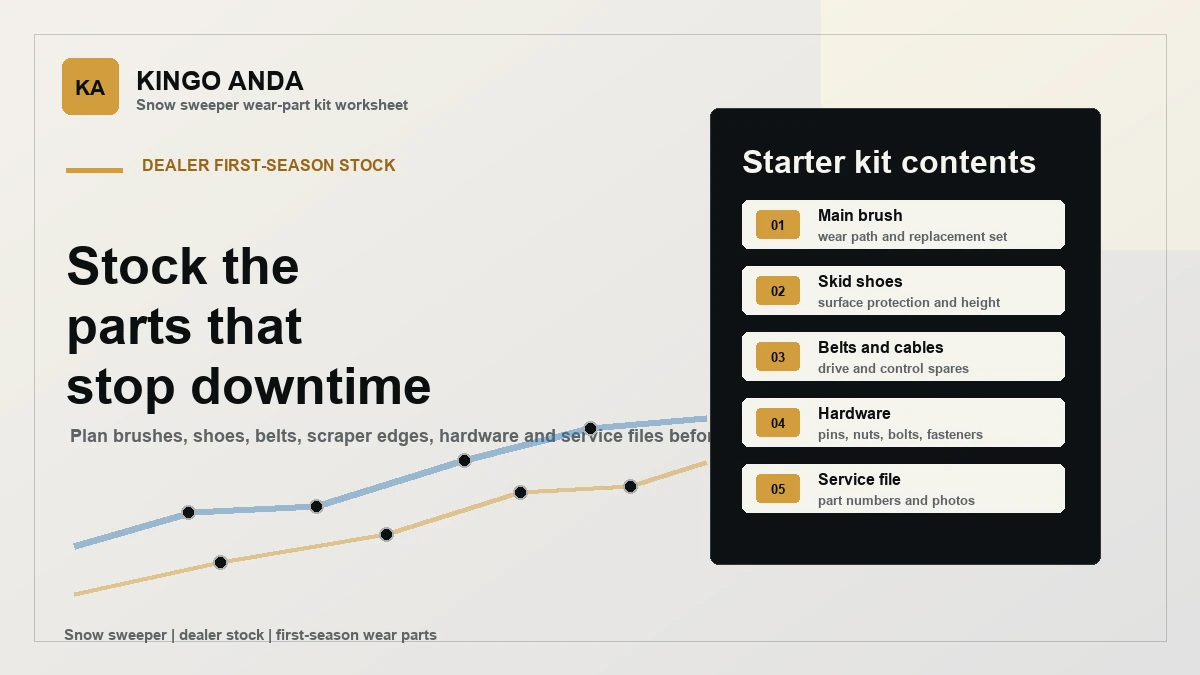
A dealer can sell the right snow sweeper and still lose the first winter relationship if the first wear item is not on the shelf. The customer does not separate the machine from the parts counter during a storm. If a brush section, skid shoe, belt, cable or fastener stops the route, the dealer owns the delay in the buyer’s mind.
That is why first-season stocking has to be planned as a kit, not as a random shelf of parts. SIMA’s preseason equipment guidance tells contractors to build parts lists, order early and keep spares ready before the busy season. Green Industry Pros makes the same point from the contractor side: September is when parts, crew training and contracts should start lining up, not when dealers are still trying to guess what will fail.
For compact walk-behind snow equipment, the dealer kit should be narrow, documented and tied to the units actually sold. The goal is not to carry every possible part. The goal is to carry the parts that prevent a route from sitting idle while the customer waits for a small component.
Start with parts that stop the route
The first cut of a snow sweeper kit should ask one question: if this part fails at 5 a.m., does the buyer lose the route? That usually brings the list back to wear surfaces, drive items, control items and basic mounting hardware.
On a sweeper attachment, brush wear is the obvious starting point, but it is not the only one. Dealers should also look at skid shoes or height-control wear points, belts or drive service items, control cables, pins, nuts, bolts and the small hardware that gets lost during an urgent field repair. A good first-season kit is often less glamorous than the machine brochure. It is the part of the sale that keeps the brochure promise alive.
Separate sweeper, blade and thrower kits
Do not let one winter shelf label cover every attachment. A snow blade has a different wear profile from a sweeper. A compact thrower creates a different support conversation again. Black Cat Wear Parts’ snow plow catalog language is a useful reminder that blades, shoes, runners, nose pieces and supports form their own wear-parts world. Pro-Tech’s public parts page also shows how much of the snow-pusher support category is built around cutting edges, shoes, hardware and compatibility.
A sweeper kit should be written around brush and drive support. A blade kit should be written around cutting edge, shoes and mounting hardware. A thrower kit should focus on the parts specified by the manufacturer for the auger, impeller, belt and chute system. When the dealer separates kits this way, the parts counter can answer faster and the sales team can include the correct support bundle in the original quote.
Stock by route exposure, not unit count alone
One sold unit does not equal one stock plan. A contractor using one sweeper for several commercial entrances may consume parts differently from a municipality using multiple machines on shorter sidewalk loops. Surface type, snow texture, operator training, curb contact and route hours all matter.
Flyntlok’s dealer-software guidance points to the seasonal nature of OPE inventory: mower parts move in spring, snowblower components wait until fall, and stocking levels should be based on actual consumption rather than guesswork. For a new KINGO ANDA dealer, actual consumption will be limited in the first season, so the opening kit should combine manufacturer guidance, unit count, attachment mix and expected route exposure. After the first winter, the dealer should replace assumptions with real order history.
Put part numbers and photos in the dealer file
A first-season kit only works if the dealer can identify parts quickly. Snapper’s snow blower support page points buyers toward dealers and parts sources for keeping snow equipment running through winter. That support path is only clean when the counter has model numbers, serial numbers, part diagrams, product photos and clear replacement notes.
For B2B buyers, the dealer file should include the parts and service contact path, machine model, attachment model, part numbers, package photos, recommended opening stock, reorder notes and the document version date. This keeps the parts counter, sales team and OEM support contact working from the same record. It also helps the dealer avoid sending an operator home with a near-fit part that creates a second service problem.
| Kit area | Dealer should prepare | Why it matters |
|---|---|---|
| Sweeper wear | Brush sections or roller wear items, height-control wear points and approved hardware. | Keeps light-snow and sidewalk routes moving after normal wear. |
| Drive support | Belts, cables or other manufacturer-specified service items. | Prevents a small drive issue from becoming a stopped route. |
| Blade support | Cutting edge, skid shoes and mounting hardware where blades are sold with the package. | Separates pushing wear from sweeper wear. |
| Documentation | Part numbers, photos, serial/model fields and service notes. | Reduces counter mistakes during urgent winter repairs. |
| Reorder control | Minimum shelf level, reorder trigger and first-season consumption notes. | Turns the first winter into a better second-season forecast. |
Use the first winter to tighten reorder levels
The first kit is a starting stock decision. The second kit should be a measured decision. Dealers should record which parts moved, which parts sat untouched, which parts were requested but not stocked, and which attachment combinations created the most support tickets. That record is more useful than a broad “stock more parts” note.
This is where the dealer program and product pages should connect. A buyer comparing the walk-behind power unit and the attachment range should see that the support package has a parts logic behind it. A dealer does not need to promise unlimited inventory. It needs to prove that the most likely winter interruptions have been thought through before the season opens.
Build a first-season wear-part kit for snow sweeper buyers.
Send the target attachment mix, expected route type, opening unit count and dealer support model. KINGO ANDA can help prepare a compact parts package for first-season snow equipment sales.
Editorial references: SIMA preseason snow equipment prep, Green Industry Pros snow season preparation coverage, Flyntlok OPE dealer inventory guidance, Black Cat Wear Parts snow plow wear-parts overview, Pro-Tech Sno Pusher parts page and Snapper snow blower parts and maintenance guide. Image source: locally generated KINGO ANDA editorial graphic, owned site asset.