Dealer Operations / Route Planning
Snow Attachment Transport Width vs Working Width: What Dealers Must Verify
Two width figures answer different questions. Record the exact machine and attachment configuration before you quote a delivery, storage bay or sidewalk route.
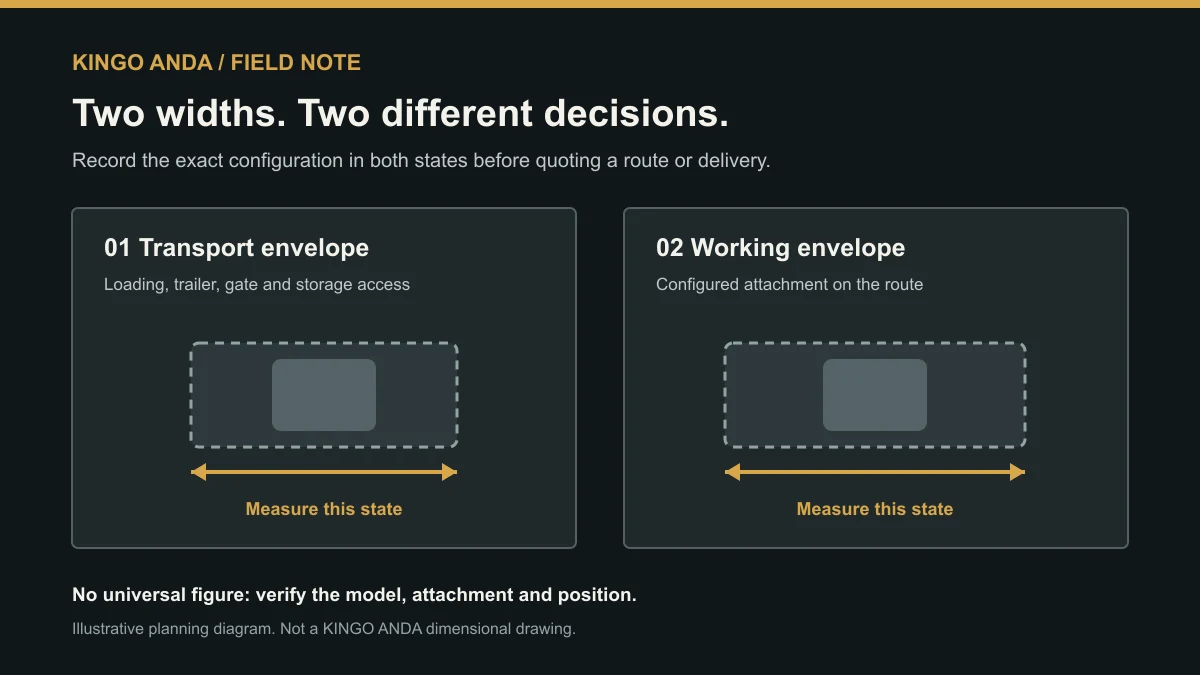
A snow attachment can fit the job on paper and still cause trouble at the loading ramp or the first narrow gate. The quoted clearing width describes one part of the operation. The overall machine-and-attachment envelope during transport answers a different question: what actually has to pass through the trailer, doorway or storage lane?
For dealers, the useful response is not a universal width allowance. It is a model-specific measurement sheet tied to the power unit, attachment, installed accessories and the position in which each dimension was taken. Without that context, two similar-looking figures can be compared as if they describe the same state when they do not.
Define the two states before requesting dimensions
Start with the exact power-unit model and attachment version. Then write down the transport state: attachment mounted or removed, guards or chutes in their approved travel position, handles in their specified position and any accessory that remains fitted. Use the manufacturer’s instructions for permitted adjustment; do not assume a component can fold or detach simply because it appears to in a photograph.
Next define the working state. This is the assembled configuration intended for the route, including the attachment and the normal operating position of adjustable parts. The working envelope should be measured at the widest relevant point, not inferred from a brush, blade or auger width alone. For attachment-interface questions, the compatibility checklist for dealer sample orders is a separate gate: width does not establish that an interface, drive or control arrangement matches.
Ask for both figures in the same unit, with a drawing or annotated photo that identifies the measurement points. If the seller provides only a nominal clearing width, mark transport width as unknown rather than copying the same number into the delivery plan.
Check the delivery path, not just the trailer floor
A trailer’s published deck width is not the whole loading path. Dealers should check the usable opening between ramps or rails, tie-down clearance, the point where a handle or chute passes a wall, and the space required to move the machine without turning sharply at an obstruction. Record the actual route from unloading position to storage, including gates and doorways. A machine that fits the trailer floor may still be awkward or impossible to move through the intended access point.
Compare the measured transport envelope with the narrowest verified opening, allowing for the loading method specified in the equipment and vehicle instructions. Do not publish a blanket clearance margin: terrain, operator method, ramp geometry and the exact configuration vary. Where an opening is close, arrange a physical demonstration or ask for a dimensioned drawing before accepting the order.
The pre-delivery inspection checklist can carry the final package identity and photographs. It does not replace the route measurement; it is the place to preserve the agreed configuration once the dealer has verified it.
Measure the route in the position the attachment will work
Working width affects route planning, but the broadest equipment point may not be the advertised clearing path. A municipal sidewalk, hospital entrance or property path can also include bollards, curb returns, benches, parked vehicles and seasonal snow banks. Survey the narrowest repeated pinch points, not only a representative straight section.
For each route segment, note the planned attachment, expected surface condition, access restriction and where snow or debris can be moved. Compare those observations with the actual working envelope and model manual. A smaller nominal attachment is not automatically the better choice if it leaves an impractical pass pattern; a wider one is not useful if it cannot reach the work area. The hospital sidewalk route specification guide shows why operating width belongs in a site survey rather than a catalog-only comparison.
Where local access or public-path rules apply, confirm them for the specific location. This article does not set a legal sidewalk clearance or a safe turning radius.
Put the measurements in the quotation and approval file
A dealer quote should carry a small measurement record instead of a single width number. List model and attachment identifiers, transport and working configurations, measurement points, units, source drawing or field measurement date, and any accessories that change the envelope. If a value is supplier-reported but not yet checked on the assembled sample, mark it that way.
| Record | Question it answers | Evidence to retain |
|---|---|---|
| Transport envelope | Can this configuration be loaded and moved into storage? | Dimensioned drawing or dated measured photo. |
| Working envelope | Can this configured unit pass the actual route restrictions? | Assembled-unit measurement and route survey. |
| Attachment interface | Does the selected attachment match the power unit? | Exact model compatibility confirmation. |
| Open exception | What still needs proof before approval? | Named owner, test date and disposition. |
If the buyer changes the attachment or destination after the original quote, repeat the relevant checks. Do not carry dimensions from an earlier sample into a new package without confirming that the revision and fitted accessories are unchanged.
Use a demonstration when the numbers are close
Paper dimensions are useful for screening. A controlled dealer demonstration answers the remaining practical questions: how the actual unit is loaded, where the widest point sits, whether controls can be reached in the intended work position and whether the machine can be moved through the real access route. Keep the demonstration bounded by the operator manual and site rules; do not test in live traffic or assume a public path is available for a trial.
Photograph the tested configuration and record any adjustment required. When a close-fit route cannot be demonstrated, state the limitation in the quotation and ask the buyer to approve the remaining risk or select another configuration. That is a stronger dealer record than an unqualified “fits sidewalks” line.
Quote the configuration, not just the clearing width.
Send the power-unit model, attachment choice, transport opening and narrowest route point. KINGO ANDA can help organize the dimensions and documents that the dealer needs to verify.
Editorial basis: KINGO ANDA’s published attachment compatibility, pre-delivery and route-planning guides. Actual dimensions and permitted positions must come from the exact-model manual, drawing or measured unit. The featured diagram is an original planning illustration, not a product specification or a photograph.