Property Maintenance / Dealer Support
Property Maintenance Sidewalk Snow Equipment Bid Scope: What Contractors Should Specify
A contractor and dealer guide to sidewalk snow equipment bid scope, covering maps, trigger depths, route widths, attachment choices and proof records.
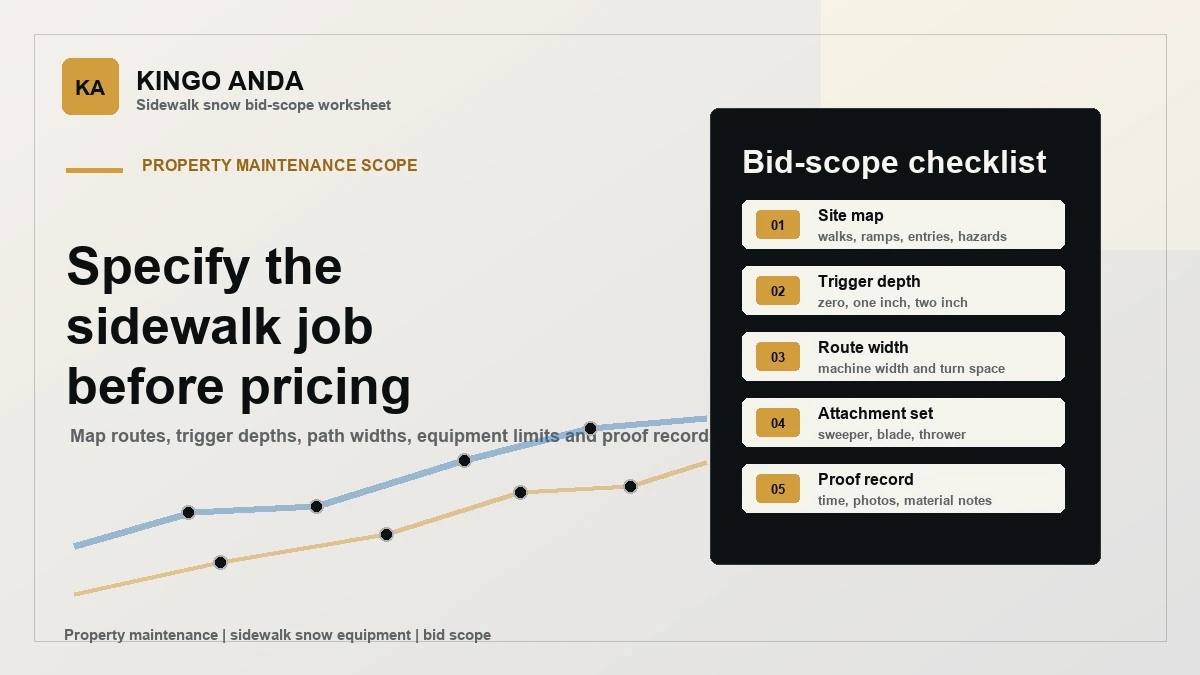
A property-maintenance sidewalk snow equipment bid should define the buyer’s route and the questions that still need confirmation. A product name alone does not establish route fit, attachment compatibility, surface suitability, commercial terms or the exact work the equipment will support. Clear records give a dealer a better starting point for a quote and give the contractor a more useful brief to review.
KINGO ANDA lists a Multifunction Power Unit as the main unit for interchangeable front and rear attachments across winter and warm-season work. It also lists a Snow Sweeper for sidewalks, yards, estates and light commercial snow clearing, and a Snow Blade for walkways, yards and property access routes. These descriptions help identify a possible product family; pricing, packaging and attachment compatibility are confirmed by inquiry.
Map the proposed work before selecting a package
A usable bid brief begins with the routes the buyer expects to maintain. Identify the sidewalks, entries, yards, access routes and any areas that require separate attention. Add measured constraints, surface notes, turning locations, obstructions, storage limits and the locations where the buyer expects the equipment to work. If the bid includes property-management requirements, attach the relevant drawings or photos rather than relying on a single route label.
The map does not prove that a particular attachment is suitable. It gives the supplier the context required to respond. A route that includes a narrow entry, changing surfaces or limited snow-placement space may require different questions from a wider property access route. State what is known and mark uncertain items for supplier confirmation.
Turn the service scope into quote questions
A property-maintenance contract may identify its own service trigger, response expectation, priority areas and proof requirements. Those are buyer-defined commercial terms, not product specifications. Keep them visible in the quote request so that the proposed equipment is considered against the actual scope rather than a generic “sidewalk snow removal” label.
Ask the buyer to identify the intended work sequence, the priority locations, the route conditions they expect and any requirement for service records. Then ask the supplier which configuration, attachments, included items and support materials can be confirmed for the specific request. Do not turn a preliminary bid note into a promise about clearing results, capacity, labor, timing or snow placement.
Keep attachment roles distinct
The public product pages describe separate intended uses. The Snow Sweeper is presented for sidewalks, yards, estates and light commercial snow clearing. The Snow Blade is presented for walkways, yards and property access routes. A Compact Snow Thrower is listed for residential, estate and property-maintenance channels. These descriptions are useful for a buyer’s initial product shortlist, but they do not establish a complete route plan or a universal attachment match.
For each item in a bid, record the intended route area, the power unit under consideration and the questions needing confirmation. If the buyer asks about a combination of products, request written confirmation of compatibility, supplied hardware and application suitability for the exact configuration. Keep that response alongside the commercial quote.
Use a field-by-field scope record
A structured request makes it easier for a contractor, dealer and supplier to see what has been supplied and what remains open. The goal is not to create an operating procedure; it is to create a reliable quotation record.
| Bid-scope field | What to record | What needs confirmation |
|---|---|---|
| Route areas | Sidewalks, yards, entries and property access routes to be reviewed. | Whether the proposed product configuration suits the described application. |
| Site constraints | Measured openings, surface notes, obstructions and snow-placement limits. | Any model-specific limits or setup requirements. |
| Equipment shortlist | Power-unit and attachment identifiers being considered. | Compatibility, included hardware and quotation configuration. |
| Support materials | Documents, parts information, label needs and service questions. | What is available for the exact proposed order. |
| Commercial brief | Market, buyer type, sample or order quantity and branding requirements. | Current pricing, packaging, lead-time and order terms. |
Use “factory confirmation required” for any open field. This is more accurate than copying a detail from a different attachment, older quote or product photo. It also makes the final review easier when a dealer moves from a sample request to a broader property-maintenance proposal.
Prepare the support record before ordering
Before an order is placed, keep the supplier’s product-specific answers with the bid scope. The file can include the final product identifiers, configuration notes, relevant documents, parts-support questions, packaging discussion and the date each point was confirmed. This protects both sides from presenting a preliminary assumption as an approved order detail.
For parts or service questions, start with Parts & Service. For a dealer or property-maintenance quote request, use Dealer Support or contact KINGO ANDA with the routes, product identifiers and open questions. The response can then distinguish confirmed information from items that need further review.
Frequently asked questions
Does a sidewalk bid automatically determine the right attachment?
No. A bid describes the buyer’s scope. The equipment configuration, attachment compatibility and suitability need to be confirmed for the exact request.
Can a dealer use the public product page as a complete quotation?
No. Public descriptions are an introduction. Request confirmation of product identifiers, included items, pricing, packaging and commercial terms for the proposed order.
What should a property-maintenance buyer send with an inquiry?
Send the route map or photos, site constraints, priority areas, product shortlist, intended market, quantity and the documents or commercial details requiring confirmation.