Industry Products / Dealer Support
Product Selector Fields for Walk-Behind Power Units and Snow Attachments
A dealer guide to the product selector fields buyers need for walk-behind power units, snow sweepers, blades and compact throwers.
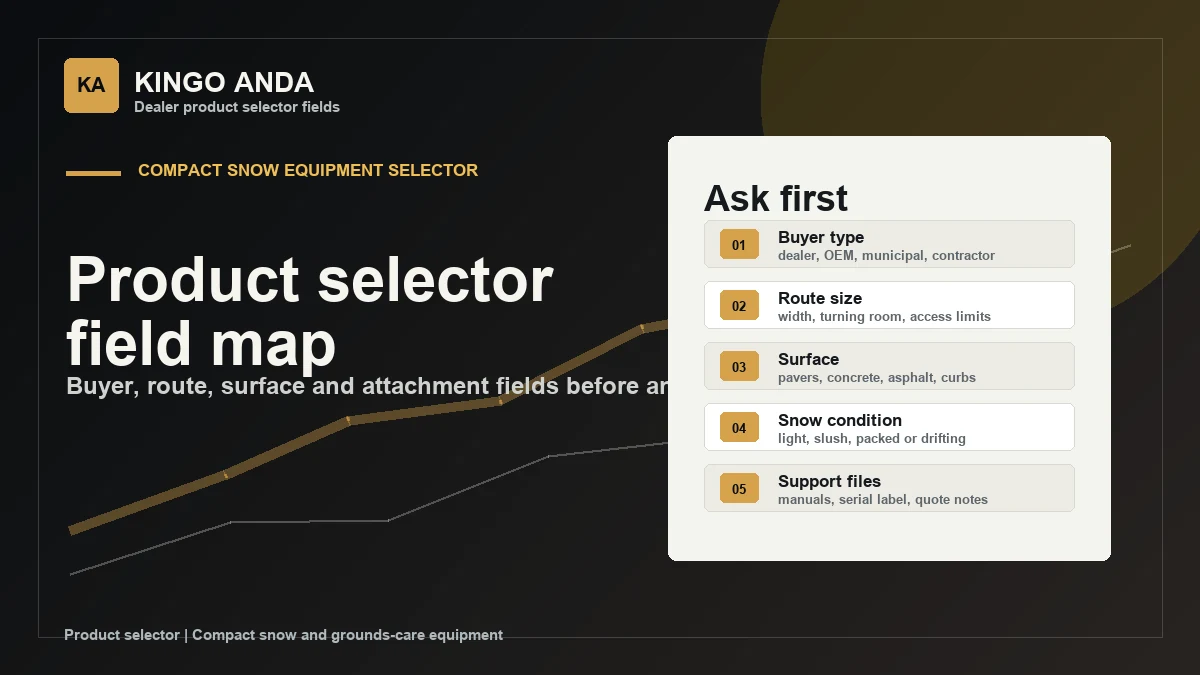
A product selector is useful only when its fields match the way buyers actually size compact snow equipment. A dealer, OEM buyer, municipal crew and property-maintenance contractor do not start with the same question. One asks about margin and stocking risk. Another asks about private-label documents. A public works buyer asks about route width, training and fleet maintenance. A contractor asks whether the machine will clear the sites he has already sold for winter.
That is why a walk-behind selector should begin before the brochure. It should translate buyer type, route condition and attachment use into a short quote path for the power unit, snow sweeper, snow blade and compact thrower package. The selector does not need to behave like a consumer shopping quiz. For B2B buyers, it needs to collect the fields a dealer or factory will use to quote, support and reorder the equipment later.
Recent dealer conversations around outdoor power equipment keep returning to the same commercial point: parts, service, education and aftermarket support are not side issues. Rural Lifestyle Dealer’s 2026 OPE survey coverage and OPPAA dealer resources both show why the sale must be connected to support. Equip Exposition continues to frame dealer education as part of the product business. Public works training calendars, including APWA Michigan’s 2026 SPOT snow plow operator and fleet maintenance seminar, make the same point from the fleet side.
Start with the buyer and the route
The first selector field should identify the buyer role. A dealer starter package should not be routed the same way as a municipal sidewalk program. A dealer may need display units, basic wear parts, carton information and fast quote sheets. A municipal buyer may need route width, storage limits, operator training notes and spare-parts planning. An OEM buyer may care more about label control, sample timing, packaging and documentation.
The next fields should describe the route. Ask for clear width, turning space, surface material, curb cuts, doorways, slope and whether the machine will work around bollards, school entrances, storefronts or long open walks. These details decide whether the buyer needs a compact sweeper, a blade, a thrower or a mixed attachment set. They also reduce the common mistake of quoting a machine by engine size while ignoring where it has to work.
Separate platform fields from attachment fields
A clean selector keeps the platform question separate from the attachment question. The platform fields cover power unit model, operator handling, service access, serial-label location, storage and expected annual hours. The attachment fields cover work width, snow condition, surface sensitivity, replacement wear parts and route productivity. Putting everything in one flat inquiry form makes the buyer fill in too much and gives the sales team too little structure.
| Field group | Selector field | Why it matters |
|---|---|---|
| Buyer role | Dealer, OEM, municipal or contractor. | Changes the quote package, documentation, stock plan and follow-up path. |
| Route size | Clear width, turning room, doorway limits and obstacle density. | Guides work width and whether the equipment is practical for the site. |
| Surface | Concrete, asphalt, pavers, curb edges or sensitive finished areas. | Helps choose sweeper, blade or thrower behavior before discussing horsepower. |
| Snow condition | Light snow, wet slush, packed snow, drifting or repeated small events. | Separates broom, blade and throwing use cases more clearly than generic “snow removal”. |
| Support files | Manuals, serial-label notes, wear-part list and photo requirements. | Makes dealer support, reorder and warranty conversations easier after delivery. |
This structure gives the buyer an easier path and gives the sales team a better RFQ. The selector should be short on the page, but the fields behind it should be specific enough to guide the next quote.
Use surface and snow condition before horsepower
Compact snow equipment is often sold into routes where maneuverability and contact quality matter more than raw power. A sweeper may be a better first recommendation for light snow, slush and surface-sensitive entrances. A blade may be the practical choice where snow can be pushed straight to the side. A compact thrower matters when snow has to be cast away from a doorway, curb edge or narrow passage.
That is the selector logic buyers expect from a professional supplier. It shows that the factory understands the jobsite. It also prevents an inexperienced buyer from treating every winter route as the same problem. For KINGO ANDA, the selector can become a bridge between the public product range and the more specific dealer support conversation.
Add support fields that protect the dealer later
The best selector also asks for support expectations. Does the buyer need a manual set, spare-parts list, exploded diagram, carton label, sample packing photo or seasonal reorder sheet? Is the buyer preparing a dealer launch, a municipal order or a private-label program? These questions may feel less exciting than the equipment image, but they decide how smooth the account becomes after the first shipment.
Support fields are especially important for snow equipment because the usage window is compressed. A small missing part, unclear label or late manual can become a bigger problem during the first storm. A selector that captures documentation requirements early helps the factory prepare the right files instead of repairing the relationship later.
Make the selector useful for RFQs, not just browsing
The final test is whether the selector creates a usable RFQ. A good submission should tell the sales team who the buyer is, where the equipment will work, which attachment family is likely, what support files are needed and how urgent the season timing is. That is enough to prepare a first quote path without forcing the buyer into a long technical form.
KINGO ANDA can use this approach across product pages, Blog articles and the quote form. The public-facing language should stay practical: buyer type, route width, snow condition, attachment set, volume and document needs. The internal sales team can then convert those fields into a power-unit package, attachment recommendation and dealer support checklist.
Turn selector fields into a quote path.
Send buyer type, route width, main snow conditions, attachment set and document needs. KINGO ANDA can prepare the right package route.
Editorial references: Rural Lifestyle Dealer 2026 OPE parts and accessories survey coverage, OPPAA dealer resources, APWA Michigan 2026 SPOT snow plow operator and fleet maintenance training and Equip Exposition 2026. Image source: locally generated KINGO ANDA editorial graphic, owned site asset.