Dealer Program / Product Planning
Preseason Dealer Order Forms for Compact Snow Equipment Packages
A dealer guide to preseason order forms for compact snow equipment packages, covering route data, attachments, spare parts and support files.
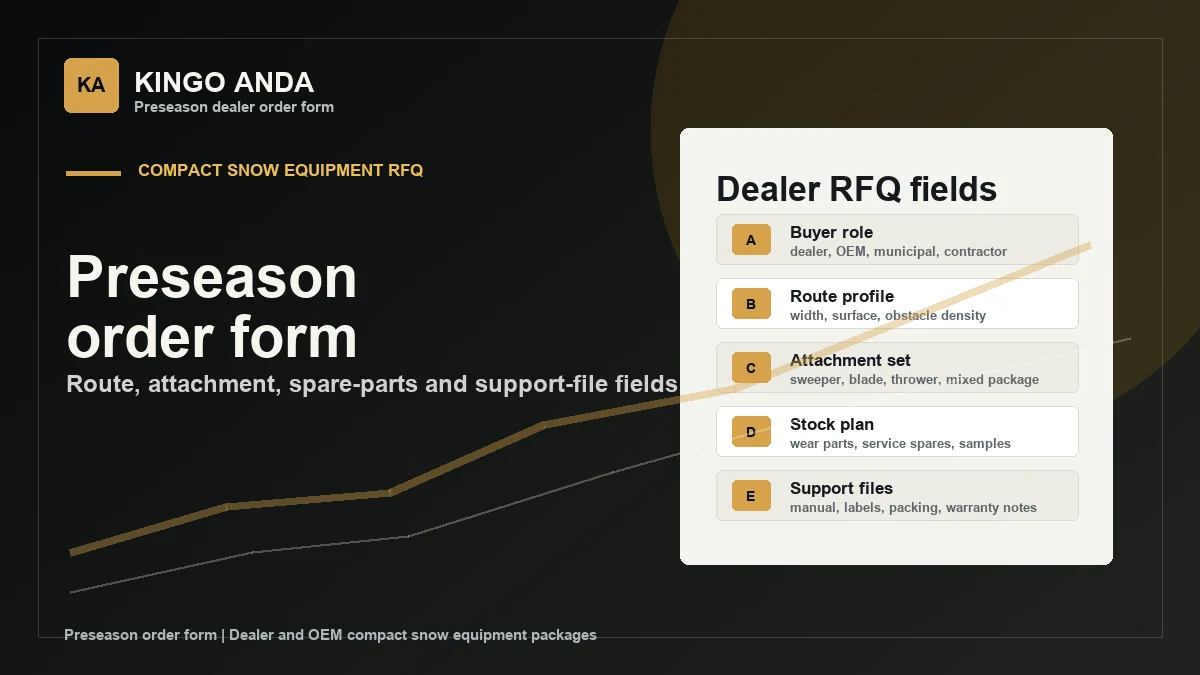
A preseason dealer order form helps a compact snow-equipment inquiry move from a broad request to a reviewable package. Its job is not to select a machine automatically or promise a delivery date. Its job is to collect the product reference, buyer context and open questions that JGAD needs to confirm before a quote, product-page claim or customer commitment is made.
This structure is useful for dealers, property-maintenance buyers, municipal procurement teams and OEM/private-label inquiries. It can be used when discussing a multifunction power unit together with snow attachments, or when the initial inquiry concerns a snow sweeper, snow blade or compact snow thrower.
Start with the buyer role and the exact request
The first fields should identify who is making the inquiry and what they need to evaluate. A dealer may be planning a seasonal stock discussion; a contractor may be comparing equipment for a defined route; a municipal buyer may be collecting information for a procurement process; and an OEM or private-label buyer may have branding or packaging questions. These are different conversations even when they start with the same product family.
Record the product name or identifier, the attachment or configuration under review, the intended market and the required quantity if known. Avoid a form that asks only for “snow equipment.” That wording does not tell the supplier what must be checked, and it risks turning an early conversation into assumptions about fit, price, availability or documentation.
Describe the work without turning it into a specification
The form should give practical context: sidewalk, yard, estate, property-maintenance route or another stated application; surface conditions; route width; turning constraints; storage limits; and the buyer’s priority. These notes help frame a product discussion. They do not establish that a particular attachment is compatible, suitable or available for the route.
Published JGAD pages describe general roles: the power unit is intended for interchangeable front and rear attachments; the snow sweeper is a rotating-brush attachment; the snow blade is adjustable; and the compact thrower is a compact snow-clearing unit. Ask JGAD to confirm the exact configuration and any technical details before preparing a final specification or recommendation.
Keep the equipment request and support questions separate
A clean order form separates the product request from the questions that still need a supplier answer. This makes it easier for a dealer to track what has been requested and avoids presenting a generic checklist as a confirmed package.
| Order-form area | What to record | What still needs confirmation |
|---|---|---|
| Product reference | Product name or ID, attachment and intended use | Exact configuration and compatibility |
| Buyer context | Dealer, contractor, municipal or OEM/private-label request | Commercial path and applicable support |
| Route notes | Surface, space constraints and stated operating needs | Whether the selected product suits the application |
| Information request | Images, product details, support questions or files needed | Which current material can be supplied for the request |
| Commercial questions | Quantity, destination, packaging and branding context | Price, availability, lead time and order terms |
Request supporting information by purpose
Use one field for the exact information the buyer needs. For example, a dealer preparing a catalogue may ask for product-specific images; a sales team may ask which public description applies to the item under review; and a procurement contact may list documentation or packaging questions. The form should not assume that a manual, drawing, label, warranty note or spare part is available. It should record the request and ask for confirmation.
For questions after a customer inquiry, the dealer support and parts and service pages provide useful contact context. They do not confirm a particular part, support file, price or service arrangement. Include the product reference and market in every follow-up.
Build a clear review trail before quoting
A simple status field keeps the form honest: received, awaiting product confirmation, information supplied, quote requested or closed. Keep the buyer’s requirements, the supplier’s confirmed reply and any later revisions together. This is especially helpful when a dealer’s product-page content, a customer quote and a seasonal order are being prepared at different times.
Before a quote is sent, confirm the product identity, configuration, quantity, destination market, packaging needs and all open commercial questions. Do not use the form itself as evidence of price, delivery timing, certification, warranty coverage or compatibility.
FAQ
Can a preseason order form confirm an attachment package?
No. The form captures the request. JGAD must confirm compatibility and the exact configuration before a dealer makes a commitment.
What should a dealer include when asking for supporting information?
Include the product reference, intended use, destination market, quantity if known and the exact images, documents or commercial points that need review.
Where should a dealer send the completed request?
Submit it through the JGAD contact page, keeping the product and open questions together so the request can be reviewed accurately.
Ready to organize a compact snow-equipment inquiry? Send the product reference, buyer type, use case, destination market and open requirements through the JGAD contact page. JGAD can review the request before the dealer publishes product information or finalizes a quote.