OEM Buyers / Dealer Support
OEM Sample Request Forms for Compact Snow Equipment Attachments
An OEM buyer guide to sample request forms for compact snow equipment attachments, covering specs, artwork, spare parts and approval evidence.
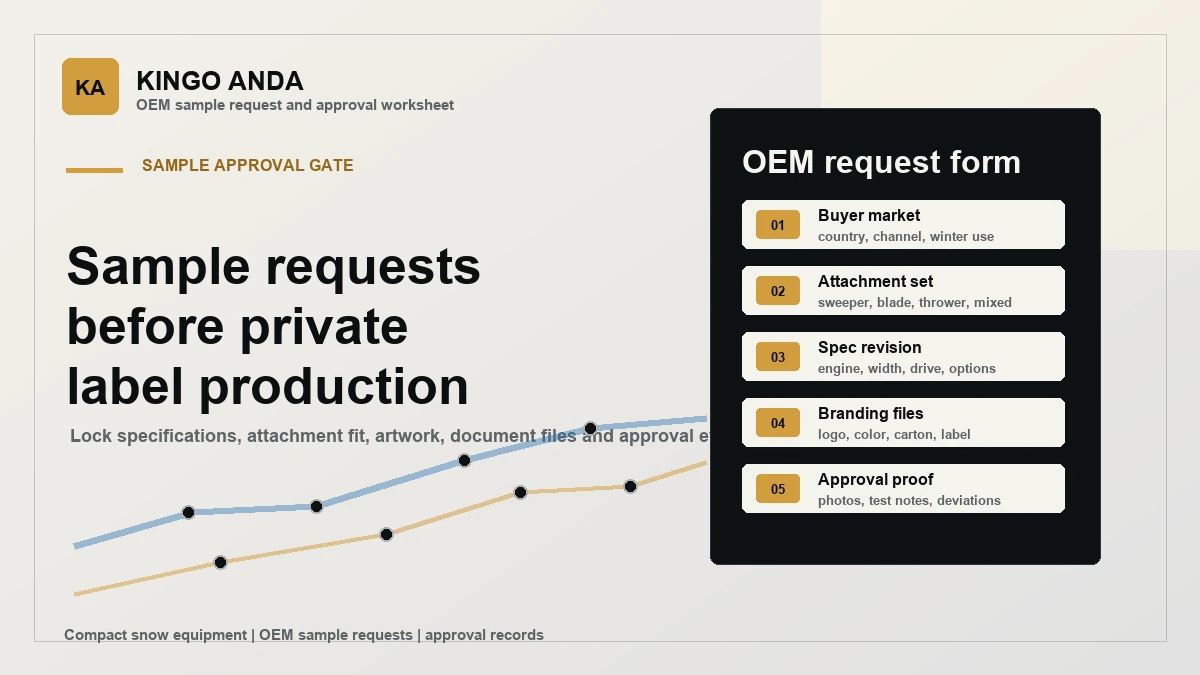
An OEM sample request for compact snow equipment should identify the exact products and the decisions the buyer needs confirmed. It should not treat a product photo, a generic attachment family or an old order as proof of configuration, documentation, packaging or private-label approval.
KINGO ANDA lists a Multifunction Power Unit for interchangeable front and rear attachments across winter and warm-season work. Its public catalog also introduces a Snow Sweeper, Snow Blade and Compact Snow Thrower for their stated channels. Pricing, packaging and attachment compatibility are confirmed by inquiry, so an OEM request needs to preserve the questions that still require a supplier response.
Identify the buyer, market and intended review
Start with the buyer’s company type, destination market, intended sales channel and the purpose of the request. State whether the sample is for internal review, a dealer demonstration, a private-label discussion or another specific use. This makes the request easier to route without implying that a market requirement, order quantity or commercial term has already been approved.
The form should also identify the contacts responsible for the commercial brief, product review and artwork discussion. Keep these names and questions in the same record so the supplier can see which items are factual product questions and which are commercial or branding requests.
List exact products, not a generic attachment family
Record every product identifier the buyer wants to consider. If the request includes a power unit and attachments, list them individually and ask the supplier to confirm the proposed configuration, attachment fit and included-item details. The public product pages are an introduction; they do not establish that every attachment combination is approved for every order.
Where the buyer wants to compare alternatives, keep the comparison visible rather than using a single broad label. Note the intended application, route or channel information the buyer has provided and mark unanswered questions as “supplier confirmation required.” This prevents a preliminary sample discussion from becoming an unverified specification.
Separate branding requests from product confirmation
OEM and private-label requests often include names, logos, colors, labels, carton artwork or other presentation questions. Record these as requested items rather than assuming that any particular placement, language, label format or packaging approach is available. If the buyer supplies artwork, identify the file version and the question that requires review.
Keep the branding section separate from product identity and compatibility. A logo discussion does not confirm a configuration, and a product description does not approve packaging or brand presentation. A clear form allows the supplier to respond to each item without ambiguity.
Request documents and support information by need
An OEM buyer may need product information, parts-support information, label details or documentation for its own internal review. The request should list exactly what is needed and ask which materials are available for the proposed product and order. Do not claim that a manual, certificate, parts list, warranty term, packing photo or serial-label format is included until it is confirmed.
For product-specific support questions, use the Parts & Service route. Identify the product, configuration and question being reviewed. This gives the support team the information needed to distinguish a documentation request from a parts inquiry or a commercial question.
Use a sample-review record before wider approval
After a sample discussion, record what was provided, what was confirmed, what the buyer reviewed and what still needs a response. The record can include supplier correspondence, product identifiers, artwork version references, document requests and open items. It should not treat a preliminary review as approval for a larger purchase or production program.
| Request field | Buyer record | Supplier confirmation needed |
|---|---|---|
| Buyer brief | Market, channel, review purpose and contacts. | Commercial route for the inquiry. |
| Product list | Power unit and attachment identifiers under consideration. | Configuration, compatibility and included items. |
| Branding request | Artwork files, labels, packaging or private-label questions. | Available review process and requirements. |
| Support materials | Documents and parts-information needs. | What can be provided for the proposed order. |
| Open items | Questions, requested revisions and decision owner. | Written clarification before next approval step. |
Send a structured inquiry
For a dealer, OEM or private-label request, use Dealer Support or contact KINGO ANDA. Include the buyer brief, product identifiers, requested documents, artwork questions and the exact points requiring confirmation. A structured inquiry is more useful than a general request for “OEM information” because it creates a record the buyer can review before moving to another step.
Frequently asked questions
Does a product page confirm OEM or private-label availability?
No. Product pages introduce the items. Request confirmation of branding, packaging and commercial details for the specific proposed order.
Can a buyer assume every attachment fits the same power unit?
No. Attachment compatibility is confirmed by inquiry using the exact product identifiers and configuration.
What should be included in an OEM sample request?
Include the buyer market, channel, product list, configuration questions, document and support needs, artwork requests and all commercial details requiring confirmation.