Contractors / Dealer Support
Compact Equipment Route Profitability: Matching Labor, Site Width and Attachment Choice
A dealer and contractor guide to matching compact snow equipment, labor hours, route width and attachments before winter bids are priced and stocked.
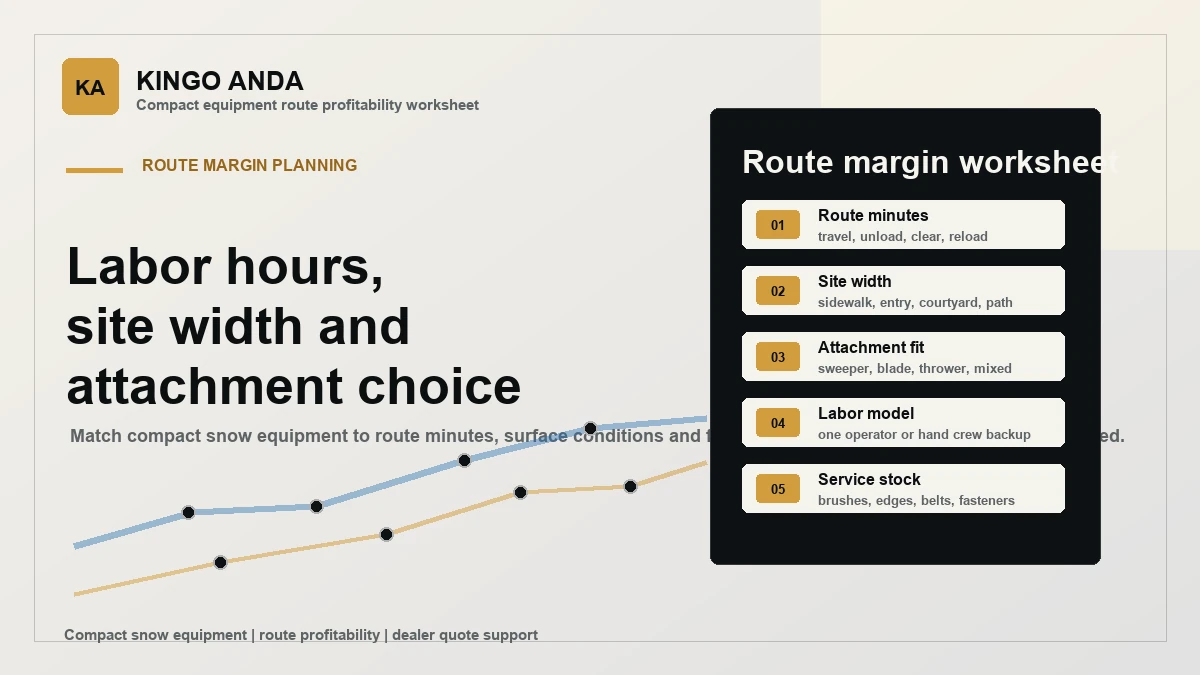
A compact equipment route package should be built from the buyer’s actual information, not a claim about profitability. For a dealer, contractor or property-maintenance buyer, the useful first step is to record the work areas, route constraints, product shortlist and commercial questions that require supplier confirmation before a quote is approved.
KINGO ANDA lists a Multifunction Power Unit as the main unit for interchangeable front and rear attachments across winter and warm-season work. Its public descriptions also identify a Snow Sweeper for sidewalks, yards, estates and light commercial snow clearing, a Snow Blade for walkways, yards and property access routes, and a Compact Snow Thrower for residential, estate and property-maintenance channels. Pricing, packaging and attachment compatibility are confirmed by inquiry.
Start with the route record
A route record should identify the locations the buyer wants to maintain and the limits that affect equipment selection. Capture route photos, access points, measured openings, surface notes, obstructions, snow-placement restrictions and the buyer’s priority areas. The record can also identify whether the request is for a sample, a dealer stocking discussion or a specific contractor proposal.
These details do not determine a machine or labor outcome on their own. They give the supplier a clearer basis for a product-specific response. Mark anything uncertain as requiring confirmation instead of using a product image or an earlier quote as proof.
Separate the product shortlist from the final configuration
The public product descriptions help a buyer create an initial shortlist. They do not establish that every attachment fits every power unit, that a specific product is suitable for a given surface or that items can be combined into one order. For each product considered, record the product identifier, intended area and the connection or included-item questions that need a written answer.
Where the buyer wants to compare a sweeper, blade and compact thrower, avoid ranking them with generic performance claims. Ask the buyer to describe the route and the supplier to confirm the proposed configuration. Keep those answers tied to the correct product identifier rather than presenting a product-family description as an approved package.
Build commercial questions into the inquiry
A route package needs a separate commercial brief. State the destination market, buyer type, requested quantity, packaging needs, labeling requirements and whether the request is dealer, OEM or private-label work. These questions should remain separate from the route description so that the final quotation can show which product details and commercial terms have actually been confirmed.
Do not promise order timing, dealer margin, operating cost, labor savings or parts availability in a preliminary inquiry. The appropriate next step is to ask the supplier which current quotation, packaging and order information can be supplied for the specific request.
Use a route-package record before wider ordering
A simple record makes it easier to review a sample or prepare a wider dealer proposal. It should document what the buyer supplied, what the supplier confirmed and what still needs further review. This protects the dealer from turning a preliminary conversation into a sales commitment.
| Package field | Buyer or dealer record | Supplier confirmation needed |
|---|---|---|
| Route areas | Work locations, access limits, site photos and surface notes. | Whether the proposed configuration requires further application review. |
| Product shortlist | Power unit and attachment identifiers under consideration. | Compatibility and included-item details. |
| Commercial brief | Market, buyer type, quantity and branding needs. | Pricing, packaging and current order terms. |
| Support request | Documents, parts information and follow-up questions. | Available support information for the proposed order. |
| Decision record | Open items and next review date. | Written clarification of outstanding points. |
Keep support questions product-specific
If a buyer asks about parts, service files or a component, attach that question to the exact product and configuration. The Parts & Service route is the correct starting point for support inquiries. Ask the supplier what identifiers, photos or order information are needed before the question can be reviewed.
For a broader dealer package, use Dealer Support or contact KINGO ANDA with the route record, product shortlist and commercial brief. This lets the response distinguish confirmed facts from items that are still being evaluated.
Use the review to protect the final decision
The value of a route-package worksheet is not a promised margin or a predicted outcome. It is a more complete decision record. When the dealer knows the route context, the exact product identifiers and the open questions, it can ask for the right confirmation before a sample order, quote or wider stocking decision is made.
Frequently asked questions
Can a route worksheet prove an attachment will fit a power unit?
No. Attachment compatibility is confirmed by inquiry for the exact proposed configuration.
Can a dealer promise labor or cost savings from a preliminary package?
No. A route worksheet should record buyer requirements and open questions; it does not establish operating or commercial outcomes.
What should a buyer send with a route-package inquiry?
Send the route record, product identifiers, site constraints, market, quantity, packaging or branding needs and the specific details requiring supplier confirmation.