Blade Setup / Dealer Support
Snow Blade Cutting Edge and Skid Shoe Choices for Walk-Behind Equipment
A dealer guide to snow blade cutting edge and skid shoe choices for walk-behind equipment, covering surfaces, wear, support notes and winter quote packages.
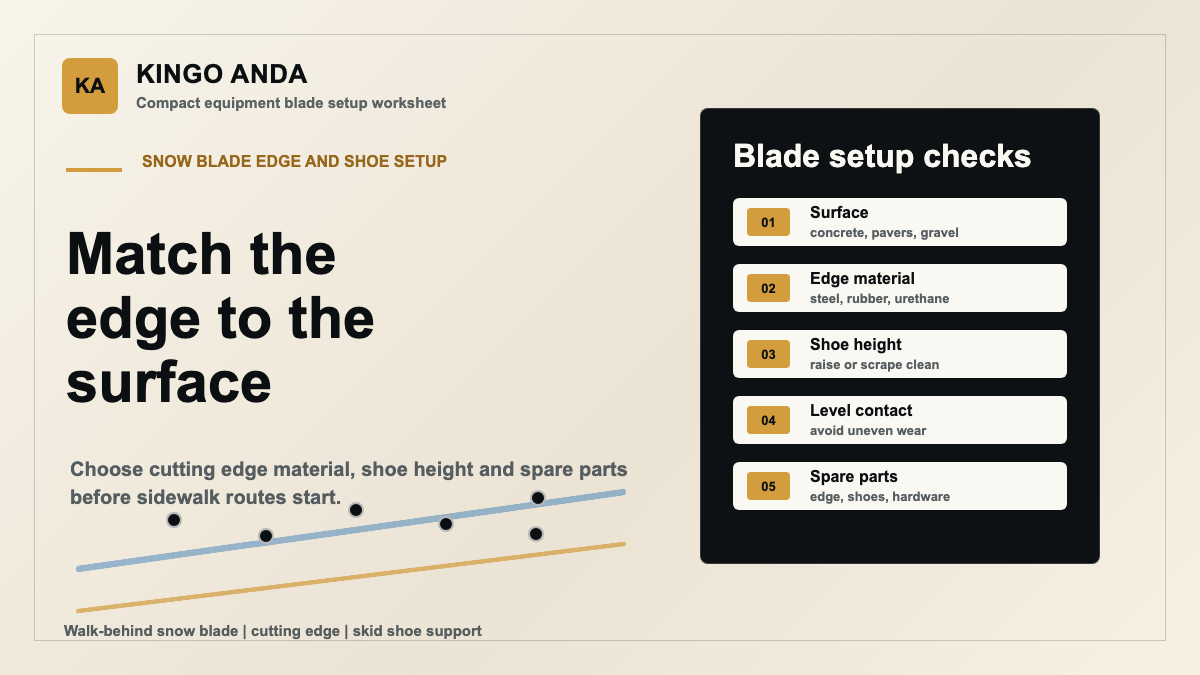
A snow blade cutting-edge or skid-shoe question should be handled as a product-specific support request, not as a universal setup recommendation. Dealers need to identify the exact blade, proposed power unit, route and buyer requirement before asking the supplier which components, documents or commercial details can be confirmed for the order.
KINGO ANDA describes its Snow Blade as an adjustable attachment for walkways, yards and property access routes. The public product description also directs dealer and OEM buyers to inquire for pricing, packaging and attachment compatibility. This guide helps a dealer document edge and shoe questions without claiming material choices, height settings, parts availability or route performance that have not been confirmed.
Record the equipment before discussing a component
Begin with the product identifier and the proposed configuration. If the request relates to equipment already on site, add clear photos of labels, connection points and the component being discussed. Include the buyer’s market, channel and whether the inquiry relates to a sample, a service question or a future dealer/OEM quotation.
If the blade is considered with a Multifunction Power Unit, record both identifiers. The power unit is publicly presented for interchangeable front and rear attachments across winter and warm-season work, but public information does not establish universal fit. Ask the supplier to confirm compatibility, included hardware and any model-specific details for the exact package.
Describe the route without assuming a setup
A buyer may describe walkways, yards, access routes or a mixed property-maintenance site. Capture the surface notes, route constraints, obstacles, measured openings and snow-placement requirements they provide. Photos can clarify the question, but they do not prove that a particular cutting edge, shoe setting or configuration is suitable.
Keep route conditions separate from product facts. The Snow Blade’s published intended uses are a useful starting point for an inquiry. The supplier still needs the actual request to confirm whether the quoted configuration should be reviewed further. Avoid presenting a generic route label as proof of suitability or a specific clearing result.
Ask edge and shoe questions in writing
A useful inquiry does not need to diagnose why a component appears different or prescribe a correction. It can identify the observed question, attach photos, name the equipment and ask the supplier to clarify the relevant product information. If the dealer wants replacement details, it should ask how the correct component is identified for the proposed model and what information is required before an order can be confirmed.
Do not transfer edge material, shoe setting, part numbers, wear expectations or hardware details from another blade or a previous order. These details can vary by configuration. A written supplier response is more reliable than an assumption based on a similar product image.
Separate service questions from commercial requests
A product-support inquiry may concern a known item and a factual question. A commercial request may concern quantity, destination market, labeling, packaging or an OEM/private-label program. Keep these records distinct so that an observed question is not mistaken for an approved parts order, and a preliminary quote is not presented as a confirmed support package.
Use the Parts & Service path for product-specific support questions. Use Dealer Support or contact KINGO ANDA for a dealer quotation or broader package discussion. In both cases, provide the product identifiers and state exactly which details require confirmation.
Build an order record around confirmed details
A dealer handover or sample-review file should show the difference between what has been confirmed and what remains open. Include the product identifier, configuration, supporting photos, supplier response, documents received and commercial questions. This gives the dealer a traceable record before it commits to a larger order or describes the package to a buyer.
| Record field | Dealer input | Supplier confirmation |
|---|---|---|
| Blade identity | Exact Snow Blade and power-unit identifiers. | Quoted configuration and compatibility. |
| Route context | Walkway, yard or access-route notes, constraints and photos. | Whether additional application review is needed. |
| Component question | Factual observation and images of the identified item. | Correct identification and support path. |
| Support materials | Requested documents and parts-information needs. | What is available for the proposed order. |
| Commercial brief | Market, quantity, packaging and branding requirements. | Current quotation and order terms. |
Use the inquiry to protect the next decision
The right result from an edge or shoe inquiry is a clearer next step: a product-specific response, an updated quote, a request for more route information or a separate support discussion. It is not a generic maintenance promise. Keeping the record complete makes the dealer’s recommendation more reliable and prevents unconfirmed details from travelling into a customer handover.
Frequently asked questions
Can a dealer choose a cutting-edge material from a public product image?
No. Request the relevant component and configuration information for the exact proposed product.
Do skid-shoe questions prove a blade fits a power unit?
No. Attachment compatibility is confirmed by inquiry. Provide both product identifiers and request written confirmation.
What should accompany a blade support inquiry?
Send the product identifiers, configuration details, route context, photos, observed question, buyer market and the parts or commercial details that need confirmation.