Industry Products / Dealer Support
Parts Counter Training for Snow Sweepers, Snow Blades and Compact Throwers
A dealer training guide for stocking and explaining snow sweeper, snow blade and compact thrower parts before winter service calls begin cleanly.
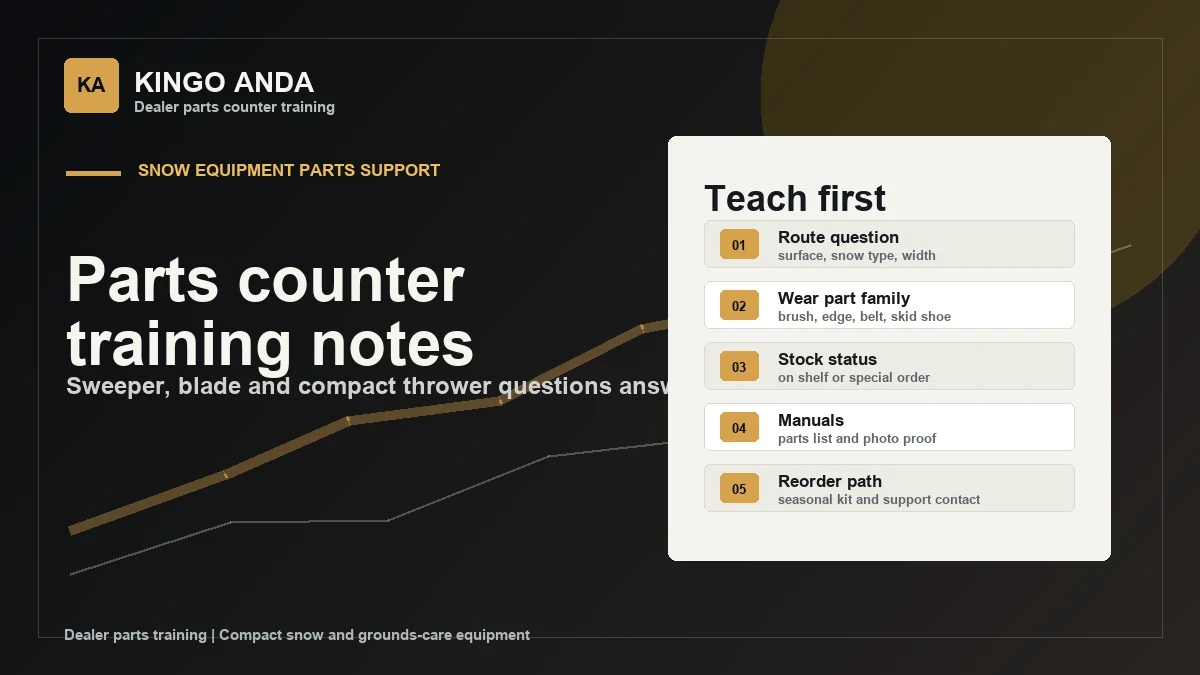
The parts counter is where many compact snow equipment programs either become repeat business or turn into winter frustration. A dealer can sell a clean walk-behind power unit package in September, but the real test arrives when a contractor calls during the first long storm and asks which brush, edge, belt, skid shoe or fastener belongs on the machine in front of him.
That is why parts counter training should be planned before the first seasonal rush. The 2026 OPE Dealer Survey coverage from Rural Lifestyle Dealer and OPPAA puts parts availability, dealer purchasing behavior, service growth and aftermarket support in the center of the OPE channel conversation. Snow and ice buyers may be seasonal, but the dealer’s support reputation is built all year.
For KINGO ANDA dealers, the useful training target is straightforward: help counter staff explain the difference between snow sweeper, snow blade and compact thrower wear items, then connect those parts to route conditions, manuals and reorder timing.
Train the counter before the first storm
Parts training should not begin with a warehouse shelf. It should begin with the buyer’s route. A sidewalk contractor, campus maintenance team or municipal crew will describe a problem in plain language: wet snow at entrances, light snow on long walks, slush near storefronts, packed snow around curb cuts, or narrow passes around bollards. Counter staff need to translate that language into an attachment family and then into the first parts question.
With sweepers, the conversation usually starts around brush wear, drive setup, operating surface and replacement intervals. With blades, it moves toward scraper edges, skid shoes, mount hardware and impact damage. With throwers, the staff should know how to ask about belts, shear points, chute condition and whether the machine is throwing snow from tight areas or open paths. This does not require over-promising. It requires a consistent question path.
Separate fast-wear items from slow-moving parts
A small dealer does not need every part in depth, but the counter should know which items are likely to stop a customer quickly. Fast-wear and damage-prone parts deserve clearer shelf labels, photo references and reorder points. Slow-moving structural items can remain special-order as long as the customer knows the path and lead time.
| Attachment family | Counter staff should know first | How to explain it to buyers |
|---|---|---|
| Snow sweeper | Brush sections, drive notes, common fasteners and setup photos. | Best suited for light snow, slush and surface-sensitive paved areas where clean contact matters. |
| Snow blade | Scraper edge, skid shoes, mount hardware and replacement fasteners. | Useful for straight pushing, entrances and simple sidewalk clearing where snow can be moved aside. |
| Compact thrower | Belt path, chute hardware, shear or protection points and intake inspection notes. | Better when snow must be cast away from doorways, curbs, fence lines or tight route edges. |
| Power unit | Filters, cables, belts, handles, safety checks and serial-label location. | The platform must be easy to identify before the attachment discussion starts. |
This split keeps stocking decisions practical. A dealer can hold the parts that answer most winter calls and still quote less common items through the normal parts and service channel.
Teach buyers how to describe the route and failure
Good counter training also teaches buyers how to ask for help. A parts request that says “brush worn” is weaker than a request that includes model, serial label, attachment type, route surface, operating hours, damaged side and two photos. The second request lets the dealer answer faster and gives the factory a cleaner service record if escalation is needed.
Counter staff should ask for the same evidence each time: machine identification, attachment identification, close-up photo, whole-machine photo, route condition and urgency. This discipline feels basic, but it is what separates a professional dealer program from a one-time equipment sale.
Keep manuals and photos beside the parts list
The easiest parts counter improvement is not always more stock. Often it is better information at the point of request. A binder, shared drive or dealer portal should place parts lists, manual pages, serial-label examples, carton photos and common wear-item photos beside the price sheet. When a new employee joins the parts desk, those files shorten the learning curve.
Equip Exposition’s 2026 programming continues to put dealer education beside the product conversation, and public works training calendars tell the same story from the user side. APWA Michigan’s 2026 SPOT training pairs operator instruction with fleet maintenance, which is exactly the connection dealers should make at the counter. Compact snow equipment dealers need staff who can connect a product to a route, a route to a wear item and a wear item to a reorder path.
Turn parts support into a dealer package
Parts support should be sold as part of the program, not apologized for after the sale. When a dealer quotes a compact snow package, the quote should include the power unit, attachment set, likely wear parts, manuals, serial-label notes and the first reorder path. If the buyer is an OEM or private-label customer, the package should also identify carton labels, artwork rules and warranty documentation. If the buyer is a municipal or property-maintenance team, it should identify route width, snow type, surface condition and expected seasonal hours.
KINGO ANDA can support dealers by turning the product range into practical equipment and parts packages. The best first step is a training sheet that tells the counter what to ask, what to stock and when to escalate. That sheet will help the dealer look prepared before the weather does the testing.
Build a dealer parts training file.
Send target market, main attachments, expected winter volume and document needs. KINGO ANDA can prepare a compact quote and support path.
Editorial references: Rural Lifestyle Dealer 2026 OPE parts and accessories survey coverage, OPPAA dealer resources, APWA Michigan 2026 SPOT snow plow operator and fleet maintenance training and Equip Exposition 2026. Image source: locally generated KINGO ANDA editorial graphic, owned site asset.