Industry News / Municipal Routes
Compact Snow Equipment Maintenance Checklist for Municipal Sidewalk Routes
A municipal buyer checklist for compact snow equipment maintenance, attachment inspection, route proof and dealer support before winter routes begin.
By early August, winter equipment buying is no longer theoretical. Municipal councils are already approving plow trucks, public works departments are opening vendor registration, and school districts are asking snow contractors to list the equipment they can put on site. That timing matters for compact sidewalk equipment. The small machine that clears a library entrance, a campus path or a downtown curb ramp usually fails a route before it fails mechanically.
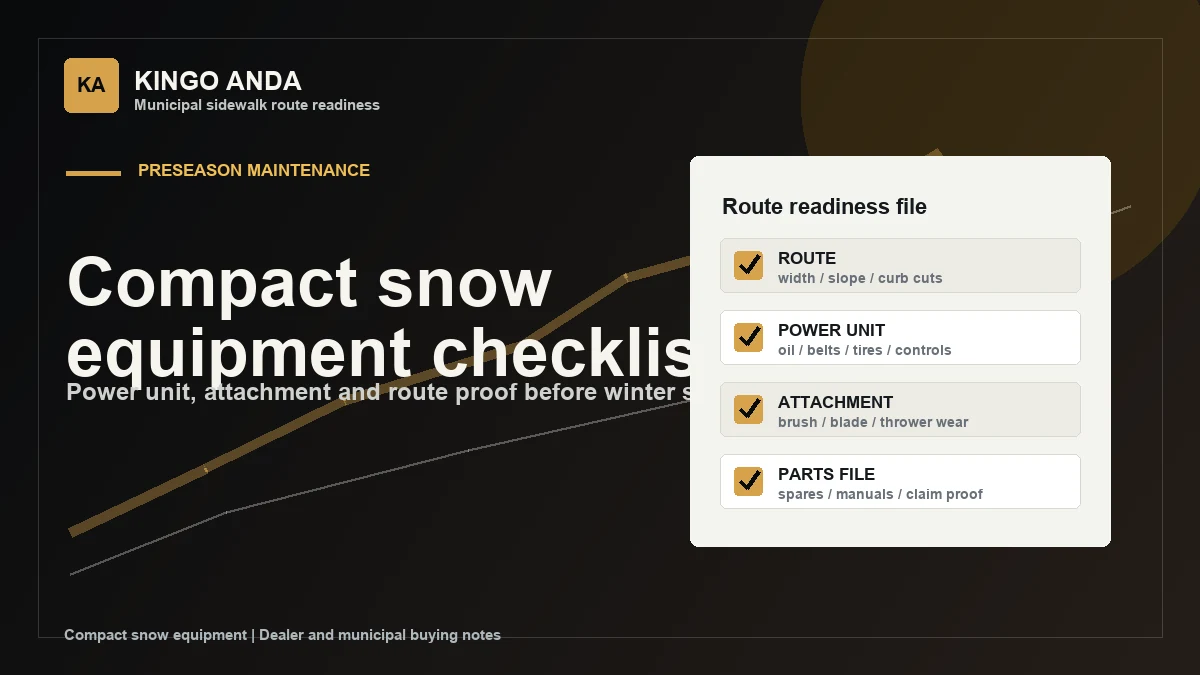
The maintenance checklist for compact snow equipment therefore has to begin with the route. A dealer or municipal buyer should not only ask whether a walk-behind power unit starts and whether a sweeper turns. They should ask whether the package has enough width, traction, wear parts, lighting, service notes and documentation to survive the first week of winter calls.
KINGO ANDA’s compact line is built around that buying logic: one walk-behind power unit can support snow and grounds-care attachments, but each winter route still needs a disciplined preseason inspection file.
Start with the route, not the machine
Public works snow operations show why route discipline matters. Cedar Rapids describes a snow program that moves across more than 1,400 lane miles with a mixed fleet, material staging and route priorities. Virginia Beach’s FY26 winter plan breaks its operation into 30 routes and puts equipment checks inside the operator rules. Those documents are for larger fleets, but the lesson travels well to compact sidewalk work: the machine is only useful when it matches a known route.
For sidewalk equipment, that means measuring clear width, curb cuts, ramps, tree wells, bollards, bus stops, bridge decks, protected bike-lane segments and storage turns before locking a package. A sweeper may be the right first pass on light snow and slush. A blade may be quicker on a straight paved path. A compact thrower may earn its place where snow needs to be moved away from doorways or curb lines. Dealers should turn those route notes into an RFQ attachment, not leave them buried in email.
Inspect the power unit before the first cold start
The power unit check should be boring and repeatable. Confirm engine oil, fuel condition, air filter, belts, cables, throttle response, tire condition, wheel fasteners, handle controls and emergency stop behavior before a machine is offered for a municipal demo or contractor route. If the unit has been used for warm-season attachments, clean the coupling area and check that the attachment interface has not been damaged by tilling, mowing or transport.
Cold-start confidence is not only about the engine. The buyer should know where the unit will be stored, whether the operator can load it safely, which spare belt or control cable belongs in the first kit, and who receives the service photo when something feels wrong. A compact power unit is often sold as a simple platform; in winter it becomes a schedule-critical tool.
Check attachment wear before ordering spares
Attachments deserve their own inspection list. On a snow sweeper, inspect brush wear, shaft alignment, belt or drive condition, shield fasteners and any height adjustment points. On a snow blade, check the scraper edge, skid shoes, trip or angle mechanism, mount points and curb-contact wear. On a compact thrower, review skid shoes, chute movement, belts and shear or wear items where the design uses them.
The dealer should turn that inspection into a stocking note. A good quote does not simply say “one sweeper package.” It lists the attachment, working width, power unit match, expected wear items, starter spare parts, operator notes and replacement lead time. That makes the winter support conversation much cleaner when a city, campus or property manager is comparing suppliers.
| Checklist area | What to confirm | Why it belongs in the quote file |
|---|---|---|
| Route proof | Clear width, ramps, curb cuts, slopes, tight turns and storage points. | Prevents a package from being oversized or under-equipped. |
| Power unit | Cold start, controls, tires, belts, cables and coupling area. | Separates machine readiness from attachment choice. |
| Attachment | Brush, blade, thrower, mount and wear-item condition. | Shows what the buyer must maintain during the season. |
| Support file | Manuals, parts list, service contact, photos and warranty evidence. | Keeps winter support from becoming a chain of unclear messages. |
Make the quote easy for public works buyers to approve
Current public procurement signals point in the same direction: buyers want proof, not brochure language. Edwardsville’s August council agenda ties winter use to a specific equipment purchase. Prince George’s County opened 2026-2027 snow-season vendor opportunities in July. School and municipal bid packages commonly ask contractors to list equipment and personnel. Even when KINGO ANDA is supplying dealers rather than bidding directly, the dealer still needs a file that a public buyer can read quickly.
A useful quote page should therefore include product model, route use case, attachment set, working width, spare-parts starter kit, service documents, carton or label notes, warranty path and expected delivery timing. If private-label or OEM supply is involved, add serial labels, manual language and package artwork to the same file. A buyer should not have to chase basic evidence after price is discussed.
Where KINGO ANDA fits in a preseason package
KINGO ANDA dealers can use the product range to build a compact route package around the power unit, sweeper, blade and other attachments. The buying conversation should then move to dealer support, parts and service, and the evidence needed for municipal, campus or property-maintenance approval.
For a serious preseason inquiry, send the route width, snow type, pavement condition, buyer type, expected annual volume, target attachment set and required documents. KINGO ANDA can prepare the right catalog path, spare-parts note and quote structure for the dealer or OEM buyer.
Build a sidewalk route package.
Send route notes, buyer type, attachment set and support-document requirements. KINGO ANDA can prepare a compact snow equipment quote path.
Editorial references: Edwardsville equipment agenda, Prince George’s County snow-season vendor notice, Cedar Rapids snow and ice control notes and Virginia Beach FY26 winter maintenance plan. Image source: locally generated KINGO ANDA editorial graphic, owned site asset.