Industry Products
Snow Sweeper Wear Parts Dealers Should Confirm Before Winter Orders
Dealers stocking compact snow sweepers should confirm brush wafers, skid shoes, scraper edges and fasteners before winter orders lock.
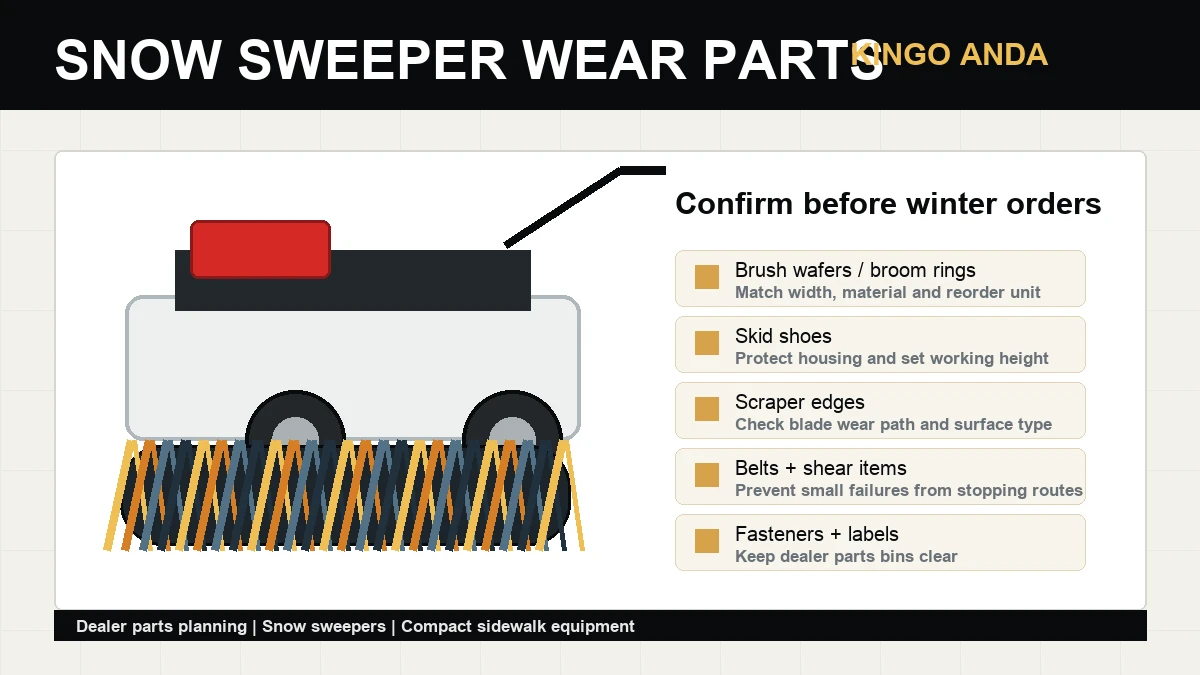
Snow sweeper orders are often discussed as machine orders. That is convenient for the first quote, but it is not how the first winter is won. A dealer can place a compact sweeper in front of a municipality, campus buyer or property-maintenance contractor and still lose confidence if the wear parts are vague.
The question is not whether a brush will wear. It will. The question is whether the dealer knows which brush wafers, skid shoes, scraper edges, belts, pins and fasteners belong with the first shipment. For compact sidewalk equipment, that conversation should happen before winter orders lock, not after the first operator calls from a route.
Parts planning is now part of the sale
Dealer aftermarket demand gives the parts conversation more weight. Farm Equipment’s 2026 aftermarket coverage reported that more than half of surveyed dealers expected parts revenue to increase over 2025, while service revenue expectations also remained positive. For a snow-equipment dealer, that is more than a revenue note. It is a reminder that the machine sale and the support sale are tied together.
Commercial snow operations also leave little room for weak support. Facility-maintenance cost guides continue to point to equipment maintenance, repairs and replacement parts as real operating costs for winter service providers. Municipal news out of New Haven in early 2026 showed how heavy snow can create budget and equipment pressure at the same time, with some snow-removal vehicles temporarily out of service during a storm response. Dealers do not control the weather, but they can control whether common wear items are named, stocked and reorderable.
This is why a compact snow sweeper should be quoted with a parts path. The buyer may not ask for every item on day one. The dealer still needs the list before the first demo, sample order or container plan is finalized.
Brush wafers and broom rings come first
The brush is the visible working part of a snow sweeper. It is also the item most likely to create confusion if the parts description is loose. Dealers should confirm the brush style, working width, wafer or ring count, material, left/right orientation if applicable, and whether the factory sells replacement brushes as individual pieces, sections or complete assemblies.
For a dealer program, the best parts list is not just a name and a price. It should identify the sweeper model, brush width, matching power-unit model, packing quantity, minimum reorder unit and any seasonal lead-time warning. If a brush is shared across more than one attachment or model year, that should be written clearly. If it is not shared, that should be written even more clearly.
Sno-Way’s 2026 snow-removal trend discussion pointed to more attention on sidewalk precision and efficient material use. The same logic applies to sweepers: buyers working around entries, schools, transit stops, campus paths and storefronts are buying control as much as clearing power. Uneven brush wear or unclear replacement supply undermines that control.
Skid shoes and scraper edges protect route uptime
Skid shoes and scraper edges do not always look important in catalog photos, but they decide how the attachment meets the surface. Sidewalk routes are rarely perfect. They include concrete joints, pavers, ramps, curb cuts, patched asphalt and transitions around landscaping. A dealer should know which wear points are intended to contact the ground and which parts should be replaced before the housing or brush frame is damaged.
The checklist should separate consumable wear parts from structural service parts. Skid shoes, scraper strips and edge items belong in the first category. Housings, shafts, frames and drive components should not become emergency replacements because a low-cost wear item was not stocked.
Bobcat’s snow-removal equipment pages position snow attachments around different job areas, including narrow sidewalks and broader work sites. That language reflects how buyers think. They do not buy a sweeper in isolation. They buy a route solution, and the parts kit has to match the route surface.
Belts, pins and fasteners need named bins
Small hardware can stop a winter route just as easily as a brush problem. Dealers should confirm belt sizes, shear items, locking pins, cotter pins, mounting bolts, guards and any attachment-specific fasteners that are likely to be removed during routine service. These parts are not glamorous, but they are the difference between a clean service counter and a parts bin built from guesses.
For imported compact equipment, naming matters. A dealer should not rely on a translated description that says only “belt” or “bolt.” The useful version names the model, position, dimensions, compatible attachment and reorder code. If private-label packaging is planned, the dealer should decide whether those parts need its own labels, barcode structure or service manual references.
The July KINGO ANDA note on dealer spare-parts starter kits covers the broader stocking logic. For snow sweepers, the tighter rule is this: every wear item in the first shipment should have a name that a service counter can repeat without opening the machine.
What dealers should ask before the RFQ
A strong RFQ for a snow sweeper should not ask only for machine price. It should list the target buyer, route type, expected working width, intended power unit, sample quantity, first-season volume, private-label needs and the wear parts expected in the first shipment. The dealer should also ask which items are usually paired with a demo unit and which are kept for replenishment.
For KINGO ANDA, the practical package can connect the walk-behind power unit, snow-removal attachments, starter wear parts, documents and carton labels into one quote path. That matters for dealers and OEM/private-label buyers because the first winter is not a showroom event. It is a support test.
Before ordering, dealers should send the intended attachment set, buyer type, region, first shipment volume and service expectations through the RFQ path. The more precise the parts conversation is before the order, the easier it is to build a winter package that can actually be supported.
Build the sweeper order with the wear-part kit.
Send the sweeper width, power-unit model, expected route type and first-season volume. KINGO ANDA can prepare the attachment quote, parts list and document path together.
Industry sources checked for this article: Farm Equipment 2026 aftermarket outlook, Sno-Way 2026 snow-removal trends, Bobcat snow-removal equipment guidance, Trillium commercial snow-removal cost guide and New Haven Register municipal snow-removal budget coverage.