Industry News
Sidewalk Snow Equipment Preseason Order Calendar for Dealers
A preseason order calendar helps compact snow equipment dealers align demos, attachments, parts and documents before winter demand hits.
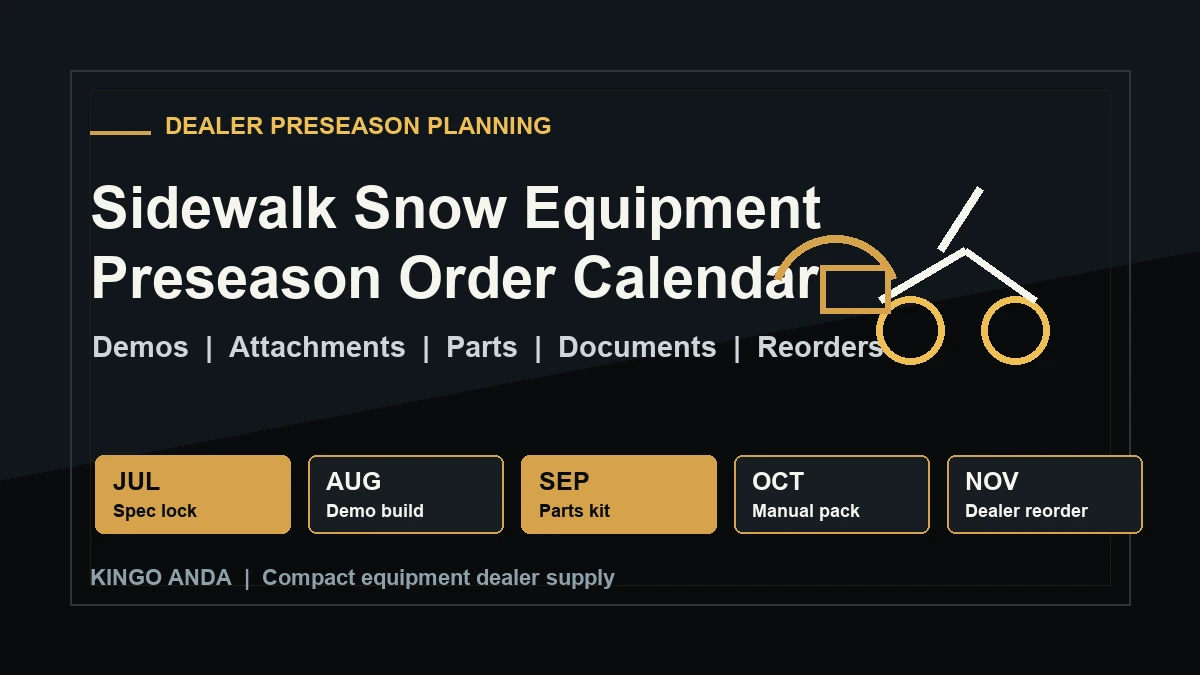
Preseason snow orders usually fail quietly before the first storm. The dealer waits too long to confirm the attachment mix. The factory sends a quote without the wear-part path. The buyer asks for manuals, carton labels or sample photos after the container plan is already tight. By November, everyone is still talking, but the season has already moved.
For compact sidewalk snow equipment, July through October should be managed as a calendar, not as a loose inquiry queue. Dealers need enough time to compare sweepers, compact throwers and blades, decide which units can be demonstrated, confirm the attachment package, and prepare the first parts order before route managers begin winter scheduling.
Why the calendar starts before buyers feel winter pressure
Dealer outlook data makes one point clear: aftermarket and service work still matter even when wholegoods demand is uneven. Farm Equipment’s 2026 aftermarket outlook reported that more than half of surveyed dealers expected service revenue to increase over 2025, with a similar outlook for parts revenue. That is useful context for snow equipment because winter products are not sold only as machines. They are sold as route uptime, parts availability and dealer confidence.
Municipal and campus sidewalk work adds another reason to start early. A 2026 Michigan sidewalk agreement reported by the Big Rapids Pioneer showed how snow removal responsibility can become the practical blocker on a sidewalk project when the owner lacks the proper equipment or personnel. For dealers, that is the commercial signal: buyers are not simply shopping for steel. They are trying to solve a maintenance obligation.
July: lock the buyer type and first attachment set
July is the month for narrowing the market, not filling a warehouse. A dealer should decide whether the first package is built for municipalities, campus facilities, property-maintenance contractors, rental counters or rural property owners. Each buyer group changes the attachment mix.
- Municipal sidewalk teams often care about route width, operator visibility, service parts and documentation.
- Campus and HOA buyers usually compare sweepers, blades and throwers against mixed surfaces, tight turns and pedestrian safety needs.
- Contractor channels need simple quoting, fast replenishment and equipment that can be explained to crews without a long handover.
- Dealer showrooms need a demo unit that looks complete, with compatible attachments and clear literature.
For KINGO ANDA packages, July is also the right time to separate the core power unit from the seasonal attachments. One buyer may need a snow sweeper and blade first. Another may need a sweeper, compact thrower and spare brush kit. A year-round dealer may want snow removal plus soil or mowing attachments so the unit is not presented as a one-season product.
August: build the demo and photo proof
By August, the dealer should know what will be shown to buyers. A demo unit does not need to represent every configuration, but it must answer the first practical questions: how the attachment connects, what the working width is, where the wear items sit, how the controls feel and what photos the sales team can use.
This is where many small equipment programs look weaker than they are. The machine may be capable, but the buyer sees a loose image, a missing spec sheet or a configuration that does not match the quoted package. Dealers should request a clean photo set for each attachment family, a basic compatibility table and the document files that will be used in RFQ follow-up.
Snow equipment manufacturers have trained buyers to expect fit tools, service libraries and dealer support paths. Sno-Way’s 2026 snow-removal trend coverage, for example, points to compact and mixed fleets serving walkways, HOA communities, campuses and municipal sidewalk networks. Even when a dealer is selling smaller walk-behind equipment rather than truck plows or UTV plows, the buyer expectation is similar: the package should look planned.
September: confirm parts before the first winter order
September is late enough for winter buyers to pay attention and early enough to fix the package. It is the right month to confirm the wear-part kit, not the right month to discover that parts were never discussed.
The starter list should be tied to the attachment set: brush wear parts for sweepers, belts or shear items for throwers, scraper edges and skid parts for blades, plus the basic service items for the power unit. The point is not to overstock. The point is to protect the first season so the dealer can support the machines already sold.
The recent KINGO ANDA note on dealer spare-parts starter kits covers the parts logic in detail. For preseason planning, the rule is simpler: never quote the winter package without a parts path. If the buyer has to ask later, the dealer has already made the package feel incomplete.
October: finish documents, labels and reorder rules
October should be the clean-up month. The dealer should not still be debating basic fit, model names or carton marks. This is when quote files, manuals, carton labels, spare-parts names, warranty notes and reorder contacts are checked against the final shipment plan.
Public snow-removal budgets show why this matters. In Connecticut, CT Insider reported a 2026 municipal snow-removal overrun tied to labor, salt, sand and equipment pressures. That story is about a city budget, not a walk-behind machine order, but it reflects a buyer reality that dealers should respect: snow operations are unforgiving when cost, materials and equipment readiness collide.
A dealer-ready October package should include the equipment quote, attachment list, spare-parts starter kit, product images, manual files, carton label requirements and a clear reorder process. If private-label or OEM work is involved, packaging and manual files should be confirmed before artwork changes start moving through the factory.
What dealers should send with the RFQ: a strong request is short, but it should be specific. Send the target market, region, first attachment set, intended demo quantity, expected preseason volume, document needs, certification requirements and whether private-label packaging is required. That gives the supplier enough context to build a practical package rather than a price-only reply.
KINGO ANDA can support compact snow equipment programs around walk-behind power units, snow removal attachments and dealer/OEM document needs. The most useful conversation starts before the winter rush: what needs to be shown, stocked, labeled and reordered before the first buyer depends on the machine.
Plan the winter package before the rush.
Send the target market, attachment mix, expected volume and document requirements. KINGO ANDA can prepare the equipment, parts and quote path together.
Industry sources checked for this article: Rural Lifestyle Dealer June 2026 industry roundup, Farm Equipment dealer revenue outlook, Farm Equipment 2026 aftermarket outlook, Big Rapids sidewalk plowing agreement coverage, CT Insider municipal snow-removal cost coverage and Sno-Way 2026 snow-removal trends.