Dealers importing compact snow equipment should confirm carton marks, labels, spare-parts packs and document sets before preseason orders.
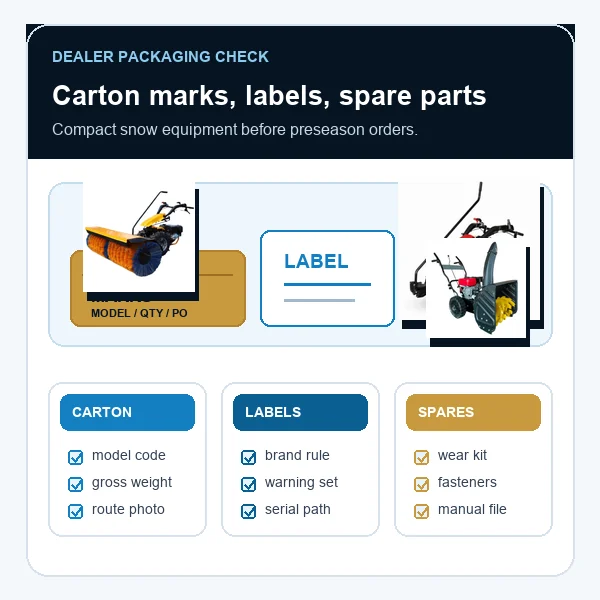
Packaging is where a compact snow equipment program stops being a product idea and becomes something a dealer can receive, store, explain and service. A good carton does not sell the machine by itself. A bad one can make the first order look improvised before the buyer has even unpacked the power unit.
The calendar is already tight. SIMA’s 2026 snow show has just put contractors and suppliers through another June buying cycle, Equip Exposition is pointing outdoor power equipment dealers toward its October 2026 Louisville program, and APWA keeps public-works snow planning tied to training, fleet readiness and winter operations. Dealers who wait until autumn to settle carton marks, labels, spare-parts packs and document files are late.
For a distributor, OEM buyer or property-maintenance channel, compact snow equipment should arrive as a package, not a loose collection of machines. That package has to move through a warehouse, a dealer counter, a service bench and a first customer visit without forcing the buyer to guess.
Carton marks should answer warehouse questions
Carton marks are not decoration. They are a low-cost way to prevent receiving mistakes. A practical carton mark should show the model code, attachment name, purchase order or batch reference, quantity, gross weight, carton size, country requirement if applicable, and any handling note that keeps the equipment from being stacked or opened the wrong way.
For compact snow equipment, the mark should also separate the power unit from the attachment. A multifunction power unit is not the same inventory item as a snow sweeper, even when both are sold as one winter package. If the cartons are unclear, the dealer’s first inventory count is already weak.
The better question is not whether the factory can print a mark. It is whether the mark matches the quote, the packing list, the spare-parts file and the photo set used by the dealer’s own team.
Label approval belongs before the first shipment
Labels become sensitive when the buyer plans dealer branding, private label work, or a mixed product line that must sit beside established machines. A small warning label, serial label or model sticker can delay a shipment if the size, language, material or placement is decided after production.
Dealers should ask for the label map before the sample order: where each label sits, which labels are mandatory, which can carry a dealer brand, which must stay with the manufacturer’s model identity, and how serial numbers will be recorded. The goal is not to over-design the first order. The goal is to avoid discovering during receiving that the product cannot be shown cleanly.
This matters for OEM buyers as well. A private-label snow attachment still needs consistent naming, safe warning placement and a repeatable serial path. If the first batch uses one label rule and the second batch uses another, after-sales support gets harder than it needs to be.
Spare-parts packs should be built around downtime
The common mistake is to make the spare-parts pack look broad instead of useful. A dealer does not need every low-probability component in the first sample shipment. It needs the parts most likely to stop a demonstration, delay a repair or make the first customer lose confidence.
For winter attachments, that usually means wear parts and fast-moving service items: brushes, scraper edges, belts, skid shoes, shear pins, fasteners, bearings, cables, guards and filters where the package requires them. For a compact snow thrower or sweeper, the spare pack should be tied to actual route use, not copied from a full catalog.
The Parts & Service conversation should happen with the quote. If the dealer has to ask for a wear-kit recommendation after the sample arrives, the RFQ was not specific enough.
Crates, pallets and import checks need early attention
Compact equipment often looks simple until it crosses a border. Pallet type, crate material, wood-packaging treatment, carton strength, moisture protection, accessory separation and label visibility can all affect receiving. International wood-packaging requirements vary by market, and buyers should confirm the applicable rules before a shipment is packed.
This is not legal paperwork for the sake of paperwork. It is a commercial issue. A dealer that loses a week to unclear pallet marks or a broken crate is not thinking about reorder volume. It is thinking about whether the supplier is ready for export business.
The safest approach is to agree on a packaging photo set before shipment: closed carton, open carton, inner protection, accessory bag, spare-parts pack, label placement, carton mark, pallet or crate, and the final loaded view where possible.
Photo assets make the dealer’s job easier
Most suppliers send product photos and stop there. A dealer needs more. It needs enough packaging and support photos to show its own team what is arriving and to answer simple buyer questions without opening every box.
A compact snow package should include clean product photos, attachment photos, package photos, parts-kit photos and one or two route-use images if available. The dealer may use those assets in a product sheet, a sales email, a counter conversation or a service note. Bad photos create extra work. Missing photos slow the buyer down.
KINGO ANDA already has a broad snow-removal attachment line. The next level is to make each quote easier to handle by tying the product photo, carton mark, label rule and spare-parts pack into one consistent file.
What dealers should send in the RFQ
A strong dealer RFQ should not ask only for price. It should tell the factory which market is being served, which buyer type is targeted, the first order or sample quantity, the attachment mix, expected annual volume, private-label or dealer-label needs, carton mark requirements, spare-parts expectations, and any import or document requirement the dealer already knows.
For snow equipment, add the route detail: sidewalk width, expected snow depth, surface type, storage limits, whether the buyer needs sweeping, throwing, pushing or a mixed package, and whether the dealer expects a demonstration unit before stock orders. That information helps narrow the package before the quote is written.
The most useful path is to start with Dealer Support, compare related posts in the blog, and send the final buyer profile through the contact page. The best compact snow equipment order is not just a machine order. It is a receiving-ready, sellable, serviceable dealer package.