English trade-editorial updates from KINGO ANDA
Walk-Behind Tractor Attachment Compatibility: What Dealers Should Check Before Sample Orders
Define the exact equipment combination, supplied hardware, instructions and intended application before approving a dealer sample order.
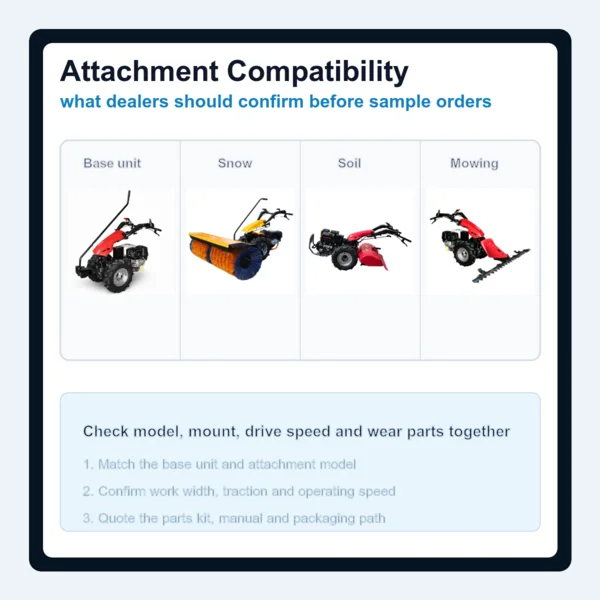
A sample order reading “one power unit plus a sweeper and tiller” leaves a dealer with an unfinished compatibility decision. Which versions are included? What connects each attachment? Which documents identify the approved combination? Those questions should be answered before the sample is treated as representative of a future stocking order.
A walk-behind tractor attachment compatibility check is therefore more than a list of tools. It is a record linking identifiable equipment, supplied components, manufacturer instructions and the buyer’s intended application. This guide focuses on the dealer’s first sample order, not on designing an adapter or deciding how to operate an unconfirmed combination.
Identify the exact power unit and attachment on every line
Start with the equipment identifiers that the supplier will use on the quotation and sample documents. Record the power-unit model, the attachment model and any configuration or version distinction the supplier says affects compatibility. For equipment already owned by the buyer, provide readable identification-label photographs and existing paperwork rather than relying on a familiar-looking cover or wheel arrangement.
KINGO ANDA describes its Multifunction Power Unit, P001, as a main unit for interchangeable front and rear attachments across winter and warm-season work. Its product information also states that attachment compatibility is confirmed by inquiry. The interchangeable-platform description does not establish universal fit across every model or production version.
Use catalog identifiers to begin the conversation, then ask the supplier to confirm the exact identifiers that will appear in the order. If a proposed component changes during quotation, update the whole combination and request confirmation again. A previous answer for one power-unit version should not silently approve a different sample.
Keep separate entries for the requested combination and the supplier-confirmed combination. If they differ, the difference needs an explicit buyer decision before the sample is ordered.
Ask for the connection, drive and control requirements together
A photograph of two mating areas is useful inquiry evidence, but it is not a complete compatibility approval. Request the connection specification and the manufacturer-approved hardware for the exact equipment pair. Ask the supplier which drive and control requirements apply and where they are documented. Do not assume a particular coupling, drive arrangement or speed merely from the attachment category.
The written response should make clear whether the quotation includes every required connection component or whether identified items must be ordered separately. A dealer should not have to discover at unpacking that the supplier and buyer meant different things by “complete attachment.”
- Connection: which approved interfaces and hardware belong to this exact combination?
- Drive and controls: what requirements and restrictions does the supplier specify, and which instructions cover them?
- Configuration: are any particular power-unit options required, and are those options included in the quote?
- Documentation: which setup and operating documents apply to the quoted versions?
Record unanswered items as pending. Do not resolve them by sourcing an unapproved adapter, transferring settings from another machine or treating a physical connection as proof of safe operation. The supplier’s model-specific instructions and approval are needed before an evaluation involving operation.
Separate attachment fit from suitability for the buyer’s job
A confirmed equipment pairing still needs to be assessed against the intended task. KINGO ANDA’s Snow Sweeper, P002, is described as a rotating brush attachment for sidewalks, yards, estates and light commercial snow clearing. Its Rotary Tiller, P012, is described as a soil-preparation attachment for gardens, small farms and row-crop work. These descriptions identify applications, not confirmed pairings with every P001 configuration.
For the sweeper inquiry, describe the surface, expected snow conditions, measured access points and permitted placement areas. For a tiller inquiry, describe the proposed ground conditions, work area and access constraints. Ask which conditions the quoted equipment is approved to address and which are outside its intended use.
Request dimensions for the complete configuration where route, gate, transport or storage clearance matters. Do not substitute working width for overall clearance. If the buyer needs a particular output, speed or duty pattern, state it as a requirement awaiting verification rather than adding it to the product specification.
The dealer’s record should show two separate answers: “Is this equipment combination approved?” and “Is it appropriate for this stated application?” Neither answer should be inferred solely from the other.
Turn the sample order into a versioned acceptance record
Before ordering, agree on what the sample is intended to establish. A document review, an included-components check and an operating evaluation answer different questions. Specify who will review each item and what evidence is required, while keeping any operational evaluation within manufacturer-approved conditions and instructions.
Use a dated record with one row per proposed combination. Include the equipment identifiers, supplier confirmation reference, included hardware, document versions, intended application and unresolved questions. Give each row a clear status such as pending confirmation, confirmed for the stated configuration or not approved as proposed. This is an internal purchasing record, not a certification or a substitute for technical approval.
At receipt, compare the sample labels, components and supplied documents with that record before proceeding. If an identifier, supplied part or configuration differs, document the discrepancy and obtain a response. Do not carry an earlier approval forward to a substituted item without checking its scope.
Ask about the parts and service information applicable to those same versions. Request part identifiers and available documentation for the supplied configuration; do not assume parts are shared across attachments. Pricing, packaging and compatibility remain inquiry-confirmed. Any requested OEM labeling or document-language arrangement should also be recorded as confirmed or still open.
Frequently asked questions
Does appearing in the same catalog mean two products are compatible?
No. The JGAD product information requires inquiry-based compatibility confirmation. Obtain the exact power-unit and attachment combination in writing, including required hardware and applicable instructions.
Is a successful physical mounting check enough to approve a sample?
No. A mounting observation does not establish drive, control or application suitability. Confirm the complete configuration and follow the relevant manufacturer documentation before any operating evaluation.
Can sample approval automatically cover later orders?
Do not assume it does. Link the sample result to the recorded identifiers and configuration. If the proposed production order differs, ask the supplier to identify the change and confirm whether the earlier approval still applies.
Dealers and OEM buyers can send KINGO ANDA a sample-package inquiry with the equipment identifiers, proposed attachments, intended applications and quantity. Ask for a clearly defined combination and a list of points still awaiting confirmation before placing the order.
Sample order planning
Need a compatibility matrix before quoting a mixed attachment package?